Modiki El Niños and Atlantic hurricane activity
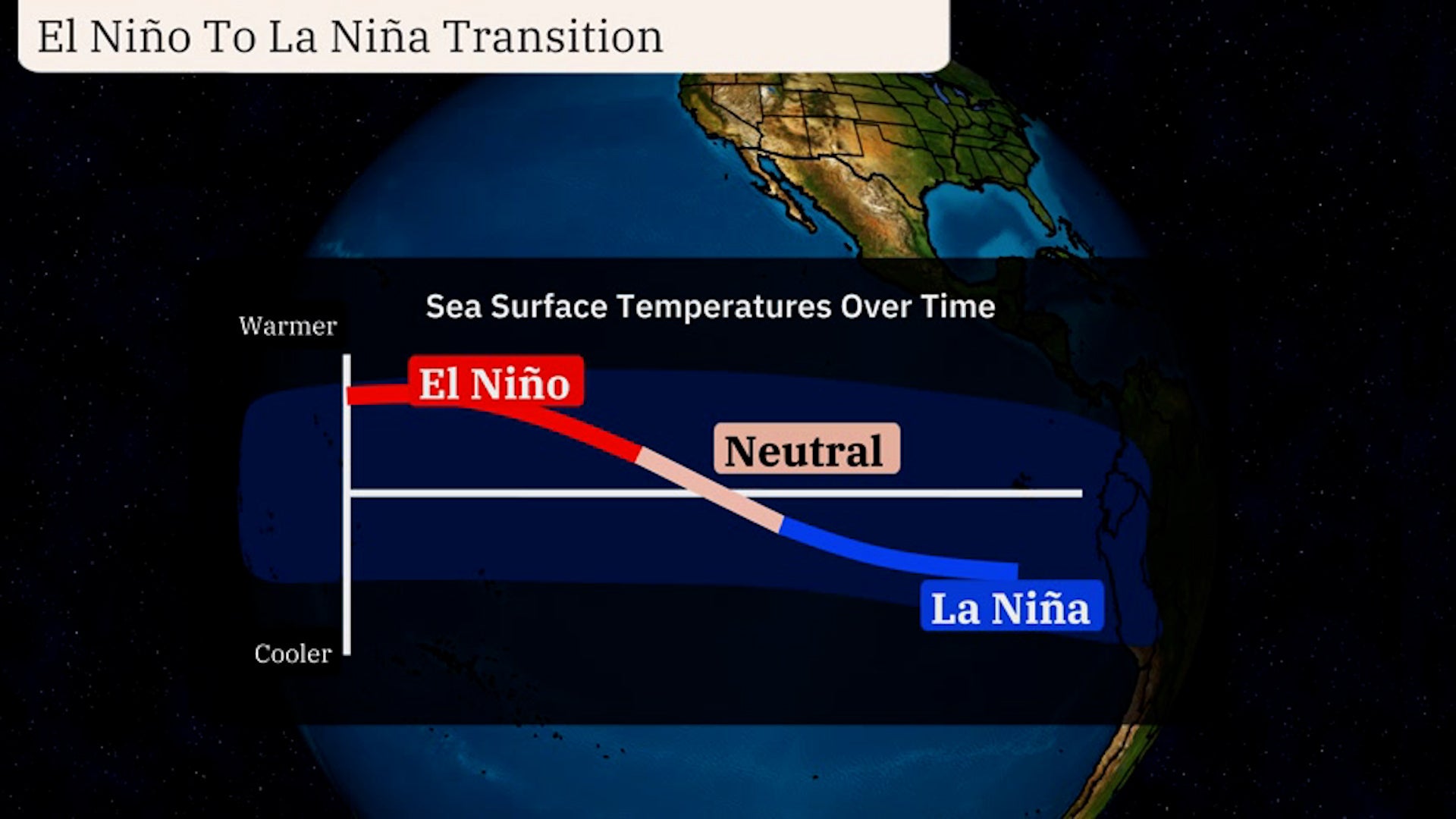
It's an El Niño year, which typically means that Atlantic hurricane activity will be reduced. But not all El Niño events are created equal when it comes to their impact on Atlantic hurricane activity. Over the past 150 years, hurricane damage has averaged $800 million/year in El Niño years and double that during La Niña years. The abnormal warming of the equatorial Eastern Pacific ocean waters in most El Niño events creates an atmospheric circulation pattern that brings strong upper-level winds over the Atlantic, creating high wind shear conditions unfavorable for hurricanes. Yet some El Niño years, like 2004, don't fit this pattern. Residents of Florida and the Gulf Coast will not soon forget the four major hurricanes that pounded them in 2004--Ivan, Frances, Jeanne, and Charley. Overall, the 15 named storms, 9 hurricanes, and 6 intense hurricanes of the hyperactive hurricane season of 2004 killed over 3000 people--mostly in Haiti, thanks to Hurricane Jeanne--and did $40 billion in damage.
A new paper published in Science last Friday attempts to explain why some El Niño years see high Atlantic hurricane activity. "Impact of Shifting Patterns of Pacific Ocean Warming on North Atlantic Tropical Cyclones", by Georgia Tech researchers Hye-Mi Kim, Peter Webster, and Judith Curry, theorizes that Atlantic hurricane activity is sensitive to exactly where in the Pacific Ocean El Niño warming occurs. If the warming occurs primarily in the Eastern Pacific, near the coast of South America, the resulting atmospheric circulation pattern creates very high wind shear over the tropical Atlantic, resulting in fewer hurricanes. This pattern, called the Eastern Pacific Warming (EPW) pattern, occurred most recently during the El Niño years of 1997, 1987, and 1982 (Figure 1). In contrast, more warming occurred in the Central Pacific during the El Niño years of 2004, 2002, 1994, and 1991. The scientists showed that these Central Pacific Warming (CPW) years had lower wind shear over the Atlantic, and thus featured higher hurricane activity than is typical for an El Niño year. One of the paper's authors, Professor Peter J. Webster, said the variant Central Pacific Warming (CPW) El Niño pattern was discovered in the 1980s by Japanese and Korean researchers, who dubbed it modiki El Niño. Modiki is the Japanese word for "similar, but different".

Figure 1. Difference of Sea Surface Temperature (SST) from average during the peak of hurricane season, August-September-October, for seven years that had El Niño events (except for 2009, when the SST anomaly for July 1 - 3 is plotted). On the left side are years when the El Niño warming primarily occurred in the Eastern Pacific (EPW years). On the right are years when the warming primarily occurred in the Central Pacific (CPW years). Shown on the top of each plot is the number of named storms (NS), hurricanes (H), and intense hurricanes (IH) that occurred in the Atlantic each year. Atlantic hurricane activity tends to be more prevalent in CPW years than EPW years. An average hurricane season has 10 named storms, 6 hurricanes, and 2 intense hurricanes. Image credit: NOAA/ESRL.
What, then, can we expect the current developing El Niño event to do to 2009 hurricane activity? Kim et al. note that in recent decades, the incidence of modiki CPW El Niño years has been increasing, relative to EPW years. However, the preliminary pattern of SST anomalies in the Pacific observed so far in July (lower left image in Figure 1) shows an EPW pattern--more warming in the Eastern Pacific than the Central Pacific. If Kim et al.'s theory holds true, this EPW pattern should lead to an Atlantic hurricane season with activity lower than the average 10 named storms, 6 hurricanes, and 2 intense hurricanes. There is still a possibility that the observed warming pattern could shift to the Central Pacific during the peak portion of hurricane season, however. We are still in the early stages of this El Niño, and it is unclear how it will evolve.
Jeff Masters
Reader Comments
Page: 1 | 2 | 3 | 4 | 5 | 6 | 7 | 8 | 9 | 10 | 11 | 12 | 13 | 14 | 15 | 16 | 17 | 18 | 19 | 20 | 21 | 22 | 23 — Blog Index
Reflector site for those at work, which includes Weather456, daily updates
AOI
AOI
yep it on WU
Based on current and forecast parameters across the Atlantic Basin, I would be mildly surprised by 13 named storms. Could still be interesting if we get the right timing of system development and periodic blocking across the NW Atlantic. The Southern and Eastern Gulf along with the NW Caribbean area is likely to produce 1-2 storms that will have an impact.
Flag, ignore, repeat.
Philippines Atmospherical Geophysical Astronomical Services and Administration
Tropical Depression "GORIO" has accelerated as it continues to threaten Extreme Northern Luzon.
Tropical Cyclone Bulletin #2
========================
At 11:00 PM PhST, Tropical Depression Gorio located at 18.3°N 124.0°E or 230 kms east of Aparri, Cagayan has 10 minute sustained winds of 55 km/h (30 knots).
Signal Warnings
=================
Signal Warning #1 (30-60 kph winds)
Luzon Region
1.Cagayan
2.Calayan group of Islands
3.Babuyan group of Islands
4.Isabela
5.Kalinga
6.Apayao
7.Mt. Province
8.Abra
9.Ilocos Sur
10.Ilocos Norte
11.Batanes
Additional Information
=======================
TD "GORIO" is expected to enhance the Southwest Monsoon and bring rains over the Western section of Luzon and Western Visayas.
Residents in low lying areas and near mountain slopes are advised to take all the necessary precautions against possible flashfloods and landslides.
The public and the disaster coordinating councils concerned are advised to take appropriate actions and watch for the next bulletin to be issued at 5AM tomorrow.
bold - now that's where your wrong. The season is quiet thus far, and I have much to discuss.
Also, I need a link to the model which shows activity in August/September, becuz I cant find any model which shows activity during the peak of 2009.
The wave entering the Eastern Caribbean has no threat of developing. At least for the next 4 Days. Conditions are just way too hostile in the Caribbean at this time.
Tropical Cyclone Warning #1
=============================
At 18:00 PM UTC, Tropical Depression FIVE (NONAME) located at 18.5N 122.3E or 510 NM east-southeast of Hong Kong, China has sustained winds of 25 knots with gusts of 35 knots. The depression is reported as moving west at 14 knots.
Significant wave height associated with 05W is 8 feet
Wrong? LOL!!!
The convection on that Rainbow Map you have there is not being caused by the wave. Its being caused by diffluence. Which has nothing to do with TC Genesis.
Also, Go look at a map and see how strong the Wind Shear is in the Caribbean, Go look at how strong the Easterlies are too and tell me again that I'm wrong.
By the weekend...the trough shears out leaving a weak inverted trough over the eastern Gulf. The 12z NAM/GFS/ECMWF solutions take this weak low across the Gulf towards the Yucatan
and Bay of Campeche. The GFS is a little farther north than the other solutions and actually tries to bring in precipitation to the Upper Texas coast on sun despite having high pressure and subsidence in the surface to 700mb layer. The NAM/European model (ecmwf) keep this low far enough away that southeast Texas is not expected to see any precipitation chances due to the ridge being strong.
Just wait and See
Again,
The convection is not being caused by the wave itself.
Models also being very bullish, making 95E a Category 2 'cane.
There is no intimidate threat of development from that wave. The chance of it developing maybe slightly higher when it gets in the Western Caribbean in 4 days if conditions are better there by then. But even then I highly doubt it.
i think we now have TD 4E soon too be the next name storm
No, you are completely wrong, African dust does decrease in the peak months of hurricane season, and has bigger outbreaks in June and July, so this is typical of any other season, also you do not need Cape Verde Hurricanes to make it a bad season, in fact 2005 only had 1 cape verde type storm. But, you are certainly wrong, and I am putting you on ignore.
LOL, no ones wants that. For some is either now or never. Impatience is growing each and every day and leading to some of the most ridiculous speculations. July 10 is 2mr which is the average date of the 1st named storm. By Monday ppl will be leaving for good with one or 2 left by the end of the month.
July makes me 4 years here, been here since the blogs started. This is the first year I have seen this on the blog. Interestingly, this is the first time on the blogs the season started so late. People's perception of a normal hurricane season have been damaged severely by recent years.
I agree 100%, the overactivity of the last few years has really clouded their judgement
I can see it as a cat 1, maybe a 2. depending on how fast its moving towards the dust, it looks like its going to be moving right in between the two areas of dry/stable air. but it will still probably suck the dry air in.
Heavy thunderstorms are just east of Trinidad and tobago at this moment,looks nasty...
Viewing: 701 - 751
Page: 1 | 2 | 3 | 4 | 5 | 6 | 7 | 8 | 9 | 10 | 11 | 12 | 13 | 14 | 15 | 16 | 17 | 18 | 19 | 20 | 21 | 22 | 23 — Blog Index