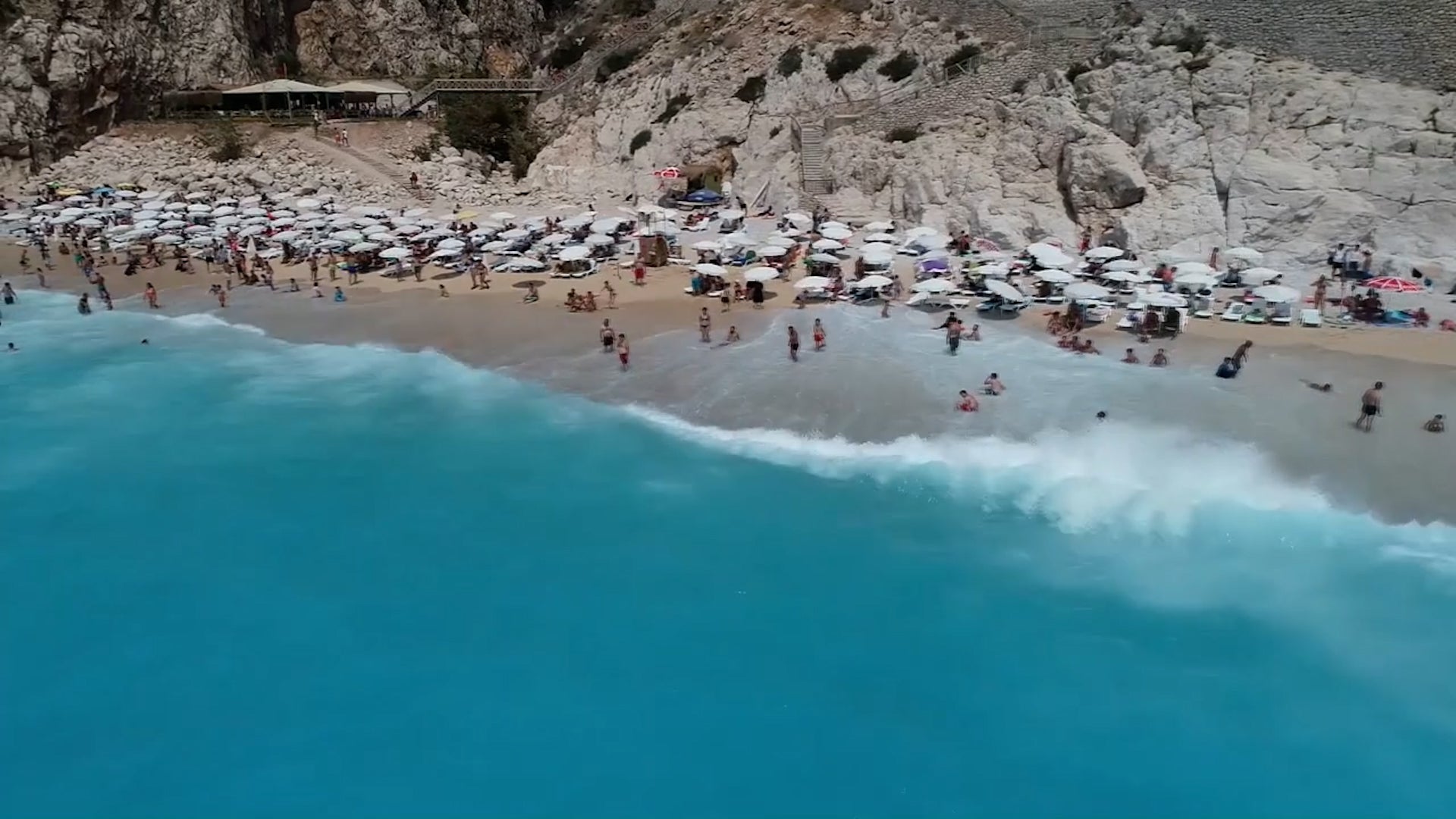
Bill weakens, but still generating huge waves
Hurricane Bill has peaked in intensity, and now shows signs of weakening. Visible and infrared satellite imagery show that the hurricane is no longer as symmetric as it once was, with an oval instead of circular shape to its cloud pattern. Upper-level cirrus clouds are restricted on the storm's southwest side, indicating that upper-level winds from the southwest are shearing the storm. The University of Wisconsin CIMSS wind shear analysis shows about 10 - 15 knots of wind shear impacting Bill. The latest 8:18am EDT eye report from the Hurricane Hunters indicated that the eyewall had a gap in its southwest side, and the pressure had risen 2 mb since last night, to 951 mb. Maximum winds at the surface observed by the SFMR instrument were only Category 2 strength, though winds measured at the aircraft flight level of 10,000 feet still suggested Bill may be a Category 3 hurricane.
Wind shear is forecast to remain low to moderate, 5 - 15 knots, for the next three days, and it is possible Bill may see a relaxation of the wind shear affecting it, allowing re-intensification to Category 4 status. Sea Surface Temperatures (SSTs) will be plenty warm over the next three days, as Bill traverses a region of ocean with SSTs of 28 - 29°C. Total ocean heat content is at a maximum today, and will gradually decline over the next three days.

Figure 1. Visible satellite image of Bill at 1:33 pm EDT Thursday 8/20/09. Bill had an oval shape oriented SW - NE, and was missing upper-level cirrus clouds on the southwest side, indicating that wind shear from strong upper-level southwesterly winds was affecting it.
Water vapor satellite loops continue to show two small "short-wave" troughs of low pressure to the northwest of Bill, and these troughs are continuing to steer Bill to the northwest. The short wave troughs (so called because they have a relatively small amplitude and wavelength) are not strong enough to turn Bill due north, so Bill is expected to miss Bermuda. The official NHC forecast has the radius of tropical storm force winds from Bill barely reaching Bermuda on Saturday, so the island can expect sustained winds in the 35 - 45 mph range for a few hours on Saturday if the hurricane follows the NHC forecast track.

Figure 2. Visible satellite image of Bill's eye zoomed in, taken from NASA's Aqua spacecraft at 10:15am EDT Wednesday August 19, 2009. Image credit: NASA GSFC.
An unusually strong "long wave" trough of low pressure (called long wave because of its large amplitude and wavelength) is expected to develop along the U.S. East Coast this weekend. This trough will turn Bill to the north, and also bring high levels of wind shear in the 40 - 65 knot range on Sunday. The models have moved the forecast landfall point of Bill several hundred miles back and forth to the east and west over the past few days, but mostly agree that Cape Cod and Maine will probably miss a direct hit by Bill. However, these regions are still at the edge of Bill's cone of uncertainty, and a direct strike by Bill at Category 1 or 2 strength is a possibility. However, it is more likely that Bill will come ashore over the Canadian provinces of Nova Scotia or Newfoundland. Bill will be weakening rapidly as it makes landfall, and is likely to be a Category 1 hurricane if it hits Nova Scotia, or strong tropical storm if it hits Newfoundland. If Bill follows the official NHC forecast path, winds on Cape Cod and in eastern Maine are likely to remain below tropical storm force (below 39 mph).
Bill's waves
Hurricane Bill is generating huge waves, thanks to its enormous size and major hurricane intensity. Bill passed about 75 miles southwest of Buoy 41044 this morning, and the buoy recorded sustained winds of 67 mph, gusting to 92 mph, with a significant wave height (the height of the average 1/3 highest waves) of 38.8 feet. Output from NOAA's Wavewatch III model suggests that significant wave heights near Bill's center will peak at 50 feet by Saturday. Large swells from Bill will reach Bermuda this afternoon, increasing seas to 5 - 9 feet, according to the Bermuda Weather Service. Seas will increase to 10 - 20 feet on Friday and 20 - 30 feet on Saturday as Bill makes its closest approach to the island.
In the U.S., Bill's swells will reach New York's Long Island on Friday afternoon, and seas will build to 7 - 10' on Saturday and 12 - 16' on Sunday in the near shore waters. By Friday night, Bill's swells will be affecting the entire U.S. East Coast from Florida to Cape Cod. Maximum sea heights in near shore waters over the weekend will be about 7' from Florida to South Carolina, 11 - 14' along the North Carolina coast, 8 - 11' along the mid-Atlantic coast, and 10 - 11' along the coast of Maine. The highest waves along the U.S. coast will occur at Cape Cod, Massachusetts, where waves of 18 - 23' are being forecast by NOAA for Sunday. Bill's high waves are going to cause millions of dollars in erosion damage and create very dangerous rip currents and swimming conditions along the coast.
Hurricane History of Canada
Canada is no stranger to hurricanes, and receives a hit by a Category 1 or stronger hurricane several times per decade, on average. The most recent hurricane strike on Canada occurred in 2008, when Hurricane Kyle struck the southwestern tip of Nova Scotia, just north of Yarmouth. Kyle was rated a Category 1 hurricane with 75 mph winds at landfall, but damage was limited to uprooted trees, scattered power outages, and minor street flooding in Shelburne. The other hurricane to hit Nova Scotia this decade was much more serious. In 2003, Hurricane Juan made landfall at Halifax, Nova Scotia, as a Category 2 hurricane with 100 mph winds. A record storm surge of 4.9 feet inundated the city's waterfront, resulting in extensive flooding of the Halifax and Dartmouth waterfront properties. A buoy just outside Halifax Harbor measured a significant wave height of 9 meters (30 feet), and maximum wave heights of 20 meters (65 feet). Four people died in the storm. Juan downed a phenomenal number of trees--agriculture specialists estimate that 50 - 100 million trees blew down in Nova Scotia in two hours, with one million downed in Halifax alone. The Canadian Hurricane Center has a nice historical hurricane page with more information and photos.

Figure 3. Close up view of the damage at the Bedford Yacht Club after Hurricane Juan in 2003. Photo: Gary Dunbrack. Image credit: Environment Canada website on Hurricane Juan.
Elsewhere in the tropics
There are no threat areas in the Atlantic worth mentioning today, and no reliable models are calling for tropical cyclone development over the next seven days.
I'll have an update Friday morning.
Jeff Masters
Reader Comments
Page: 1 | 2 | 3 | 4 | 5 | 6 | 7 | 8 | 9 | 10 | 11 | 12 | 13 | 14 | 15 | 16 | 17 | 18 | 19 | 20 | 21 | 22 | 23 | 24 | 25 | 26 | 27 | 28 | 29 | 30 | 31 | 32 | 33 | 34 | 35 | 36 | 37 | 38 | 39 | 40 | 41 | 42 | 43 | 44 | 45 — Blog Index
Are there predictive factors we can watch over the next couple of days, which might help pin down that small probability?
What kind of winds can southern Maine expect?
Thanks.
on the map wundergrounds main tropical weather page
what are all the island looking spots that basically form line or boundaries?
I hope Canada gets spared somehow... Even a Cat1 or 2 can cause some damage and a lot of headaches!
Thanks
Thanks!
They can drop to the surface and form tropical systems, but I'm not knowledgeable enough to tell what factors would be involved in making that happen...
Wow!!! ((((Flood!!!!)))
WTNT43 KNHC 201447
TCDAT3
HURRICANE BILL DISCUSSION NUMBER 21
NWS TPC/NATIONAL HURRICANE CENTER MIAMI FL AL032009
1100 AM AST THU AUG 20 2009
CONVENTIONAL SATELLITE...MICROWAVE IMAGES AND NUMEROUS OBSERVATIONS
FROM A NOAA P-3 RESEARCH PLANE INDICATE THAT BILL HAS WEAKENED A
LITTLE BIT DURING THE PAST SEVERAL HOURS. DVORAK T-NUMBERS HAVE
DECREASED SINCE YESTERDAY...THE EYEWALL HAS BECOME OPEN TO THE
SOUTHWEST AND THE MAXIMUM FLIGHT LEVEL AND SFMR WINDS WERE 121 AND
93 KNOTS...RESPECTIVELY...EARLIER THIS MORNING. IN FACT...SOME ARC
CLOUDS ARE MOVING AWAY FROM THE HURRICANE SUGGESTING THAT BILL IS
NOT STRENGTHENING AT THIS TIME. BASED ON THESE DATA...THE INITIAL
INTENSITY HAS BEEN REDUCED TO 105 KNOTS...AND THIS IS PROBABLY ON
THE HIGH SIDE. THE LARGE SCALE ENVIRONMENT IS CONDUCIVE FOR
REINTENSIFICATION SINCE BILL IS ABOUT TO ENCOUNTER THE WARMEST
WATERS ALONG ITS PATH SO FAR...AND THE SHEAR IS FORECAST TO BE
QUITE LIGHT. HOWEVER...MOST OF THE INTENSITY CHANGE COULD BE
ASSOCIATED WITH EYEWALL REPLACEMENT CYCLES. THE OFFICIAL FORECAST
CALLS FOR RESTRENGTHENING AND BILL IS EXPECTED TO REACH CATEGORY
FOUR AGAIN IN A DAY OR SO. THEREAFTER...THE HURRICANE SHOULD
GRADUALLY BEGIN TO INTERACT WITH A MID-LATITUDE TROUGH AND BY 96
HOURS IT SHOULD BE IN EXTRATROPICAL TRANSITION AND BE FULLY
EXTRATROPICAL IN FIVE DAYS.
BILL HAS CONTINUED TO MOVE ON A STEADY NORTHWEST TRACK OR 305
DEGREES AT 16 KNOTS...EMBEDDED WITHIN THE FLOW SURROUNDING THE
AZORES-BERMUDA HIGH. IN ABOUT TWO DAYS...THE HURRICANE WILL BECOME
STEERED NORTHWARD AND THEN NORTHEASTWARD BY THE FLOW BETWEEN A
LARGE MID-LATITUDE TROUGH SWINGING EASTWARD ACROSS THE EASTERN
UNITED STATES AND THE SUBTROPICAL HIGH. ONCE THE RECURVATURE
BEGINS...THE HURRICANE SHOULD INCREASE IN FORWARD SPEED. MOST OF
THE TRACK GUIDANCE SHIFTED SLIGHTLY TO THE WEST COMPARED TO THE
PREVIOUS RUN. THIS SHIFT IN GUIDANCE JUSTIFIES A VERY SMALL SHIFT
TO THE WEST OF THE TRACK OFFICIAL FORECAST...WHICH INDEED IS VERY
CLOSE TO THE CONSENSUS.
LARGE SWELLS GENERATED BY THIS HURRICANE ARE AFFECTING THE NORTHERN
LEEWARD ISLANDS AND SHOULD BEGIN AFFECTING THE BAHAMAS...BERMUDA...
MOST OF THE EASTERN U.S. COAST...AND THE ATLANTIC MARITIMES OF
CANADA DURING THE NEXT FEW DAYS. THESE SWELLS WILL LIKELY
CAUSE EXTREMELY DANGEROUS SURF AND LIFE-THREATENING RIP CURRENTS.
PLEASE CONSULT STATEMENTS ISSUED BY YOUR LOCAL WEATHER OFFICE FOR
MORE DETAILS.
THIS AFTERNOON NOAA AND THE 53RD HURRICANE HUNTERS WILL BE
CONDUCTING A TWO-AIRCRAFT SYNOPTIC SURVEILLANCE MISSION AROUND
HURRICANE BILL TO IMPROVE THE INITIAL ANALYSIS FOR THE NUMERICAL
MODELS.
FORECAST POSITIONS AND MAX WINDS
INITIAL 20/1500Z 22.6N 61.7W 105 KT
12HR VT 21/0000Z 24.2N 63.8W 110 KT
24HR VT 21/1200Z 26.6N 66.0W 115 KT
36HR VT 22/0000Z 29.5N 67.5W 115 KT
48HR VT 22/1200Z 32.5N 69.0W 110 KT
72HR VT 23/1200Z 40.5N 66.5W 100 KT
96HR VT 24/1200Z 48.0N 53.0W 65 KT...BECOMING EXTRATROPICAL
120HR VT 25/1200Z 55.0N 28.0W 50 KT...EXTRATROPICAL
$$
FORECASTER AVILA
you can try this and see if this is the information you're looking for...
Coastal Marine Zone Forecasts by the Baltimore/Washington, DC Forecast Office
Hiya, kiddo...how's things?
I was thinking the same thing...
Haha agreed!
I'm doin' alright. Just watching Bill and looking forward to getting work over with today so I can start my weekend.
Think they all decided Bill wasn't worth it? LOL
They are achieving this all by themselves.
Link
Even the recurvature suddenly looks like bad news - if the storm tracks along the southeastern edge, curving back out toward the Atlantic, then Halifax lies directly in its path, and the fact that much of its circulation will remain over water could slow any weakening.
If this storm were to shift far enough west to bring the Cape & Islands within its windfield, we should be seeing some indication of that in the models - but they're starting to cluster more tightly, and even as they shift westward they're simultaneously pulling off of the coastline. So New England should be spared more than showers and fierce (and potentially deadly) wave action.
The Canadian Hurricane Center is now issuing information statements on the storm - we should see the first watches and warnings posted tomorrow afternoon.
You have to lokk out for those space flies; they're a real problem as they prefer satellite optics to lay their eggs
I have no problem with those posts.
So your that desperate now,your relying on the weather to do us in,so sad!!!
HEY!
I've got tickets to tomorrow's games, so my focus is slowly shifting to a more short term forecast.
BTW... is seem to remember a desperate Yankees team trying to get MLB to have a game with TB conceeded to them due to a hurricane. Babies :)
School has started in some areas, at least in some areas of South Florida.
9. pearlandaggie
Thanks for the perspective!
Bad Karma to bet on where, if you are outside of the area of interest.
However, those with a potential impact might find it a good idea to bet Bill will have an effect, and prepare accordingly. If you are impacted - your are prepared - you win. If you are not impacted - you win.
can anyone tell me if this is suppose to happen?
300-850 mb steering -3hrs
300-850mb steering current
looks like their is strengthing of the circle area over fl? im not a "Caster" of any type...just need comfort is all.
thanks!
Excellent shot of the Fly, she must be Freezing if she's on the Pole
Viewing: 1 - 51
Page: 1 | 2 | 3 | 4 | 5 | 6 | 7 | 8 | 9 | 10 | 11 | 12 | 13 | 14 | 15 | 16 | 17 | 18 | 19 | 20 | 21 | 22 | 23 | 24 | 25 | 26 | 27 | 28 | 29 | 30 | 31 | 32 | 33 | 34 | 35 | 36 | 37 | 38 | 39 | 40 | 41 | 42 | 43 | 44 | 45 — Blog Index