Potentially historic winter storm poised to impact 100 million Americans
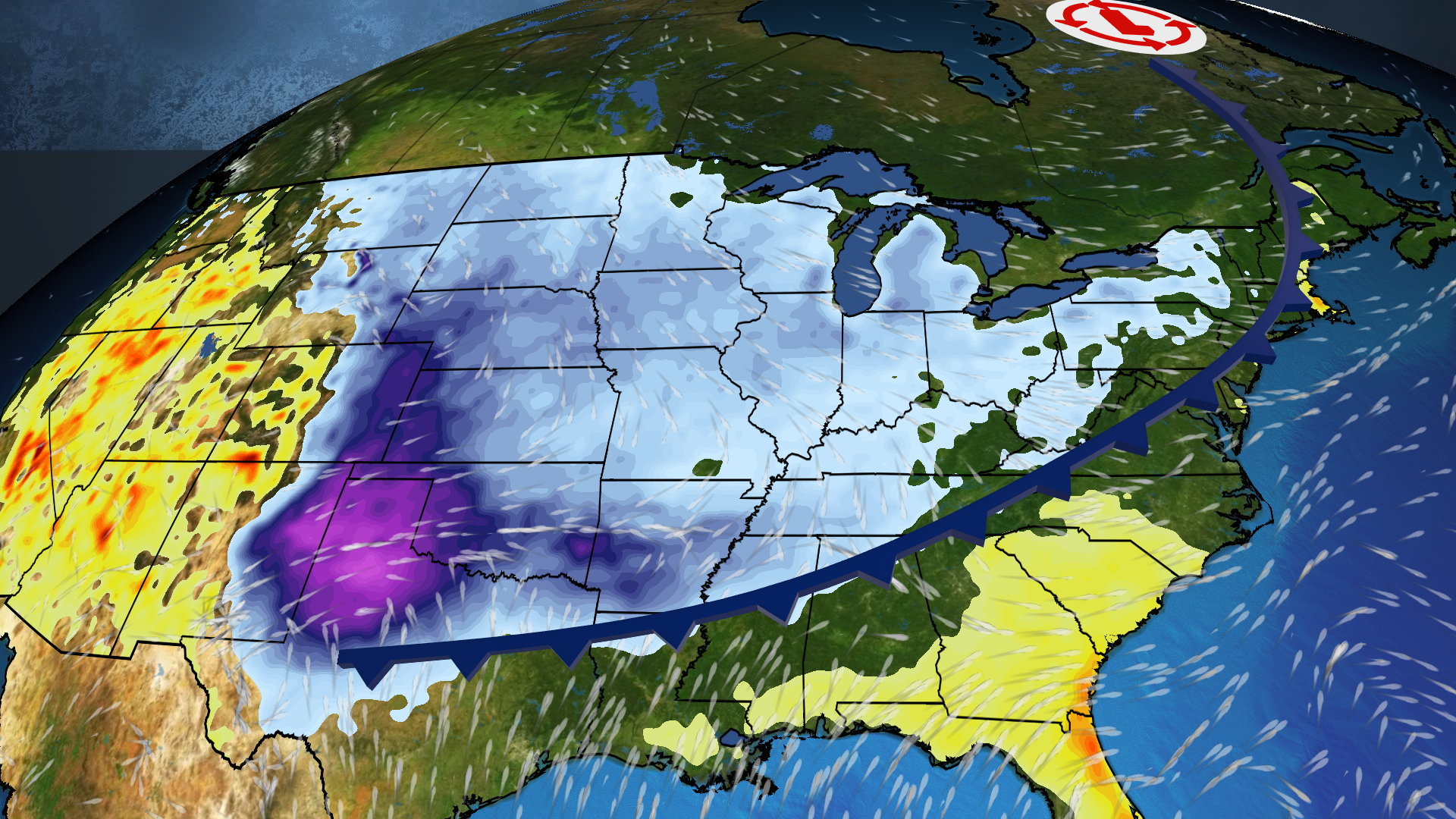
A huge and potentially historic winter storm is taking shape over the Southern Plains today. By the time the storm exits New England on Wednesday night, as many as 50 million Americans may see heavy snows of at least 6 inches or dangerous ice accumulations of 1/4" or more from the massive storm, and 100 million will be affected by the storm. A potent jet stream with strong winds will dive southwards over the central U.S. today, allowing a cold Arctic airmass to spill southwards out of Canada. In front of this cold air, a flow of very warm, moist air from the Gulf of Mexico will surge northwards, providing copious moisture to fuel snowfall amounts that will likely approach two feet across portions of Iowa and Illinois on Tuesday. The storm could be Chicago's biggest blizzard since January 1999, when a storm dumped 21.6" of snow. Accompanying the heavy snow on Tuesday will be strong winds gusting to 40 mph in Northern Illinois and Northwest Indiana, and a blizzard watch is posted for Chicago. Strong winds in Chicago are expected to generate 14 - 18 feet waves on Lake Michigan, with occasional waves up to 25 feet. A significant coastal flooding event is possible for Chicago, with beach erosion and flooding along Lake Shore Drive. Many major cities will likely receive over 8 inches of snow from the storm, including Kansas City, St. Louis, and Detroit. Perhaps of greater concern is the potential for a major ice storm along a swath from Northwest Oklahoma to Massachusetts. Widespread freezing rain is expected to bring over 1/4" of ice to many major cities, including St. Louis, Indianapolis, Columbus, Cleveland, and Pittsburgh. Some regions could see up to an inch of ice, and widespread power outages due to toppled power lines are likely for millions of people. Damages exceeding $1 billions are possible from this ice storm. In addition, the storm's powerful cold front will bring the potential for severe thunderstorms to the deep South. The NOAA Storm Prediction Center is giving Louisiana and surrounding states a "slight risk" of severe weather on Tuesday, and severe thunderstorms with damaging winds are likely Tuesday afternoon in this region.

Figure 1. Probability of receiving at least 1/4" of ice for the 24 hours ending at 7am EST on Wed Feb 2, 2011. Image credit: NOAA.
Very dangerous Tropical Cyclone Yasi headed for Australia's flooded Queensland
With February nearly upon us, the traditional peak of the Southern Hemisphere tropical cyclone season is here, and the waters surrounding Australia have been exceptionally active over the past week. We had the year's first two Category 4 tropical cyclones last week, Tropical Cyclone Wilma and Tropical Cyclone Bianca. Wilma passed over American Samoa as a strong tropical storm, and hit Tonga as a Category 3 storm, causing substantial damage to the islands, but no deaths or injuries. Wilma brushed New Zealand, bringing flooding and landslides to the North Island, and was the strongest tropical cyclone to affect that country in fourteen years, according to weatherwatch.co.nz. Tropical Cyclone Bianca skirted the west coast of Australia and dissipated before making landfall. Tropical Cyclone Anthony hit flood-ravaged Queensland, Australia, over the weekend, as a weak tropical storm with 40 - 50 mph winds. Fortunately, Anthony dropped only modest amounts of rain, and no new flooding disaster occurred in Queensland, which is struggling to recover from record floods. As reported in the latest Australian Bureau of Meteorology climate statement and flood summary, the past four months (September - December) have been the rainiest such period in Queensland's history, and the resulting flooding disaster has been Australia's most expensive natural disaster in history.
Queensland is in serious danger of renewed extreme flooding this week from Tropical Cyclone Yasi. Yasi has intensified to a Category 2 storm with 105 mph winds, and is undergoing a period of rapid intensification that is expected to take it to Category 4 strength. Yasi is expected to hit Queensland on Wednesday, probably as a major Category 3 or stronger storm. In addition the storm's damaging winds and storm surge, Yasi will bring torrential rains. The GFS model is predicting that Yasi will dump 5 - 10 inches of rain over a large swath of Queensland, which would likely cause destructive flooding.
One positive note: the European Center model was remarkably accurate predicting the formation of Yasi over a week in advance, so Queensland has had plenty of time to prepare for the arrival of the storm.

Figure 3. Tropical Cyclone Yasi at 23:20 GMT on January 30, 2011. At the time, Yasi was a Category 1 storm with 75 mph winds. Image credit: NASA.
Jeff Masters
Reader Comments
Page: 1 | 2 | 3 | 4 | 5 | 6 | 7 | 8 | 9 | 10 | 11 | 12 — Blog Index
Not only that, but the good Dr. has actually
mentioned we have a extremely cold winter too!
I'm glad to see the data has even arrived here.
http://www.msnbc.msn.com/id/41348118/ns/weather/?GT1=43001
January 31, 2011
And also explains why some current temperature anomalies are charted against data from 50 years ago (1951-1980).
That way, a larger rise above "zero" is shown (even though we're told the trend is more important).
IMO, that "flat climate trend since 2002" would need further research.
Remember, these are anomalies (the amount of deviation of a meteorological quantity from the accepted normal value of that quantity), and as such, have to be compared to previous data.
If you'll notice, in GISS, there's also a relatively "flat" period from about 51-80. So compared to that, the current might appear flat.
Or, a drop during one period, and a rise in a period 50 years later might "cancel out".
Imagine what an anomaly might look like if a rise from 2002 - current were compared to the drop from 1900 - 1910, or 1940 - 1950.
It could be we're going through a period that has the same "normal value" as the reference period.
Lots of possibilities.
Link
I no longer have to read what the scientists have to say about CO2, ENSO, PDO, AMO etc. I no longer need mathematics- and basic physics knowledge. I don't need to know the word energy balance. I don't need some chemistry knowledge. All I need is enough knowledge about how to draw a graph and a little bit of meteorology.
Woow! Even though I am from Sweden I have all the proof I need to show the worlds all scientists that they are wrong and I am right.
Just look at my graph below! There's no global warming!
The worlds all scientists are wrong and Joe Bastardi, WUWT, Bob Tisdale are right! I have the proof! ;)
If you dig a little deeper, paleo climate, pollen deposits, and ocean sediments indicated
Greenland was heavily forested 125K ago.
At the same time Alaska was a vast tundra for
Megafauna. Research from Eemian period by European authors.
Master puppeteers~ Billionaires
~A train misses Yasi..sad news to the TRMM & Cloudsat fan clubs.
There are only two true possibilities:
1) The unmitigated burning of fossil fuels is pumping so much CO2 into the air and oceans that an increasing amount of solar heat is being trapped, leading to the observed warming;
2) Some as of yet unseen and unknown alien civilization has a completely undetectable Super Duper Planet Heating Ray aimed directly at the earth.
As a devotee of Occam's Razor, I go with #1. ;-)
And let's not forget the ever popular Silverback...Not too much money but a hell of a lot of Testrozone
No, it wasn't. For Greenland to have been "heavily forested" any time in the past 400,000 years--the minimum length of time the ice sheet has been there--would have required trees that can root themselves in solid ice. Botanists would be very interested in finding evidence of such a specimen...
"...With power outages across the country leaving people without heat in the middle of ice storms, this may seem like a good time to reevaluate the wisdom of switching to electric cars.
After all, not being able to recharge your batteries would leave you not only cold, but also without the means to drive to a shelter. A trusty internal combustion engine in the garage could be a life saver.
On the other hand, people stranded without power--and blocked by snowdrifts or icy roads--might just wish they had a few kilowatt hours of power sitting in their garage instead. AC Propulsion is a small California-based company that's converting Scion xBs into lithium-ion-powered electric cars.
And all their systems can be plugged into the house--not just to charge, but also to deliver electricity back to the grid. With such a system, as well as a switch to disconnect the house from the grid, it would be possible to run lights and even electric heaters off energy in the car. That's assuming the owner had the forethought to keep the batteries topped off as the storm approached..."
Electric Cars: What Happens When the Power's Out?
And if you're stranded in the blizzard in your car, batteries tend to lose strength in cold (even for a normal car).
Say, that's amazing! And I found another that shows how much Arctic ice is growing:
Now to anyone asks why the years in the graph haver been plotted in non-consecutive order, I would ask this: would you rather I had opted for ordering years in so-called "chronological order"? I hear that's very much in vogue with UN scientists, but it's certainly not in keeping with the rigors of "WattsUpWithThat" Science. You see any WUWT Scientist must question such dogmas and ask if years could not be better ordered in some hither unknown fashion, such as alphabetically. Or, as I did, in order of the most memorable years. Certainly 1996 was such a crucial year in the ongoing arctic ice Recovery that it sticks foremost in my mind, more than any year since. As such it should be placed ahead of all other years on the x-axis. Once the final numbers come out, the question mark for 2010 is not asking what the ice level was in 2010, it's asking whether 2010 should even be on the graph at all.
;-)
Paraphrased from Denial Depot
"They found a variety of trees, including spruce and pine, similar to those found in northern boreal forests across Canada and northern Eurasia.
They also found signs of a number of creatures such as beetles, spiders, and butterflies.
All this suggests that before the area froze over, it had an open forest that supported a diverse ecosystem. "
Correct. But my point was that 125,000 years ago isn't the same as 450,000 to 800,000 years ago. A small distinction, I suppose, but an important one nonetheless.
And repeated here:
Fossil DNA Proves Greenland Once Had Lush Forests
"...Eske Willerslev, a professor at Copenhagen University, has analysed the world's oldest DNA, preserved under the kilometre-thick icecap. The DNA is likely close to half a million years old, and the research is painting a picture which is overturning all previous assumptions about biological life and the climate in Greenland..."
According to the article, the results have been published in the journal Science.
Same way an electric heater works in a house.
The electricity heats a filament (creates the heat), and electric fan distributes the heat.
I wonder what the delta is between burning fuel directly at the vehicle level vs. burning it to create electricity miles away to charge a vehicle that can drive 60 miles on a charge. Just curious
Due to technical problems, you may experience slow or unresponsive pages.
System administrators are working to resolve the issues as quickly as possible.
We apologize for the inconvenience.
www.weather.gov
....Rita.Was it something I said?
reading comprehension 101?
>Wunderground Community talks about Global Warming
Rita....It's ok. Some of us here are friendly, some are not (JFLORIDA). I am friendly, at least today, I have my spells also
He's back...........
Viewing: 151 - 201
Page: 1 | 2 | 3 | 4 | 5 | 6 | 7 | 8 | 9 | 10 | 11 | 12 — Blog Index