Sea Ice South (2): Another Brick in the Wall
My previous entry was setting the foundation for understanding the differences between sea ice in the northern and southern hemispheres. It focused on the physical geography of the Earth. Specifically, the distribution of land and ocean are different at the two poles; hence, there is no reason to expect one pole to behave like the other pole - beyond perhaps, they both get very cold in the winter.
This entry will focus on the basics of the physical climate needed to understand sea ice. As summarized in Spencer Weart’s excellent history, we have known for a long time that water vapor and carbon dioxide are ingredients of the atmosphere that are important to our ability to live on the planet. Specifically, based only on the amount of energy coming from the Sun, the temperature of the surface of the Earth should be about zero degrees Fahrenheit. It is the presence of greenhouse gases in the atmosphere that holds heat close to the surface for a while, leading to an average temperature closer to, say 60 degrees Fahrenheit.
When thinking about the climate, it is important to remember that the Earth is always cooling to get rid of the energy that comes from the Sun. A good way to experience this cooling and the effects of greenhouse gases is to spend a summer night in Death Valley, CA, and another summer night in the Everglades, FL. Because of the lack of water after sunset it cools down much faster in Death Valley. I like to think of this tendency to cool as a thermal spring always pulling the Earth towards zero degrees.
We have to remember another fact of the Earth, which is the tilt of the axis of rotation that is responsible for the seasons. As a result of this tilt, the solar energy that is directly received at the poles goes through huge cycles every year. In winter it is dark, and there is no direct solar heating of the pole. In the summer there is continuous light, but the heating is weak because the Sun is low in the sky. As a result of this tilt, far more energy comes into the Earth in the tropics than at the poles.
Interestingly, when we look at the energy leaving the Earth, on an annual average basis, there is not a huge difference between the poles and the tropics. What that means is that the “excess” of energy entering the Earth in the tropics is moved towards the poles, where there is a net loss of energy to space. This energy is carried from the tropics to the poles by the oceans and the atmosphere. Without transport of energy to the poles, in winter, when the Sun is not present at the poles, the temperature would drop to 100s of degrees below zero. That does not happen, but it still gets cold – cold enough to make ice.
That’s what the oceans and the atmosphere do. They are fluids that move to even out the distribution of energy – or effectively, heat. Therefore, the role of the atmosphere and ocean is pretty straightforward; they are not random and chaotic and unconstrained. They respond to heating and cooling through well understood physical mechanisms – like gravity and pressure. Another important force is due to the rotation of the Earth (see link at bottom).
One of the interesting things about transport is that it occurs in, let’s say, events or features. A useful metaphor on people’s minds this week is the Mississippi-Atchafalaya River Basin. The Mississippi and Atchafalaya Rivers carry a LOT of water in a channel to the Gulf of Mexico, where it immediately spreads out of the channel. You might say that it fans out, but it really doesn’t just diffuse into the Gulf. It moves as distinct features, as seen in this 2001 figure of sediment from NASA’s Earth Observatory.

Figure 1: Sediments in the Gulf of Mexico from Mississippi and Atchafalaya Rivers.
The water is channeled by the river basins; it is not like a shallow film of water spread out between Brownsville, TX and Homestead, FL. The water is channeled, and big events, like the spring runoff are responsible for a large portion of the transport. The atmosphere and oceans behave in the same way - heat is transported, preferentially, in certain places, for example in ocean currents such as the Gulf Stream and atmospheric storm tracks.
Let’s focus on the ocean. If a current like the Gulf Stream brings a lot of warm water to Greenland, then what keeps all of that water from piling up in the Arctic? There has to be a return flow, and that return flow takes cold water back towards the tropics. The Earth’s weather is just part of mixing warm and cold.
Okay, it’s time to pull together this information. The temperature at the poles, especially in the winter, is largely determined by oceanic and atmospheric transport of heat. Alternatively, the heating and cooling at the winter pole is not day-to-day determined by the radiative energy from the Sun and greenhouse gas concentrations. The heat transport occurs in preferential locations, and return flow takes cold air and water back towards the tropics in preferential locations. Fluctuations in the preferential locations mean that warm and cold regions move around. Given the information from the previous blog, the North and South Poles are different. Hence sea ice behavior is different.
Sea ice – I am setting the foundation for sea ice. From two blogs ago, one on the Northern Hemisphere, there was a number associated with the melting of the Arctic sea ice. That number is 1 watt per square meter. The melting of the Arctic sea ice that has been observed over a certain amount of time, say a decade or two, is consistent with a sustained, change in the energy balance of 1 watt for every square meter – that’s about a square yard – 3 feet by 3 feet. How much energy does this represent? Let’s go to an iconic figure of the radiative balance the Earth updated by Trenberth et al. in 2009.

Figure 2: The global annual mean Earth’s energy budget for the Mar 2000 to May 2004 period (W m–2). The broad arrows indicate the schematic flow of energy in proportion to their importance. (from Trenberth et al. , 2009)
I am mainly interested in sizes. The amount of energy at the top of the atmosphere from the Sun is about 341 watts per square meter. Ultimately, that is also just about the amount of energy that goes back to space. In the various ways that energy is absorbed and reflected and transported there are numbers in the figures that are 10s watts per square meter. Down at the very bottom of the figure is the amount absorbed by the Earth – in this figure 0.9 watt per square meter. (Very close to 1, I note.)
If we look at the energy that is transported to and away from the poles as well as that associated with energy from the Sun and emitted back to space, then there are several paths that deliver or take away 10s of watts per square meter. A change of 1 watt per square meter can be realized in several ways. And if we get right down to sea ice it gets more complicated. What happens if there is more fresh water in the ocean because of more rain, more snow, more melting of ice sheets? Fresh water freezes at a higher temperature than salt water. So could it in fact get warmer and freeze more ice in the ocean because the water is less salty? Plausible, I assert – it would become a matter of measurements, and numbers, and untangling the many different paths that energy is provided to and taken away from the surface of the sea.
Next time I will get a little more specific about the southern ocean and its sea ice.
r
(If you want to see cool movies that show how rotation organizes flow go to MIT and look at these movies.)
Useful links
Recent sea ice trends
Sea ice data
Rood’s Blogs on Ice
Reader Comments
Page: 1 | 2 | 3 | 4 | 5 | 6 | 7 — Blog Index
*Flawed Science.
I didn't post on the Climate Change Blog until several months ago, and I really didn't see SSIG post on this blog, but he did talk about Global Warming a lot of Dr. Masters' blog. I agree though. It seems to be a hybrid of SSIG and Neapolitan... LOL
LOL. I see what you did there; fooled me for a moment.
--Both ignore solid and overwhelming scientific evidence and instead use quackery and wishful thinking to support their "theories".
--Both claim that the evidence against their "theories" is flawed, and from people who "just don't get it".
--Both ignore their many previous failed predictions, promising that this time, it's for real.
--Both make huge amounts of money promoting their fakery to the gullible.
--And when it doesn't happen as they predicted, both groups go into hiding for a few days before reappearing to announce a new future date for the next event.
- - - - - - - - - -
Now, to be fair to the Coolists, the Rapturists have been repeating the above cycle for nearly 2,000 years, so they have quite a head start. But to be fair to the Rapturists, at least they don't try to claim it's already happening despite the evidence, which is something the Coolists do.
All of this leads me to one question: has anyone seen Anthony Watts and Harold Camping together? Because part of me wonders whether they may just be one and the same person. ;-)
Looks like Hansen was aboard this Rapture... maybe he just likes scaring the public with doomsday scenarios...
I've seen better Photoshop work on the cover of the Weekly World News... ;-)
LOL I just thought it would be humorous :)
If by "solid" you mean lacking in knowledge of basic climate science, loaded with a rehashing of standard denialist talking points, and rife with cherry-picked data, then, yes, I would have to agree that it is indeed "solid". ;-)
Happer is, of course, a Jason--as McBill correctly noted--and he's chairman of the BoD of the extremely conservative, Exxon-funded Marshall Instutute. IOW, his "excellent essay" is typical anti-science, pro-polluter denialist tripe.
Getting Even With ExxonMobil
Herald Sun Article...
You might be interested to know Australia's Climate Commission isn't an anti-business environmentalist group; two of the six principals are business people, and, in fact, one of them was the President of BP Australasia for a number of years. The new report shows what happens when science is allowed to be heard, and not buried under a mountain of Big Energy-funded denialist malarkey.
Yet they're still higher than they were on this date in 2006 and 2008.
Even more telling, global SSTs are higher than they were on this date in 2003, 2004, 2006, 2007, 2008, and 2009.
Toasty, no?
I don't have a problem with subsidies in general, if it can be shown that they are achieving the results that are desired and for a reasonable cost; also assuming, of course, that I agree with what the desired results are.
Interesting...although in the interest of balance, there was a correction and a response to the article in the link you posted. I'll give them below.
Correction: Jason and the secret climate change war
A response to "Jason and the Secret Climate Change War"
Destructive Tornadoes Rip Through Central U.S.
MINNEAPOLIS – Tornadoes ripped through parts of the Midwest on Sunday killing at least one person in Minneapolis and an unknown number of others in a Missouri town where a hospital was damaged.
Damage was widespread across the south side of Joplin, Mo., John Campbell, operations director for the Missouri State Emergency Management Agency, confirmed fatalities have been reported, but he did not yet have an exact number or specifics.
Phone communications in and out of the city were largely cut off.
The storm was part of a series that battered the Midwest on Sunday night. Tornado warnings and watches were posted from Texas to Michigan.
In Minneapolis, the 18 people who were hurt were treated at North Memorial Hospital, and spokeswoman Wendy Jerde said the injuries were not serious.
City spokeswoman Sara Dietrich said the city's one death was confirmed by the Hennepin County medical examiner. She had no other immediate details.
The metro area's other two trauma centers, Hennepin County Medical Center in Minneapolis and Regions Hospital in St. Paul, reported no injuries.
National Weather Service meteorologist Todd Krause said the line of damage stretched from just west of Minneapolis through the city and into the northeastern suburbs.
Minneapolis Mayor R.T. Rybak said it wasn't immediately clear how many homes were affected. "It's a lot," he said.
Though the damage covered several blocks, it appeared few houses were totally demolished. Much of the damage was to roofs, front porches that had been sheared away, or smaller items such as fences and basketball goals.
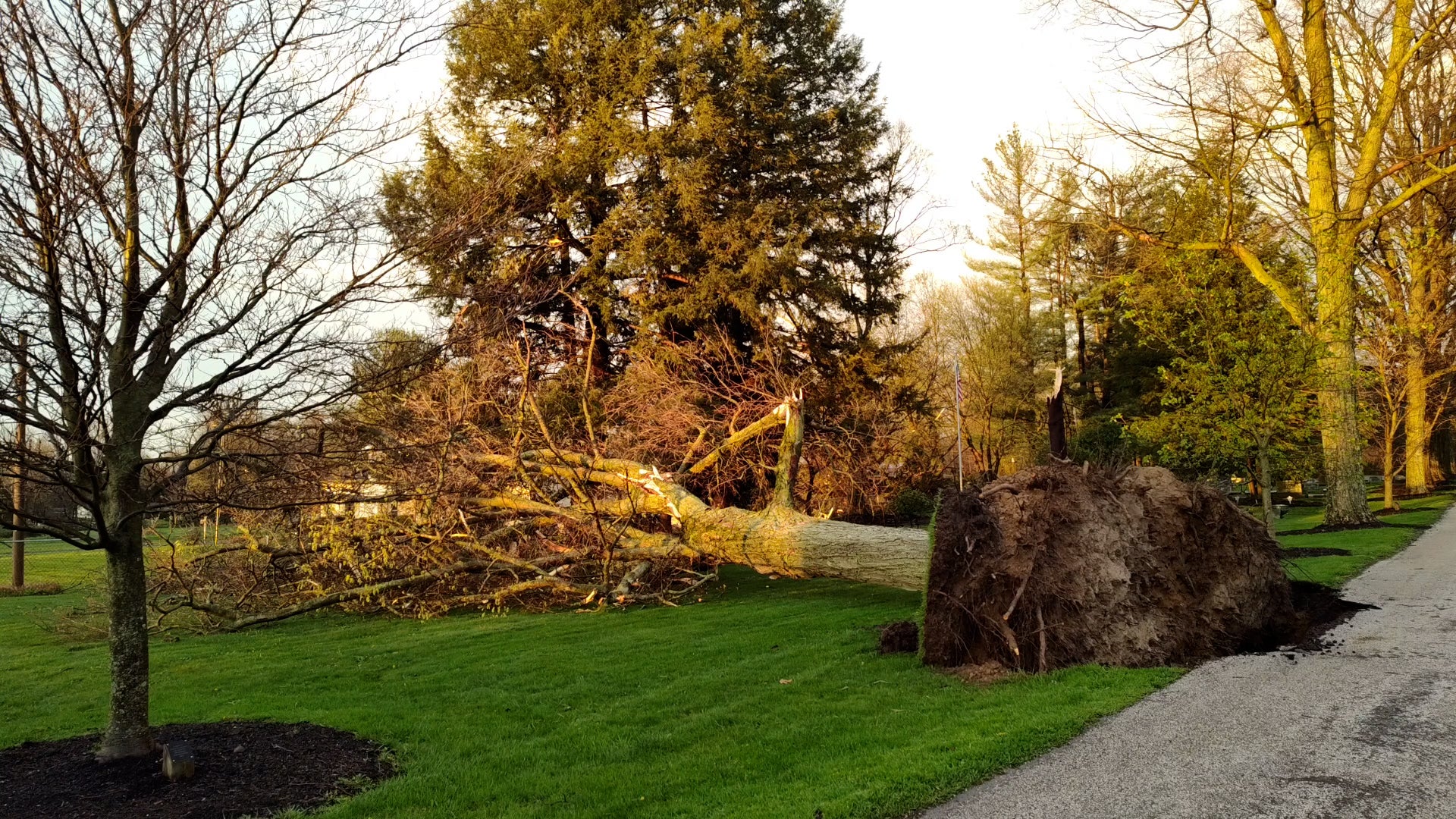
The tornado left part of a garage door in a tree. Many large trees were uprooted and toppled or left leaning against houses.
Residents walked around their neighborhoods taking in all the damage. Some chatted on cellphones about what they saw, while others snapped pictures.
Others went to work, tending to downed trees with chainsaws, machetes and hacksaws.
The tornado left a tree leaning against Pat Trafton's house, but she said her family escaped harm.
"It's been a crazy day," Trafton, 67, told The Associated Press. "They say it was a monster tornado. ... It all just happened so fast."
Krause said it was clearly a tornado -- the first to hit the city since August 2009. "There was no doubt right away," the meteorologist said.
Some north Minneapolis residents told the Star Tribune they saw the tornado go through their yards.
"It went right between our houses," said Tiffany Pabich, who was taking a nap just as the tornado passed. "A tree landed on top of my car. We smelled gas right away."
The storms uprooted as many as 50 natural gas service lines in Minneapolis and suburban St. Louis Park, and CenterPoint Energy warned residents to be careful of gas leaks. Xcel Energy reported more than 20,000 of its customers lost electricity in the metro area.
The Minneapolis Police Department asked people who didn't live in the area to stay away. A shelter for those displaced by the storm was set up Sunday afternoon at a nearby armory.
In Wisconsin, a powerful storm caused significant damage in La Crosse, tearing roofs from homes and sending emergency responders to search damaged buildings for anyone trapped inside, officials said. La Crosse County sheriff's dispatcher Tim Vogel described the damage as "significant" but told The Associated Press there were no immediate reports of serious injuries.
Those storms followed a tornado Saturday night that swept through a small eastern Kansas town, killing one person and destroying at least 20 homes, as severe thunderstorms pelted the region with hail that some residents described as the size of baseballs, authorities said Sunday.
Kansas Division of Emergency Management spokeswoman Sharon Watson identified the victim as Don Chesmore, 53, of Reading. He was in a mobile home that flipped. He was taken to a hospital in Emporia, where he was pronounced dead,
Link
89 dead in from tornado in Joplin, Missouri; number expected to rise
Joplin, Missouri (CNN) -- At least 89 people died from a tornado that tore through Joplin, Missouri, City Manager Mark Rohr told reporters Monday morning.
Residents in the southwest Missouri city braced for news of fatalities after the vicious tornado flattened buildings, tossed cars and hurled debris up to 70 miles away.
"I would say 75% of the town is virtually gone," Kathy Dennis of the American Red Cross said Sunday night.
But Joplin Emergency Management Director Keith Stammer put the estimate at 10% to 20%.
"The particular area that the tornado went through is just like the central portion of the city, and it's very dense in terms of population," Stammer said on CNN's American Morning on Monday.
He said officials have a list of places where people are believed to be trapped. "We have been working all night long, and we will continue to do so until we get to everybody," he said.
Stammer said more than 40 agencies from Kansas, Arkansas, Oklahoma and Missouri have responded.
Missouri Gov. Jay Nixon activated the Missouri National Guard and stressed urgency in rescuing survivors after the Sunday evening twister.
"It's total devastation, with a hospital down, the high school down, other areas," he said. "We just want to make sure that as the night goes on, we're saving lives between now and dawn."
Nixon said late Sunday night that there was no official death toll, but "we have had confirmation of a number of deaths. And the number appears to be rising."
Joplin city spokeswoman Lynn Ostot said the number of fatalities probably won't be determined until daylight. She said about 1/2 to 1 mile of the city was affected, including residential and commercial districts.The city is home to about 50,000 people, according to the U.S. Census.
Aerial footage from CNN affiliate KOTV showed houses reduced to lumber and smashed cars sitting atop heaps of wood. Some structures were engulfed in flames.
Amber Gonzales was driving through southwest Missouri when she heard tornado warnings on the radio. She took refuge at a gas station before getting back on the road and seeing the aftermath of what she narrowly missed.
"There were about 10 semis turned over on their sides on the highway," Gonzales told CNN. "I had to go around semis on the road."
She then stopped at a Joplin shopping center to find cars flipped over in the parking lot and rescuers extracting people from the debris.
Link
Surprising Response to Higher CO2 Levels
May 23, 2011; 9:24 AM ET
Researchers from the University of Wisconsin-Eau Claire and the University of Minnesota-Twin Cities recently concluded an 11-year experiment on the response of 13 grassland plant species to a higher carbon dioxide environment.
According to the National Science Foundation story, the research team added extra CO2 to the plants' environment to get an idea of how these plants would respond to a higher CO2 world of global warming.
Carbon dioxide delivery pipes and valves are part of the BioCON experiment. Credit: BioCON Experiment/NSF Cedar Creek LTER Site.
To their surprise, the researchers found that the plants' capacity to absorb the extra CO2 from the atmosphere may be less than anticipated.
Unfortunately, current climate models assume that vegetation will absorb much of the extra CO2 that humans put into the air through the burning of fossil fuels.
This will mean that current climate models will likely underpredict the rate of increase of future atmospheric CO2 levels and therefore the pace of climate change, according to study authors Tali Lee, Peter Reich and Susan Barrott.
"Now we have convincing evidence that the photosynthesis of typical grassland species will not respond as we had thought," says Gholz. "The cautionary implications for global climate models are clear." (via nsf.gov)
Link
:)
How ya doing Girl?
Me too! Thank God! How you like my Wonderware computer graphic image I made of how we can capture Gulfstream Kinetic Energy to prevent many such tornadoes?
:)
I agree with you. It seems only a few people and computers can comprehend them right now!
Washington Post editorial...
Sign me up.
woops; here is the real world.
Political cracks appear on carbon reduction
It's been one of the most remarkable things in British politics for many years: The political consensus, across all the main parties, on the need and the speed at which the UK is to cut its carbon emissions to avoid so called 'dangerous climate change'.
And yet, lurking just beneath the surface, there are MPs who privately either express concern at the cost of going green and how, if other countries don't do the same, it might damage the country's competitiveness; or even voice doubts about man made global warming itself, believing the threat is exaggerated.
That said it still came as a surprise to commentators this week when a prominent member of the Cabinet, the Business Secretary Vince Cable, voiced his concerns that the speed and cost of carbon reductions over the coming years could harm prospects for jobs and growth - concerns that are apparently shared by, among others, the Chancellor George Osborne.
In 2008, three budgets were announced taking the country on a path of carbon reduction to 2023. But the next target that has to be set in the next few days will take the country to 2030.
The government have been told that carbon emissions should be cut by 60% compared to 1990 levels by 2030, by the government's advisory body on climate change.
Lord Turner, who heads this body, met with ministers to try and heal a rift which has pitched Osborne, Cable and others against the Secretary of State for Energy and Climate Change Chris Huhne.
In a leaked letter, Cable wrote that he feared the Energy Secretary's plan relies on securing a cap on emissions trading across Europe that may never materialise. If this were not achieved, the UK would be left cutting carbon emissions unilaterally, which would risk putting industry at a disadvantage.
A decision will be made by the Prime Minister David Cameron on Monday and will be watched very closely to see if the UK's remarkable political consensus remains in place.
Any watering down of the UK's carbon reduction plan, which is one of the toughest in the world, would be seen as a major blow by green campaigners that could have far reaching ramifications around the world.
Link
At 13:09 14th May 2011, QuaesoVeritas wrote:
An example of "climate change" bias at the BBC.
Kate Adie, in an introduction to an item about freshwater River Dolphins, on today's From Our Own Correspondent said:
"Last year the Amazon region suffered one of it's worst droughts in recorded history. The river reached it's lowest level for half a century. Scientists do not know how much "climate change" played a part. But some computer models project more water shortages across the region as the planet warms."
http://www.bbc.co.uk/iplayer/episode/b011290j/Fro m_Our_Own_Correspondent_14_05_2011/
Now, if scientists don't know how much "climate change" played a part, then don't mention it. Of course, this is a subtle attempt to link the predictions of computer models to actual drought, when there is absolutely no evidence.
Also note the phrases "worst droughts in recorded history" and "lowest levels for 50 years", so apparently "recorded history" only goes back half a century.
Also, "more water shortages .. as the planet warms", implies that warming is the only cause of water shortages, when it they could equally be due to excessive extraction for industry and a growing population.
Clearly Ms Adie has been reading the BBCs own propaganda from Richard Black:
http://www.bbc.co.uk/news/science-environment-123 56835
"Domino Dancing"
(All day, all day) Watch them all fall down
(All day, all day) Domino dancing
(All day, all day) Watch them all fall down
(All day, all day, domino dancing)
Germany is next!
Hate to say but I already assigned that to you blokes
back at post 71.
Read it and weep.
You sir are a skeptic and therefore do not deserve an
answer, simple empirical evidence gets in the way of
AGW guilt. Same old story, same old song and dance.
Original Sin
the condition of sin that marks all humans as a result of Adam's first act of disobedience.
And anything else that can be blamed on us.
Or Perpetual Guilt
some religions teach perpetual guilt/shame as a corrective device, and some people accept those teach- ings as their soul's guide.
ECOguilt as a religion. seems fitting.
Viewing: 251 - 301
Page: 1 | 2 | 3 | 4 | 5 | 6 | 7 — Blog Index