Heat Waves (4) A Climate Case Study:
In the last article I wrote that the extreme events of 2011 were providing us with the opportunity to think about climate and how to cope with a warming world. The U.S. is experiencing an extreme heat event this week (Masters @ WU). This heat wave is the consequence of a strong, stationary high pressure system over the central U.S., and it will move to the east over the next few days. Back on July 14th The Capital Weather Gang did a nice write up on the forecast of the heat wave. At the end of this blog are links to my previous blogs on heat waves and human health.
When thinking about weather, climate, and extreme events an important idea is “persistence.” For example, a heat wave occurs when there are persistent high temperatures. Persistent weather patterns occur when high and low pressure systems get large and stuck; that is, they don’t move. In the Figure below, you need to imagine North America and the United States. There is a high pressure center over the proverbial Heartland. With blue arrows I have drawn the flow of air around the high pressure system, and in this case moist air. There is moisture coming from the Gulf of Mexico and, in fact on the date when this was drawn, from the Pacific. This is common in the summer to see both the Gulf of Mexico and Pacific as sources of continental moisture.

Figure 1: Schematic of a high pressure system over the central United States in July. While generic, this is drawn to represent some of the specifics of 2011. The green-shaded area is where there have been floods in 2011. The brown-shaded area represents sustained drought in the southern part of the nation.
At the center of this high pressure system there is a suppression of rain, because the air is moving downward. This sets up a situation where the surface heats from the Sun’s energy. There is not much mixing and cooling, because of the suppression of the upward motion that produces rain. Hence, if this high pressure system gets stuck, then there is persistent heat. This is a classic summer heat wave.
Let’s think about it some more. There is lot of moisture being drawn around the edge of the high pressure system, and this moisture contributes to the discomfort of people. People – just a short aside about people: if we think about heat and health, then we are concerned about people’s ability to cool themselves. It is more difficult to cool people when it is humid because sweat does not evaporate. Suppose that in addition to this moisture, there is a region where the ground is soaked with water from flooding. Then on top of already moist air coming from the Gulf, there is local evaporation into the air being warmed by the Sun. If on the interior of the high, where the rain is suppressed, there is hot, wet air, then it becomes dangerous heat.
It’s not easy to derive a number that describes dangerous heat. But in much of the eastern U.S. a number that somehow combines temperature and humidity is useful. Meteorologists often use the heat index. It’s the summer time version of “it’s 98 degrees, but it feels like 105.” For moist climates, the heat index is one version of the “it feels like” temperature. Jeff Masters tells me that in Newton, Iowa yesterday, July 17, 2011, the heat index was 126 degrees F. (see here, and 131 F in Knoxville, Iowa on July 18)
Another measure of heat and humidity is the dew point; that is, the temperature at which dew forms, and effectively limits the nighttime low. The dew points in Iowa, South Dakota, Minnesota, and Wisconsin are currently very high and setting records. Here is a map of dew point for July 19, 2011.

Figure 2: Exceptionally high dew points centered on Iowa.
Now if I was a public health official, and I was trying to understand how a warming planet might impact my life, then here is how I would think about it. First, the Gulf of Mexico and the Pacific are going to be warmer, and hence, there will be more humid air. This will mean, with regard to human health for the central U.S., heat waves will become more dangerous, without necessarily becoming hotter. It is also reasonable to expect heat waves will become more frequent and last longer, because those persistent, stuck high pressure systems are, in part, forced by the higher sea surface temperatures. If I am a public health official here is my algorithm – heat waves are already important to my life, and they are likely to get more dangerous, more frequent, and of longer duration. But by how much? Do I need to know by how much before I decide on a plan for action?
If I think about the air being more humid, then I might expect to see trends in the heat index. I might expect to see trends in dew points, and trends in the nighttime minimum temperatures getting higher. (That’s where a greenhouse effect really matters.) I worry about persistent heat, warm nights, and the inability of people and buildings to cool themselves. I worry about their being dangerous heat in places where people and emergency rooms are not used to dangerous heat – not acclimated to heat – not looking for heat-related illness.
Let’s go back to the figure. Rain is suppressed in the middle of the high pressure system, but around the edge of the high pressure system it will rain; there will be storms. (see Figure 3 at the end) The air around the edge of high is warm and very wet. Wet air is energetic air, and it is reasonable to expect local severe storms. (See Severe Storm on Lake Michigan) And if the high pressure is persistent, stuck, then days of extreme weather are possible. If this pattern sets up, then there is increased likelihood of flooding. If I am that public health official, then I am alerted to the possibility of more extreme weather and the dangers thereof. But, again, can the increase of extreme weather be quantified? Do I need to quantify it before I decide on a plan of action?
Still with the figure - what about that region of extended drought and the heat from the high pressure system? Dehydration becomes a more important issue. As a public health official, I start to see the relation of the heat event to other aspects of the weather, the climate. I see the relation to drought. I see the flood, and it’s relation to the winter snow pack and spring rains.
So what I have presented here is to look at the local mechanisms of the weather – what are the basic underlying physics responsible for hot and cold, wet and dry – for moist air? If I stick to these basic physics, and let the climate model frame the more complex regional and global picture, what can I say about the future? Do I have to have a formal prediction to take action? Here in 2011, I see drought and flood and hot weather and warm oceans that interact together to make a period of sustained, dangerous heat. It does not have to “set a record” to convey the reality of the warming earth. It tells me the type of event that is likely to come more often, of longer duration, and of, perhaps, of greater intensity. If I am a public health planner, then I can know this with some certainty. The question becomes, how do I use that information in my planning?
r

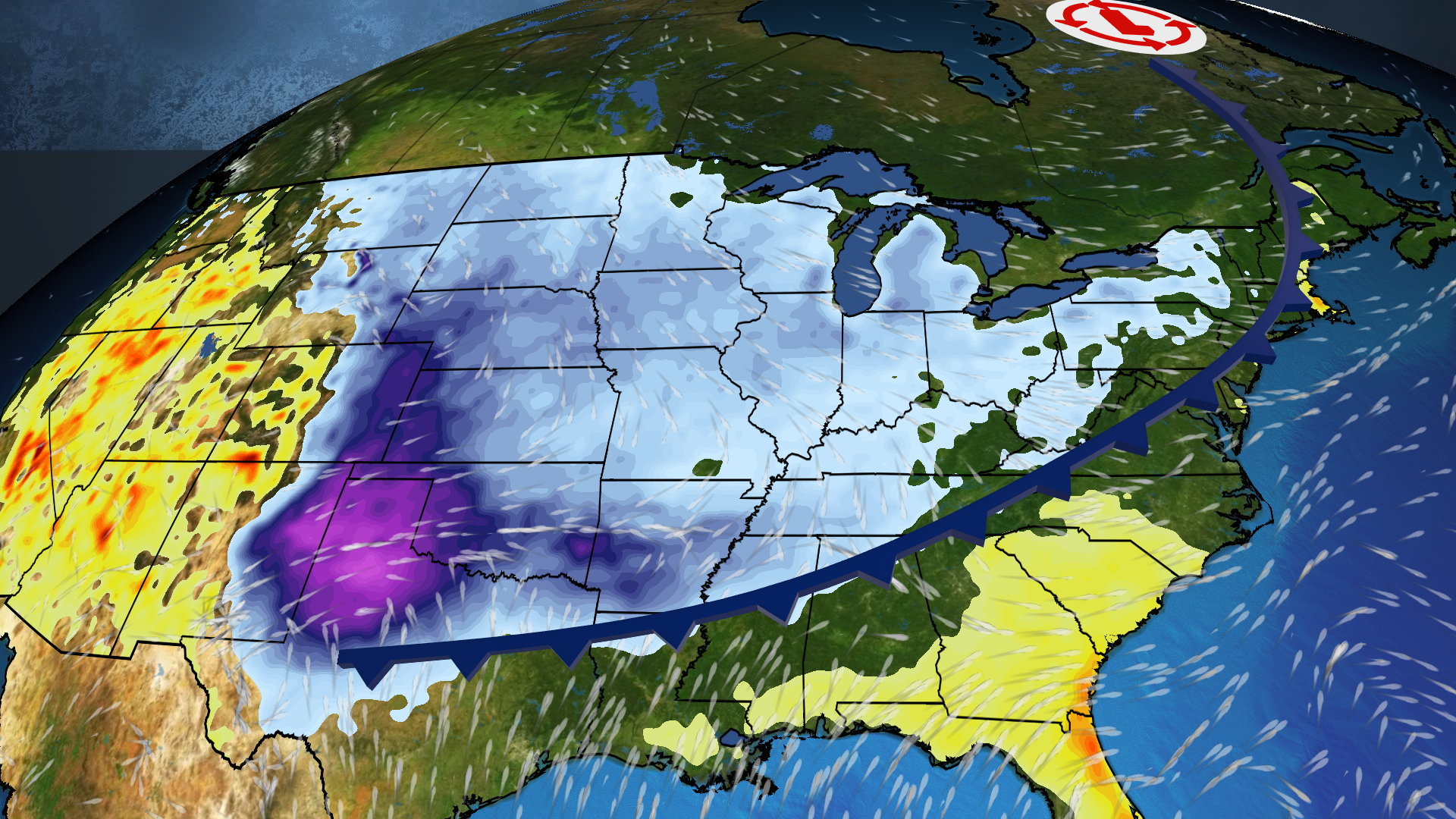
Figure 3: Radar loop showing precipitation around the edge of the large high pressure system in the middle of the continent. July 19, 2011.
Previous Blogs on Heat Waves
Hot in Denver: Heat Waves (1)
Heat Waves (2): Heat and Humans
Heat Waves (3): Role of Global Warming
Reader Comments
Page: 1 | 2 | 3 | 4 | 5 | 6 | 7 | 8 | 9 | 10 | 11 | 12 | 13 | 14 | 15 | 16 | 17 | 18 | 19 | 20 | 21 | 22 | 23 | 24 | 25 | 26 — Blog Index
Are you a scientist? Do you blog from a tent on a glacier in Greenland?
You can probably figure out that publication was written some 5 years ago.
Do you really have to insult people that post material you find objectionable?
Bottom line is this: you can't post real science to back your claims either.
Rubber and Glue
Please stop being such a child, Nea.
I'd bet you don't have a clue what those cut and pastes are actually saying.
Climate scientists believe that naturally occurring greenhouse gases warm the Earth by 33 deg C and that without them Earth would be a snowball in space, with perhaps a narrow tundra region girdling the equator where life might exist. Do you accept this, or not?
If not, maybe you could enlighten the scientists as to where they've gone wrong.
If you do accept it, then why do you think that the 40% increase in CO2, 153% increase in methane and 4% increase in water vapour are not responsible for the current warming trend?
I am one of the folks just getting by. My bike is not just for fun! I disagree that raising the cost of fuel will raise the cost of food. But 'poor' food is not less quality! For example, I just did the shopping for my parents a few hours ago using thier grocery list:
Low quality food that costs a lot: anything prepared, from potatoe chip to sauces to 'insta-cook' type stuff, also including canned beans which surpised me by being loaded with salt. Probably 65% of the cost, 20% of the nutrition.
High quality food that is cheap (-ish, it varies a bit, here I am comparing to prepared or canned varieties): fresh vegtables, rice, beans, oils (except olive, yea gods good oil is expensive over here), milk (subsidized?), ice cream ( relatively cheap unless you buy the froo froo type), local fruit. 15% of the cost, 40% of the nutrition.
High quality food in the middle: meat, imported fruit, bread (good bread). Remaining cost and nutrition.
Obviously this is all off the cuff but I noticed in comparing US shopping habits to Italian ones.
Second, there is no way to make the claim about knock on effects. Take into account: the reduced pollution (better health - seriously, much muich better health), increased excercise (e.g people taking their girlfriends to Astros game on their two seater bike), lowered transportation costs for public transport, not to mention that if all of this was done by taxes, there would be the possibility of subsidizing food costs.
So in short, yeah I think about poor people. I think about them a lot. I also think about the elderly. I am changing my life in part to help both. I also think about the health of the world. I don't think that I will get rich, i think that I will never do much more than get by. I think that I will be part of a community and help people I care about directly. I may never make a difference but I will try.
From your comments, you seem to care about others but I'm guessing you will do nothing about global warming, nothing about renewable energy, nothing about pollution - those problems aren't within your belief system as problems (again, just guessing). So what are you doing to help others?
oh my God, this whole site is cut and paste.
find a bookie and make a bet, then.
I'm off to Beijing so the Chinese Prime Minister can hand me his country's actual fossil fuel contributions via a cocktail napkin.
But the people who contribute the cut and pastes ought to understand what they're saying.
Probably could. The only problem with it is that hte math capabilites are not great.
Would it show it cooling off this jet fuel for hurricanes and tornadoes?
Who cares what china does? We are the USA!
It is a modeling system. You get what put in. Some things are better modeled using this system, but there are many more powerful modeling systems out there. That said, theoretically it could show anything, in a Turing complete sense. However, it is not particularly efficient code.
I suggest building scale models first.
I can honestly say I put more of my belief in a natural causes and effects, hard to determine its validity, but equally as hard as the anthropogenic causes and effects.
As impossible as it is, I would only conclude results of either side of the debate in a time frame unattainable because of my mortal lifespan.
That being said, we'll all go to our graves holding onto a belief that we'll never know the answer to.
I don't like the fact someone who believes nature is a cyclical system of random reactions is labeled denialist. That reminds me more of totalitarian theologists of years past that make acquisations to a majority of fearful believers, not thinkers.
CO2 has no effect on human Ego. But the AGW debate does.
I did that about 1/640 scale.
Again with the name calling? I'm sorry that you and a few others here feel the need to resort to that when frustrated; I wish that were not the case. Now, you made a demonstrably false statement. I challenged that statement on scientific grounds. You stated that you have a right to pick and choose. I responded that your're not entitled to your own facts. It seems to me that if you find that "insulting", perhaps it's only because you recognize the truth in what I say. (Though to be honest, I didn't insult you, per se; just the incorrect data you posted.)
To answer your first question, yes, I am indeed a scientist.
So how you like my Tunnel idea Neapolitan?
Yes, seriously. I don't see any link between food costs and energy taxes. The data only goes back 30 years!
Sorry, i had to say it. But seriously, there is a link between energy costs and food, there has to be, but it is not a linear link and has many offsets.
At the end of the day, the obesity in poor areas is due to poor eating habits (primary cause) not poverty (secondary cause). I agree there are many related problems: depression, lack of community options, etc...but this is a field about which I am ignorant and could be corrected. And for hte record, there are many many middle class fatsoes as well. I know because I just went a upper middle class mall and my god are Americans fat. Seriously, everyone loks like they are going to go through mitosis next week.
Anyway for the worst of those just getting by, I would really like to see food subsidies for healthy food.
As for the environmental stuff, I agree we could be doing more. Case in point: the Chesapeake Bay. They just finally signed off on an agreement to limit pollution between the 7 watershed states. What happens? The farmers union (or whatever it is) is suing to say that they have the right to pollute. They are also buying politicians to get the national laws changed to allow them to pollute.
That said, I believe the CO2 problem is more serious. I don't follow the articles any more because my mind is made up. The occasional days that I do start to wade through the articles on either side, I find the articles that show global warming is occurring much more intelligent and believable. 'Believable' isn't the same as believing though. That I reserve for the macro data I understand like shrinking artic ice, etc.. Even if unproductive, I think it is the most important fight we have right now. More than terrorism, even more than education. Usually in this space i just argue for getting America off of oil (also because I don't understand the passion to keep sucking gas pump on bended knee) and skip the ecology argument in a sort of nod to your point about that fight being futile.
I just hope that when the ice melts people like the toadies in the new GOP and the tea party and that soft titty of corruption himself, Rush Limbaugh, will be forced to step aside. Futile hope but I'd rather fight the good fight.
Hey, get in line! He still has not provided the proof for his claims in 549 I had asked for, let alone the hundreds of other opinionated claims :)
I just glanced back and find many amazing statements.
I will only comment on a few.
Food costs are directly correlated to energy costs. Farming, fertilizer production, pesticides, processing, packaging, transportation, storage, refrigeration etc, are all directly impacted by the cost of energy needed to make stuff mysteriously appear in your grocery isles.
Barely making it means a high speed internet connection, laptop, and smartphone now days I guess.
How exposure to indoctrination can change peoples interpretation of things in the real world ......
Must be some new standard with respect to calling yourself a scientist now days too. What are those standards anyhow?
You did not provide any evidnece of anyone (a real person) that agrees with you that your tunnels can work. You have farmed your idea at many, many websites and no one agrees with you. Why is that? Ya think, maybe, it's because it won't work?
Of course I've provided "proof" of my claims. In fact, unless I stated otherwise, every single thing I've ever posted here that I stated as scientific fact was, indeed, scientific fact (and it came from actual scientific sources, and not, say, from a site filled with the irrational blather of a non-degreed one-time small-market TV weather reader claiming expert knowledge). Now, I could easily waste many, many hours going back and again citing every scientific fact I've ever repeated here, but I think I'll do that when someone new comes aboard. Everyone here has had ample opportunity to see my references, so I feel no need to waste my energy repeating things I've stated before many, many times.
Ho-hum...
well, what name did I call you?
none.
I am not an author of science.
There are no rules of blogging that say one has to be a scientist or an author to form a conclusion.
I would like to believe, that true scientists don't sound like journalists and politicans, your many references and quips of news organizations you don't favor make me question the science you endorse.
Are you published? And, though you might think otherwise, I don't judge you to be wrong or unqualified in the fields of science. I myself hold no degrees in science nor am I published, but that doesn't mean, as a science hobbist, I don't understand the scientific process.
I'd like to read some of your published research if you are indeed a scientist by profession.
Forgive me if I insinuate your comments as politically driven and main stream with a touch of sarcasm and heavy doses of what I feel resembles rhetoric unfitting of educated scientists.
I enjoy the debates and look forward to more evidence man is responsible for whatever the disaster is that everyone is afraid of; that too is unclear.
If you are referring to what I posted earlier..I gave the online paper's references and works cited. Many are from NASA, NOAA, MIT and other acredited entities and professionals of climate science and geology.
maybe I'm having a hard time fidning it because I can't read mandarin chinese.
Forgive me for be a skeptic as to the causes and even the consequences.
I'm here to learn, as well as throw my own two cents around.
* Of the 186 billion tons of carbon from CO2 that enter earth's atmosphere each year from all sources, only 6 billion tons are from human activity. Approximately 90 billion tons come from biologic activity in earth's oceans and another 90 billion tons from such sources as volcanoes and decaying land plants.
*Edited to suit Neapolitan Fact, a seperate conclusion of facts based on China's willingness to share truthful information of their industrial byproducts with Neapolitan, a blogger and scientist, and not with larger unilateral global environmental agencies:
FUN FACTS about CARBON DIOXIDE
* Of the 186 billion tons of carbon from CO2 that enter earth's atmosphere each year from all sources, discounting Dr. Neapolitan's claim that "China alone pumps more than billion tonnes of CO2 into the atmosphere from the burning of fossil fuels each year", what ever that factual statement means is up to the Jeopardy judges, only 6 billion tons are from human activity. Approximately 90 billion tons come from biologic activity in earth's oceans and another 90 billion tons from such sources as volcanoes and decaying land plants.
* At 380 parts per million CO2 is a minor constituent of earth's atmosphere-- less than 4/100ths of 1% of all gases present.
NOTE: Carbon Dioxide is such a small component of Earth's atmosphere (368 ppmv) that the "slice" it represents in this chart is really only a "line" about 1/2 as thick as the line shown.
Compared to former geologic times, earth's current atmosphere is CO2- impoverished.
Late Carboniferous to Early Permian time (315 mya -- 270 mya) is the only time period in the last 600 million years when both atmospheric CO2 and temperatures were as low as they are today (Quaternary Period ).
* CO2 is odorless, colorless, and tasteless. Plants absorb CO2 and emit oxygen as a waste product. Humans and animals breathe oxygen and emit CO2 as a waste product. Carbon dioxide is a nutrient, not a pollutant, and all life-- plants and animals alike-- benefit from more of it. All life on earth is carbon-based and CO2 is an essential ingredient. When plant-growers want to stimulate plant growth, they introduce more carbon dioxide.
* CO2 that goes into the atmosphere does not stay there but is continually recycled by terrestrial plant life and earth's oceans-- the great retirement home for most terrestrial carbon dioxide.
If we are in a global warming crisis today, even the most aggressive and costly proposals for limiting industrial carbon dioxide emissions would have a negligible effect on global climate!
haha
I don't condone this type of debate but that was pretty funny
garbologist
See this is why I blog
Have you seen the idea working in the video? F1>F2 proves it works as seen in the video!
It is a closed system because it is all under water and has a head pressure at the surface as well as at the bottom. Energy is also conserved within the closed system.Have you seen the video proving the concept?
Eventually it is reused but it may take a thousand years.Depending on how many are built. Have you seen the video?
I know perfectly well what a closed system is. Being underwater is what makes it work. Again have you seen the video?
This is the formula F1>F2.Kindly explain yours?
Negative it can be for both.
Figures lie and liars figure.
Was the recent heatwave really "unprecedented"?
Link
Height or altitude.
Viewing: 651 - 701
Page: 1 | 2 | 3 | 4 | 5 | 6 | 7 | 8 | 9 | 10 | 11 | 12 | 13 | 14 | 15 | 16 | 17 | 18 | 19 | 20 | 21 | 22 | 23 | 24 | 25 | 26 — Blog Index