Heat Waves (4) A Climate Case Study:
In the last article I wrote that the extreme events of 2011 were providing us with the opportunity to think about climate and how to cope with a warming world. The U.S. is experiencing an extreme heat event this week (Masters @ WU). This heat wave is the consequence of a strong, stationary high pressure system over the central U.S., and it will move to the east over the next few days. Back on July 14th The Capital Weather Gang did a nice write up on the forecast of the heat wave. At the end of this blog are links to my previous blogs on heat waves and human health.
When thinking about weather, climate, and extreme events an important idea is “persistence.” For example, a heat wave occurs when there are persistent high temperatures. Persistent weather patterns occur when high and low pressure systems get large and stuck; that is, they don’t move. In the Figure below, you need to imagine North America and the United States. There is a high pressure center over the proverbial Heartland. With blue arrows I have drawn the flow of air around the high pressure system, and in this case moist air. There is moisture coming from the Gulf of Mexico and, in fact on the date when this was drawn, from the Pacific. This is common in the summer to see both the Gulf of Mexico and Pacific as sources of continental moisture.

Figure 1: Schematic of a high pressure system over the central United States in July. While generic, this is drawn to represent some of the specifics of 2011. The green-shaded area is where there have been floods in 2011. The brown-shaded area represents sustained drought in the southern part of the nation.
At the center of this high pressure system there is a suppression of rain, because the air is moving downward. This sets up a situation where the surface heats from the Sun’s energy. There is not much mixing and cooling, because of the suppression of the upward motion that produces rain. Hence, if this high pressure system gets stuck, then there is persistent heat. This is a classic summer heat wave.
Let’s think about it some more. There is lot of moisture being drawn around the edge of the high pressure system, and this moisture contributes to the discomfort of people. People – just a short aside about people: if we think about heat and health, then we are concerned about people’s ability to cool themselves. It is more difficult to cool people when it is humid because sweat does not evaporate. Suppose that in addition to this moisture, there is a region where the ground is soaked with water from flooding. Then on top of already moist air coming from the Gulf, there is local evaporation into the air being warmed by the Sun. If on the interior of the high, where the rain is suppressed, there is hot, wet air, then it becomes dangerous heat.
It’s not easy to derive a number that describes dangerous heat. But in much of the eastern U.S. a number that somehow combines temperature and humidity is useful. Meteorologists often use the heat index. It’s the summer time version of “it’s 98 degrees, but it feels like 105.” For moist climates, the heat index is one version of the “it feels like” temperature. Jeff Masters tells me that in Newton, Iowa yesterday, July 17, 2011, the heat index was 126 degrees F. (see here, and 131 F in Knoxville, Iowa on July 18)
Another measure of heat and humidity is the dew point; that is, the temperature at which dew forms, and effectively limits the nighttime low. The dew points in Iowa, South Dakota, Minnesota, and Wisconsin are currently very high and setting records. Here is a map of dew point for July 19, 2011.

Figure 2: Exceptionally high dew points centered on Iowa.
Now if I was a public health official, and I was trying to understand how a warming planet might impact my life, then here is how I would think about it. First, the Gulf of Mexico and the Pacific are going to be warmer, and hence, there will be more humid air. This will mean, with regard to human health for the central U.S., heat waves will become more dangerous, without necessarily becoming hotter. It is also reasonable to expect heat waves will become more frequent and last longer, because those persistent, stuck high pressure systems are, in part, forced by the higher sea surface temperatures. If I am a public health official here is my algorithm – heat waves are already important to my life, and they are likely to get more dangerous, more frequent, and of longer duration. But by how much? Do I need to know by how much before I decide on a plan for action?
If I think about the air being more humid, then I might expect to see trends in the heat index. I might expect to see trends in dew points, and trends in the nighttime minimum temperatures getting higher. (That’s where a greenhouse effect really matters.) I worry about persistent heat, warm nights, and the inability of people and buildings to cool themselves. I worry about their being dangerous heat in places where people and emergency rooms are not used to dangerous heat – not acclimated to heat – not looking for heat-related illness.
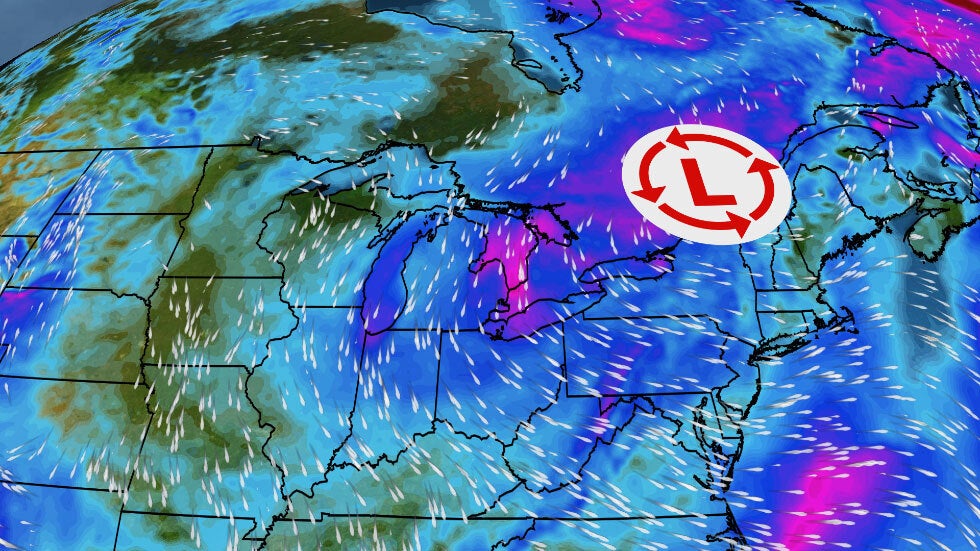
Let’s go back to the figure. Rain is suppressed in the middle of the high pressure system, but around the edge of the high pressure system it will rain; there will be storms. (see Figure 3 at the end) The air around the edge of high is warm and very wet. Wet air is energetic air, and it is reasonable to expect local severe storms. (See Severe Storm on Lake Michigan) And if the high pressure is persistent, stuck, then days of extreme weather are possible. If this pattern sets up, then there is increased likelihood of flooding. If I am that public health official, then I am alerted to the possibility of more extreme weather and the dangers thereof. But, again, can the increase of extreme weather be quantified? Do I need to quantify it before I decide on a plan of action?
Still with the figure - what about that region of extended drought and the heat from the high pressure system? Dehydration becomes a more important issue. As a public health official, I start to see the relation of the heat event to other aspects of the weather, the climate. I see the relation to drought. I see the flood, and it’s relation to the winter snow pack and spring rains.
So what I have presented here is to look at the local mechanisms of the weather – what are the basic underlying physics responsible for hot and cold, wet and dry – for moist air? If I stick to these basic physics, and let the climate model frame the more complex regional and global picture, what can I say about the future? Do I have to have a formal prediction to take action? Here in 2011, I see drought and flood and hot weather and warm oceans that interact together to make a period of sustained, dangerous heat. It does not have to “set a record” to convey the reality of the warming earth. It tells me the type of event that is likely to come more often, of longer duration, and of, perhaps, of greater intensity. If I am a public health planner, then I can know this with some certainty. The question becomes, how do I use that information in my planning?
r

Figure 3: Radar loop showing precipitation around the edge of the large high pressure system in the middle of the continent. July 19, 2011.
Previous Blogs on Heat Waves
Hot in Denver: Heat Waves (1)
Heat Waves (2): Heat and Humans
Heat Waves (3): Role of Global Warming
Reader Comments
Page: 1 | 2 | 3 | 4 | 5 | 6 | 7 | 8 | 9 | 10 | 11 | 12 | 13 | 14 | 15 | 16 | 17 | 18 | 19 | 20 | 21 | 22 | 23 | 24 | 25 | 26 — Blog Index
Too much warm too quickly = catastrophic
The Arctic has been ice-free before and it will be again.
Link
Link
What does coping mean to you? How are you personally contributing to the coping?
Or was "keeping on breathing, eating, replicating, evolving" you answer?
Wrong again. In 1926, a dirigible named the Norge manned by noted explorers, flew over the Pole and documented the lack of ice. Perhaps you'd like to see the original newspaper report:
Link
Lack of Ice is not Ice free is it?
""We came up through a very large opening in 1958 that was 1/2 mile long and 200 yards wide. The wind came up and closed the opening within 2 hours. On both trips we were able to find open water. We were not able to surface through ice thicker than 3 feet.""
So was the rest of the Arctic Ice cap melted at this time also?
Also 1/2 mile long and 200 yards wide is not that very large. I could probably run that 1/2 mile distance in 3 mins.. LOL!
I'll take a stab at an answer.
breathing = good
eating = ummm... good
replicating = sure
evolving = some of us
Can't face the fact that there was no ice at the Pole. Why are you playing the semantic game? If you took the time to read the article, the headline was "Open water at Pole." To me that would mean ice-free. I'm going to start calling warmists "deniers," because you deny that the earth could have ever been warmer in the past before CO2 could have had any influence.
The North Pole hasn't been ice-free in at least 10,000 years, and probably far longer. Scattered stories of "finding open water" at the pole is not, of course, the same as saying "ice-free". A lot of wishful thinkers will claim that it was ice-free because the U.S.S. Nautilus visited the Pole in the summer of 1958. But the only reason the Nautilus was able to do so is that it was a nuclear sub so it could stay under the ice--ice that was thick.
But you are correct in one regard: it will be ice free, most likely in the summer of 2016 or so.
Ice free! I agree but that isn't the whole Arctic Ice cap is it? I mean we are talking the whole dang thing here! You don't see a problem with that?
"Open water" = "ice free"? Talk about semantic confusion. That's a little like saying that since I have a few open spots in my schedule, all my time is free, isn't it?
Doesn't look so thick here several times:
Link
You do understand a large part of the ice melt is from the sea ice blowing out of the strait's and melting in warmer water? I posted several papers and Sat based animations related to the said 10 year old weather pattern we currently have over the arctic.
BBL
Just because your logic has been successfully challenged is no need to resort to immature name-calling. Time out for you...
Successfully challenged? You didn't answer my last question.
The Arctic dipole anomaly
The record low ice extent of September 2007 was influenced by a persistent atmospheric pressure pattern called the summer Arctic dipole anomaly (DA). The DA features unusually high pressure centered over the northern Beaufort Sea and unusually low pressure centered over the Kara Sea, along the Eurasian coast. In accord with Buys Ballot's Law, this pattern causes winds to blow from the south along the Siberian coast, helping to push ice away from the coast and favoring strong melt. The DA pattern also promotes northerly winds in the Fram Strait region, helping to flush ice out of the Arctic Ocean into the North Atlantic. The DA pattern may also favor the import of warm ocean waters from the North Pacific that hastens ice melt.
June 2010 saw the return of the DA, but with the pressure centers shifted slightly compared to summer 2007. As a result, winds along the Siberian coastal sector are blowing more from the east rather than from the south. Whether or not the DA pattern persists through the rest of summer will bear strongly on whether a new record low in ice extent is set in September 2010.
Link
LOL. I'm pretty sure I posted those pictures here before as well...Man, that seems like eons ago.
* * *
№ 359
Even if the term "ice-free" is defined by the more relaxed specific criterion of 1x10⁶ km³ sea ice area, which if I recall correctly is what I often see, there is no way that 2016 will be an "ice-free" summer.
Someone should start an Intrade market for that.
Edited for typos
I think that post on WUWT was from about 3 yrs. ago. I remembered reading it and thought it was a good example of how cyclical Arctic sea ice really is.
I have little doubt that, barring a massive volcanic eruption, the Arctic will be, literally, free of ice by summer of 2016, however one defines the term.
FWIW, Intrade has just one open Arctic Ice market at the moment. I worked for a while for an online prediction market, and this is precisely the kind of market I would have created--though, generally speaking, such long-term markets were frowned upon.
Well, I seem to recall that arctic temperatures were warmer in the 1930s than they were in the 1970s, so I would expect the arctic ice to be lower then. In reality though, we have very little evidence outside of a few anecdotal reports so it's conjectural to say one way or the other.
Too little evidence to say for sure that there is a cycle too, but there are reasons to think that there could be. I've posted before how the PIOMAS model, which most AGW proponents believe gives a reasonable estimate what arctic ice volume is, incorporates the NAO into it's model, for example. The PIOMAS also predicts low arctic volumes for the 1948-1960 period as well, as can be seen below:
From here.
Initial evidence from the Cryosat-2 satellite do seem to call the recent PIOMAS volume estimates in question however, although it's probably still too early too tell; perhaps we'll hear more on that at some point.
I just can't see that...
If the 2011 ice area manages to be as low as 2007, there will still be almost 4x10⁶ km³ of ice left. The maximum amount over the last nine years was a bit over 5x10⁶ km³. Even if we lose about the same amount of ice as the difference between the maximum and minimum over the 2002-2011 period, which looks like about 1.5x10⁶ km³ of ice, there will still be over 2x10⁶ km³ of ice area left.
Would you consider that "ice-free"? Do you think we are going to lose more ice in the next five years than we've lost in the last nine? I bet you could get pretty good odds on Intrade with that.
I'm so used to seeing that kind of thing here that I didn't even notice it.
Barring a significant increase in the subsurface volcanic activity within the arctic circle, it is not possible to be ice free under the current weather patterns. Those weather patterns will change and subsequently inhibit, not exacerbate, ice flow loss. This will allow rebuilding to occur and the age of the ice to grow older.
A group of biologists that have been studying polar bears off the coast of Alaska have determined that polar bear cubs are drowning, due to loss of sea ice. They are being forced to make longer swims than normal just to find land or stable ice sheets.
The study confirms the dangers of ice loss to Alaska’s polar bear population. It’s been widely theorized that adult polar bears have been forced to cross ever-longer stretches of open ocean as the polar regions heat up. The new work, by U.S. Geological Survey Alaska Science Center researchers, confirms that theory. It also reveals that these open-water swims have a dramatic effect on young cubs, which are forced to follow their mothers in search of food and solid ground.
“This research is the first analysis to identify a significant multi-year trend of increased long-distance swimming by polar bears,” co-author Geoff York said Monday. “Climate change is pulling the sea ice out from under polar bears’ feet, forcing some to swim longer distances to find food and habitat.”
Link
To be honest, I'm not even sure we'll see anything
muchlower than 2007 between now and 2016. This year looks like it has a shot of surpassing 2007, but it would still take rather dramatic amount of amount of melt from now until autumn to achieve it, similar to what we saw in 2007.Edited out "much"...It still wouldn't surprise me if there is no new minimum between now and 2016. I guess I'd say 50/50, given where this year is up to this point.
Are you ok with a summer ice free North Arctic?
I would not be surprised either way. Here is an interesting read on the ice flow subject.
The Cryosphere Discuss., 5, 1311–1334, 2011
www.the-cryosphere-discuss.net/5/1311/2011/
doi:10.5194/tcd-5-1311-2011
From the article in the link:
A sample size of eleven?
Hopefully not the last eleven.
Besides media sources, my change in mindset was partly related to the same in peer reviewed papers.
I got to where I understood that so very little was solidly supported by the data, either way, and that so very much of the supporting science involved what you bring up, above...even in the "conclusions" section of peer reviewed papers. Suppositions of grandeur run amok in claiming that the work proved important things when it didn't. The conclusion seems to be drawn up before the research starts and all the research is simply done to support the conclusion, poorly, in a tunnel-vision way. I have seen a great many papers by many researchers that fit this mold.
I have viewed this type of behavior first hand. If you don't provide that of which the funding source/directive is seeking, the funds stop. It is about "selling science" to many in an effort to perpetuate their grants and livings in many instances. The velocity of such has increased significantly over the last few decades. Think about how much Gov money is allocated to studies on natural climate variability? Can ya find any? Just sayin.........
Gee this wouldn't have anything to with it you suppose?
Arctic also sees heat wave, on course for record ice melt
Area of sea ice the size of Pennsylvania melts every day, data show
By Andrea Mustain
OurAmazingPlanet
updated 7/20/2011 7:06:47 PM ET
This year could be well on its way toward earning a dubious spot in the record books.
Arctic sea ice has melted away with astonishing speed in the first half of July, at an average rate of about 46,000 square miles per day, according to the National Snow and Ice Data Center (NSIDC) in Boulder, Colo.
That's equivalent to an area roughly the size of Pennsylvania melting into the sea every 24 hours.
"That's relatively fast," said Julienne Stroeve, a research scientist at the NSIDC.
Already, sea ice extent %u2014 how far ice extends across the ocean %u2014 this year is below the extent for the same time in 2007, a year which, in September, saw the lowest sea ice coverage ever recorded.
As of July 17 this year, sea ice covered 2.92 million square miles of the frigid Arctic Ocean. That may sound like a lot, but it's 865,000 square miles below the 1979 to 2000 average.
However, Stroeve said, much of what happens in the coming days depends on the weather.
Advertise | "Unless things change in the next few weeks, we might have a new record for July," Stroeve told OurAmazingPlanet. "Certainly overall, we think the ice is thinner overall leading up to this season than it was in 2007."
The ebb and flow of Arctic sea ice is a yearly occurrence. Each fall, as Northern Hemisphere temperatures drop, ice extends outward, away from the land and out over the ocean; each spring, with the onset of warmer weather, the ice recedes. However, the reach of the sea ice has declined steadily since satellite records began in 1979.
Researchers have found that the earlier Arctic ice begins to melt in the spring, the greater the overall melt for the year as a whole.
In 2011, in the Chukchi Sea, near Alaska, and the Barents, Kara and Laptev Seas, near Finland and Russia, NASA researchers found melt began two weeks to two months earlier than the 1979 to 2000 average.
Story: Polar bear cubs die as ice melts, swims get longer
This year, much of the Arctic has been in the grip of a warm spell.
Like the conditions that sparked the heat wave running roughshod over huge parts of the United States, a high pressure system has been parked over the Beaufort Sea, north of Alaska, since June, bringing warmer temperatures to the Arctic as a whole. Air temperatures at the North Pole are a full 11 to 14 degrees Fahrenheit (6 to 8 degrees Celsius) warmer than usual.
In addition, high pressure systems are associated with clear skies, Stroeve said, so the ice is often at the mercy of the sun's rays for the full Arctic day, prompting further melting.
Although Stroeve said a change in the weather could dramatically change the ultimate fate of the Arctic's sea ice for 2011, she said a new record isn't out of the question.
"It's too early to say we're going to have a new record low," Stroeve said, "but I would say it's certainly possible with the way things have been going."
Link
As I noted previously the sample sizes are small, but even given that the study doesn't really show anything that isn't common sense. They simply compared the mortality rate of polar bear cubs that had to swim long distances as opposed to shorter distances. Of course, the former will have a higher mortality rate. What they can't show with this study alone is the very thing that the article implies--that the overall mortality is going up due to declining sea ice. It would have to be compared to a past study, or a future one to assess the trend.
Also, the sample size is too small to be very meaningful...
Once again the frog refuses to jump from boiling pot of water.
img src="
Specifically which part of my post do you disagree with?
What a smart lady that Heidi Cullen is.
"What they can't show with this study alone is the very thing that the article implies--that the overall mortality is going up due to declining sea ice."
They don't have to show us that. The Bear does. Just like the Frog does. That is why the frog and the bear are equal.
As far as the article, the title is "Polar Bear Cubs Drowning due to Climate Change". This implies that the mortality has increased. Has it? What is the overall mortality rate? What was it in the past? If the study doesn't answer these questions, it doesn't show what the article is implying.
As to the second part of your post...I have no idea what you're talking about.
A 41 year old man died of hypothermia early Monday in the city of Campo Grande, state of Matto Grosso do Sul where temperature ranged from minus one to plus three. The man was found in the street a few blocks from his home.
In the state of Santa Catarina temperatures dropped to below zero with the lowest in the city of Urubici, minus 4.5 degrees with 90 kilometres gusts of wind that pushed the cold factor to minus 27 degrees. Ponds and streams in the area were covered with a thin coat of ice.
In Florianopolis, capital of Santa Catarina and a renowned sea resort, thermometers registered 6 degrees below zero and further south in the state of Rio Grande do Sul, bordering with Uruguay, several locations emerged covered in snow, which forced education officials to close schools until next Wednesday.
“We’ve had snow before but never this cold factor. Some schools opened but by 10:00 in the morning everybody was gone because of the intense cold, nobody could stand it”, said the mayor of Sao Jose, Erivetto Sinval Velho.
Forecasts until Wednesday indicate clear skies with maximum temperatures of 16 to 18 degrees Celsius but dropping to minus 4 and 6 Celsius, warned the meteorological office.
Link
South America cold snap kills 22
22 people have already died in the coldest summer in South America in recent years, news reports said on Saturday, citing Paraguay, Uruguay, Argentina and Brazil, which remain in the grip of a cold spell.
The four countries’ death toll includes those who froze to death on streets and died of carbon monoxide poisoning due to faulty heaters.
Link
More than 2,500 farmers in the south east of the province of Arequipa lost their crops due to low temperatures recorded in the city.
More than 2,500 farmers in the south east of the province of Arequipa , lost their potato crops, corn, vegetables and others, due to the intense cold that is recorded in the city.
Percy Carpio Lazo, President of the Board Members Zone Chili unregulated, said that low temperatures spoiled the crop 25% equivalent to a thousand hectares, leaving economic losses of about a million suns.
The cold snap also burned pastures, leaving no food for cattle, harming farmers in the districts of Socabaya Characato Mollebaya, Yarabamba, Pocsi, San Juan de Tarucani, and others.
Read more news from Peru in the National section
Cold snap that has already killed at least 35 people
Thick fog and snow descended on the Bolivian capital La Paz on Monday in a cold snap that has already killed at least 35 people.
Temperatures have dived to negative five degrees Celsius – the lowest in the past decade. Local weathermen say the mercury will continue to drop in the coming days.
Link
SANTIAGO .- The National Emergency Office, ONEMI, reported today that Early Warning held in custody for the frontal system in the region of Bio Bio, while Red Alert declared yesterday in the communes of Curarrehue, Lonquimay and Melipeuco and Yellow Alert in the communes Pucon, Curacautín and Cunco, Araucanía Region, by post front snow instability.
According to assessments made on site by the Civil Protection System, until the following conditions are recorded product of the frontal system:
The Bío Bío Region, remains impassable Route Q - 90 in the town of Laja result of a landslide. City staff works with heavy machinery in the DMZ. The ports of Talcahuano, San Vicente, Coronel, and Lebu Lirquén are open, like airports María Dolores Bernardo O `Higgins and Carriel South.
In the Region of La Araucanía, 1,500 customers remain affected by a power outage in the districts of Lonquimay, Melipeuco, Curacautín and Pucón. The utility works on the replacement. Also remain impassable Route S-61 Icalma - Melipeuco and back roads of the commune of Lonquimay, in which personnel work of Roads. Border crossings and ICLAM Hachado Pino remains closed by snow accumulation.
According to requirements set by the Regional Emergency Operations, ONEMI has shipped boxes of food to cater to people who are isolated from the accumulation of snow. Similarly, develop arrangements to provide machinery for the clearance of the affected routes.
The National Early Warning Center, in coordination with the Regional ONEMI, will continue to monitor the weather conditions, providing courses of action necessary for the proper attention of potential emergencies that could be generated by this condition, according to the existing alerts
Link
The flippant comments will be missed.
You left something out:
"Five of those bears lost their cubs while swimming, a 45 percent mortality rate. Among cubs not compelled to swim long distances, the mortality rate was 18 percent."
From the information given you can not determine the total sample size. The sample size is only given for one of the two comparison groups. You'll have to wait for the conference abstracts or publication before you can make an informed critique.
Given a similar sample size in the short distance swimmers and the large difference between mortality rates, the comparison of mortality rates could easily have a large enough sample size to reach a high level of statistical significance.
Predicting 21st-century polar bear habitat distribution from global climate models
And a rebuttal to the critique of this study:
Rebuttal of “Polar bear population forecasts: A public-policy forecasting audit”
The Bear doesn't know there is a change in the ice conditions no more than frog knows the temperature has changed in the pot of warming water. But we do and we study the effects of that. That is why we know the arctic ice decline will have a dramatic effect on Arctic life.
The year-to-year loss hasn't been linear:
So, yes, the September ice minima will be on the zero line by 2016. Bet on it...
Viewing: 351 - 401
Page: 1 | 2 | 3 | 4 | 5 | 6 | 7 | 8 | 9 | 10 | 11 | 12 | 13 | 14 | 15 | 16 | 17 | 18 | 19 | 20 | 21 | 22 | 23 | 24 | 25 | 26 — Blog Index