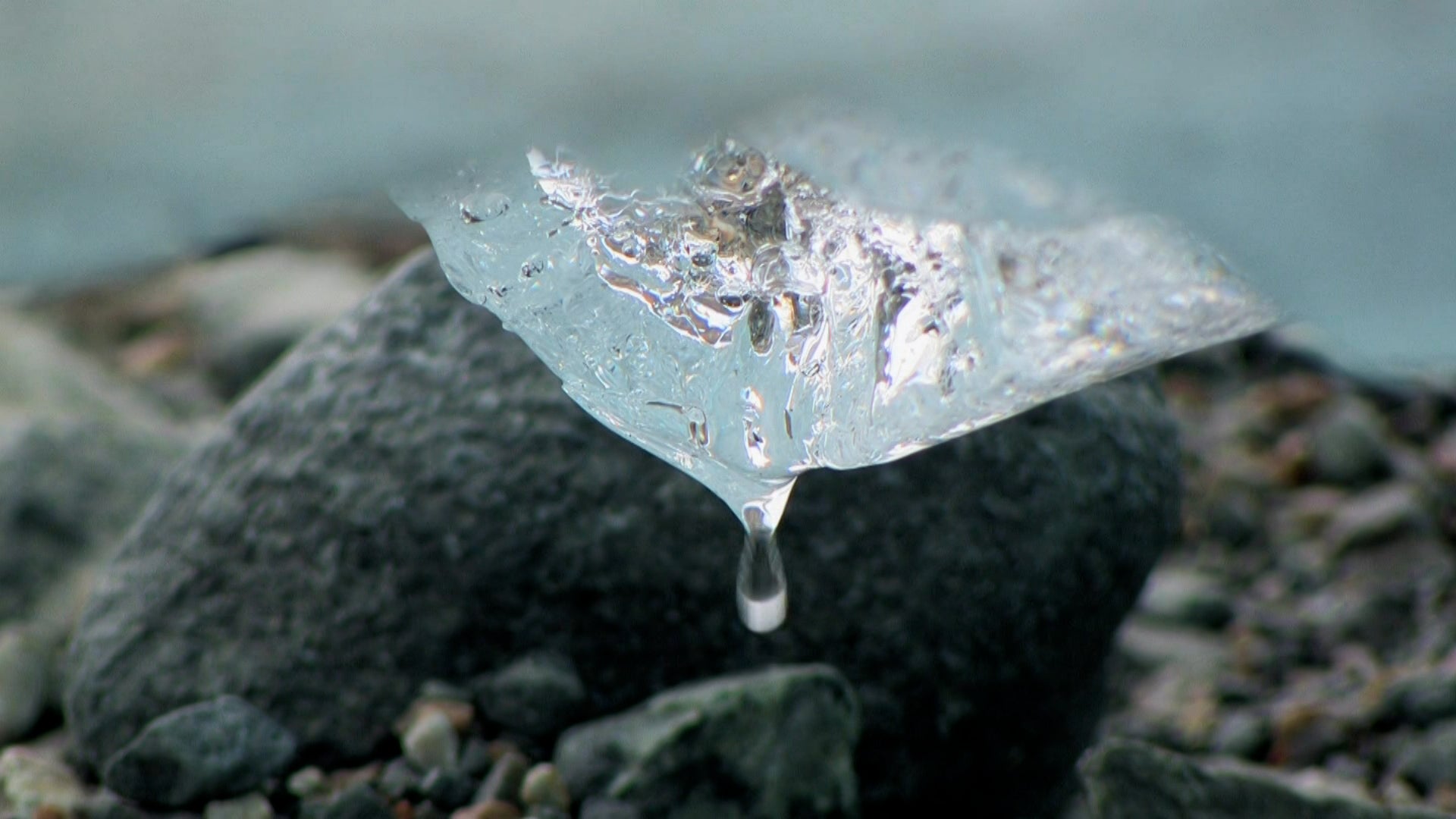
Arctic temperatures the warmest in 2,000 years; 2009 Arctic sea ice loss 3rd highest
It's time to take a bit of a break from coverage of the Atlantic hurricane season of 2009, and report on some important climate news. The past decade was the warmest decade in the Arctic for the past 2,000 years, according to a study called "Recent Warming Reverses Long-Term Arctic Cooling" published today in the journal Science. Furthermore, four of the five warmest decades in the past 2,000 years occurred between 1950 - 2000, despite the fact that summertime solar radiation in the Arctic has been steadily declining for the past 2,000 years. Previous efforts to reconstruct past climate in the Arctic extended back only 400 years, so the new study--which used lake sediments, glacier ice cores, and tree rings to look at past climate back to the time of Christ, decade by decade-- is a major new milestone in our understanding of the Arctic climate. The researchers found that Arctic temperatures steadily declined between 1 A.D. and 1900 A.D., as would be expected due to a 26,000-year cycle in Earth's orbit that brought less summer sunshine to the North Pole. Earth is now about 620,000 miles (1 million km) farther from the Sun in the Arctic summer than it was 2000 years ago. However, temperatures in the Arctic began to rise around the year 1900, and are now 1.4°C (2.5°F) warmer than they should be, based on the amount of sunlight that is currently falling in the Arctic in summer. "If it hadn't been for the increase in human-produced greenhouse gases, summer temperatures in the Arctic should have cooled gradually over the last century," Bette Otto-Bliesner, a co-author from the National Center for Atmospheric Research, said in a statement.
The Arctic melt season of 2009
Arctic sea ice suffered another summer of significant melting in 2009, with August ice extent the third lowest on record, according to the National Snow and Ice Data Center. August ice extent was 19% below the 1979 - 2000 average, and only 2007 and 2008 saw more melting of Arctic sea ice. We've now had two straight years in the Arctic without a new record minimum in sea ice. However, this does not mean that the Arctic sea ice is recovering. The reduced melting in 2009 compared to 2007 and 2008 primarily resulted from a different atmospheric circulation pattern this summer. This pattern generated winds that transported ice toward the Siberian coast and discouraged export of ice out of the Arctic Ocean. The previous two summers, the prevailing wind pattern acted to transport more ice out of the Arctic through Fram Strait, along the east side of Greenland. At last December's meeting of the American Geophysical Union, the world's largest scientific conference on climate change, J.E. Kay of the National Center for Atmospheric Research showed that Arctic surface pressure in the summer of 2007 was the fourth highest since 1948, and cloud cover at Barrow, Alaska was the sixth lowest. This suggests that once every 10 - 20 years a "perfect storm" of weather conditions highly favorable for ice loss invades the Arctic. The last two times such conditions existed was 1977 and 1987, and it may be another ten or so years before weather conditions align properly to set a new record minimum.
The Northeast Passage opens
As a result of this summer's melting, the Northeast Passage, a notoriously ice-choked sea route along the northern Russia, is now clear of ice and open for navigation. Satellite analyses by the University of Illinois Polar Research Group and the National Snow and Ice Data Center show that the last remaining ice blockage along the north coast of Russia melted in late August, allowing navigation from Europe to Alaska in ice-free waters. Mariners have been attempting to sail the Northeast Passage since 1553, and it wasn't until the record-breaking Arctic sea-ice melt year of 2005 that the Northeast Passage opened for ice-free navigation for the first time in recorded history. The fabled Northwest Passage through the Arctic waters of Canada has remained closed this summer, however. An atmospheric pressure pattern set up in late July that created winds that pushed old, thick ice into several of the channels of the Northwest Passage. Recent research by Stephen Howell at the University of Waterloo in Canada shows that whether the Northwest Passage clears depends less on how much melt occurs, and more on whether multi-year sea ice is pushed into the channels. Counter-intuitively, as the ice cover thins, ice may flow more easily into the channels, preventing the Northwest Passage from regularly opening in coming decades, if the prevailing winds set up to blow ice into the channels of the Passage. The Northwest Passage opened for the first time in recorded history in 2007, and again in 2008. Mariners have been attempting to find a route through the Northwest Passage since 1497.

Figure 1. Sea ice extent on September 2, 2009, with the Northwest Passage (red line) and Northeast Passage (green line) shown. The Northeast Passage was open, but the Northwest Passage was blocked in three places. The orange line shows the median edge of sea ice extent for September 2 during the period 1979 - 2000, and this year's ice extent is about 19% below average. Image credit: National Snow and Ice Data Center.
Commercial shipping begins in the Northeast Passage
This year's opening marks the fourth time in five years that the Northeast Passage has opened, and commercial shipping companies are taking note. Two German ships set off on August 21 on the first commercial voyage ever made through the Northeast Passage without the help of icebreakers. The Northeast Passage trims 4,500 miles off the 12,500 mile trip through the Suez Canal, yielding considerable savings in fuel. The voyage was not possible last year, because Russia had not yet worked out a permitting process. With Arctic sea ice expected to continue to decline in the coming decades, shipping traffic through the Northeast Passage will likely become commonplace most summers.
When was the Northeast Passage ice-free in the past?
People have been attempting to penetrate the ice-bound Northeast Passage since 1553, when British explorer Sir Hugh Willoughby attempted the passage with three ships and 62 men. The frozen bodies of Sir Hugh and his men were found a year later, after they failed to make it past the northern coast of Finland. British explorer Henry Hudson, who died in 1611 trying to find a route through Canada's fabled Northwest Passage, (and whom Canada's Hudson Bay and New York's Hudson River are named after), attempted to sail the Northeast Passage in 1607 and 1608, and failed. The Northeast Passage has remained closed to navigation, except via assist by icebreakers, from 1553 to 2005. The results published in Science today suggest that prior to 2005, the last previous opening was the period 5,000 - 7,000 years ago, when the Earth's orbital variations brought more sunlight to the Arctic in summer than at present. It is possible we'll know better soon. A new technique that examines organic compounds left behind in Arctic sediments by diatoms that live in sea ice give hope that a detailed record of sea ice extent extending back to the end of the Ice Age 12,000 years ago may be possible (Belt et al., 2007). The researchers are studying sediments along the Northwest Passage in hopes of being able to determine when the Passage was last open.
References
Belt, S.T., G. Masse, S.J. Rowland, M. Poulin, C. Michel, and B. LeBlanc, "A novel chemical fossil of palaeo sea ice: IP25", Organic Geochemistry, Volume 38, Issue 1, January 2007, Pages 16-27.
Darrell S. Kaufman, David P. Schneider, Nicholas P. McKay, Caspar M. Ammann, Raymond S. Bradley, Keith R. Briffa, Gifford H. Miller, Bette L. Otto-Bliesner, Jonathan T. Overpeck, Bo M. Vinther, and Arctic Lakes 2k Project Members, 2009, "Recent Warming Reverses Long-Term Arctic Cooling", Science 4 September 2009: 1236-1239.
Howell, S. E. L., C. R. Duguay, and T. Markus. 2009. Sea ice conditions and melt season duration variability within the Canadian Arctic Archipelago: 1979.2008, Geophys. Res. Lett., 36, L10502, doi:10.1029/2009GL037681.
Tropical Weather Outlook
The remains of Tropical Storm Erika are bringing heavy rain to Puerto Rico and the Virgin Islands today, and this activity will spread to the Dominican Republic on Saturday. Radar-estimated rainfall shows up to three inches of rain has fallen in eastern Puerto Rico from the storm. Long range radar out of Puerto Rico shows no surface circulation or organization of the echoes, and redevelopment of Erika over the next three days is unlikely to occur due to high wind shear of 25 - 30 knots. By Monday or Tuesday, shear may drop enough to allow redevelopment, depending upon the location of Erika's remains. Redevelopment is more likely if Erika works its way northwestward into the Bahamas.
A large tropical wave with plenty of spin is located a few hundred miles southwest of the Cape Verdes Islands, off the coast of Africa. Heavy thunderstorm activity has increased slightly in this wave over the past day, and it has the potential to gradually develop into a tropical depression by early next week. NHC is giving this wave a low (less than 30% chance) of developing into a tropical depression by Sunday. The GFS model continues to predict development of this wave into a tropical depression early next week.
I'll have an update Saturday or Sunday, depending upon developments in the tropics.
Jeff Masters
Reader Comments
Page: 1 | 2 | 3 | 4 | 5 | 6 | 7 | 8 | 9 | 10 | 11 | 12 | 13 | 14 | 15 | 16 | 17 | 18 | 19 | 20 | 21 | 22 | 23 | 24 | 25 | 26 | 27 | 28 | 29 | 30 | 31 | 32 | 33 | 34 | 35 | 36 | 37 | 38 | 39 | 40 | 41 | 42 | 43 | 44 | 45 | 46 | 47 | 48 | 49 | 50 | 51 | 52 | 53 | 54 | 55 | 56 | 57 — Blog Index
I read it (outstanding as always). Sounds like things are OK but not great for development with a better window for development a few days out. Also sounds like it will go west then nw then west again. Given my relative lack of knowledge compared to many on this site, I could certainly be reading it wrong! ;-)
both
95 RIP
Fred will be the next invest
Fred is getting ready for a big show
95 is just a tool
All the models initially had them going well to the north never really coming anywhere close to land. Then would then trend westward
Same thing here I would say, early models saying it will stay out to sea have been wrong every single time.
I just found a troll in your post. I paid him 50 cents to cross the bridge.
i see. But does the conditions stay close to the same all season or can there be drastic changes? What I mean is could the models be more right this time?
Yes, there are many troughs along the way. Its high latitude will only make it easier.
THANK YOU!!!
no point in tracking it then, you just saved me 2 weeks of heartache, thank you so much!!!
If you peeve a certain group of people on here.. they will hit the negative sign on every post you make.. they are cumulative, so it only takes a few people doing it.
All of the models originally had them all going out to sea. They all basically ended up by the Islands, and 2 of them got near the East Coast. Erika well who knows what she was trying to do. So basically 95 will feel the weakness, however eventually it will begin to take a more Westward motion(maybe because the High builds back in), and from their we will watch!!
I could be totally wrong, just what I understood.
To ex-Erika's left (Western Caribbean near Panama) is a large blow up of convection with an outflow shearing (flattening actually) ex-Erica's west side.
What is that called? More specifically, what is causing that blow up and why the outflow?
Is it the trough over the GOMEX?
Just trying to learn something. TIA.
the new word is AGITA..and i agree with you.
that will be the real fred
It will be extremely difficult in my view to get anything out across the eastern atlantic to make that trek.I just dont see it based on the pattern.
you got it exactly right, but you just heard that there is no way in heck that 95L will get anywhere close to land, basically this is a waste of time to track.
2005 troll season
very active
maybe its the fear of the swine flu
so trolls stay home
I'll take some homebrew, but even that looks unlikely right now.
October is where we really have to watch, large upswing in MJO will occur then
Yeah-yeah...put tree hundred on 95L to show...
he will be back on yellow tonight
Are you the troll everyone keeps talking about?
i dont use an ignore list
gotta make sure Fred stay out of texas
and 95 goes poof
Do you have a link for that? Tia!
I think thats the system behind 95L, looks like ECMWF does not develop 95L. That loop starts at 72 hours with a system currently where 95L is, so either 95L does not move for three days, or its another system.
No one will be tracking 95 in 3 weeks, he going to RIP, POOF and leave faster then Joan Contore on a cat 5 hitting FL
2009 = 2006
Click on image for larger view
Looking at the blob behind our invest (not yet off the coast. I realize, that the upper winds do not quite form an anticyclone. However, if they were, since it is still on land would that be called an anticyclone or something different?
EDITED: Words in bold were edited
yes. that will be fred
I learned a hard lesson once, and her name was Katrina. Never plan on that again, so until 95 says bye bye to my area of interest, I always watch, track, and wait. I can't count you how many times I heard early on, she wasn't going to affect us.
You could be right. I haven't really had time to look at the waves behind 95L.
can't trust them
storms are sneaky
coming right up..*bell rings*
and there off, here comes erika taking the lead, heading west, right behind in second place is 95L, just few hundred miles away, oh erika dissipating and 95L gaining ground heading north side, coming into the stretch to florida, erika seems to be stalling and 95L taking the lead..and here is the finish, 95 L winning by 500 miles..
Viewing: 801 - 851
Page: 1 | 2 | 3 | 4 | 5 | 6 | 7 | 8 | 9 | 10 | 11 | 12 | 13 | 14 | 15 | 16 | 17 | 18 | 19 | 20 | 21 | 22 | 23 | 24 | 25 | 26 | 27 | 28 | 29 | 30 | 31 | 32 | 33 | 34 | 35 | 36 | 37 | 38 | 39 | 40 | 41 | 42 | 43 | 44 | 45 | 46 | 47 | 48 | 49 | 50 | 51 | 52 | 53 | 54 | 55 | 56 | 57 — Blog Index