Dr. Jeff Masters' WunderBlog |
|
| Posted by: Dr. Jeff Masters, 1:41 PM GMT on April 23, 2010 | +1 |


| Permalink | A A A |
|
|
Jeff co-founded the Weather Underground in 1995 while working on his Ph.D. He flew with the NOAA Hurricane Hunters from 1986-1990.
|
Tropical Blogs
Tropical Weather Stickers®
Page: 1 | 2 | 3 | 4 | 5 | 6 | 7 | 8 | 9 | 10 | 11 | 12 | 13 | 14 | 15 | 16 | 17 | 18 | 19 | 20 | 21 | 22 | 23 | 24 | 25 | 26 | 27 | 28 — Blog Index
Tropical Cyclone Advisory
TROPICAL CYCLONE SEAN (13U)
9:00 PM WST April 23 2010
======================================
At 8:00 PM WST, Tropical Cyclone Sean, Category 2 (990 hPa) located at 14.4S 113.7E or 780 km north northwest of Karratha and 840 km north of Exmouth has 10 minute sustained winds of 50 knots with gusts of 70 knots. The cyclone is reported as moving south-southwest at 5 knots.
Storm Force Winds
==================
20 NM from the center
Gale Force Winds
===================
50 NM from the center in northern quadrants
80 NM from the center in southern quadrants
Dvorak Intensity: T3.5/3.5/D1.0/24HRS
Forecast and Intensity
======================
12 HRS: 15.4S 113.3E - 60 knots (CAT 2)
24 HRS: 16.2S 112.7E - 60 knots (CAT 2)
48 HRS: 17.3S 110.6E - 45 knots (CAT 1)
72 HRS: 17.3S 104.7E - 30 knots (Tropical Low)
Addition Information
=====================
Deep convection persists near the LLCC of Tropical Cyclone Sean. Dvorak analysis: DT between 3.0 and 3.5 based on 0.6 to 0.8 curved band on recent visible and EIR imagery. MET=3.5 based on developing [D] trend; PAT/FT/CI=3.5 with intensity rated at 50 knots. This is slightly higher than current SATCON estimates at 1100 UTC [49 knots one-minute average].
N'ly shear has increased slightly to between 15 and 20 knots based on CIMSS 12 UTC analysis and there is some microwave evidence suggesting some N-S tilting. Some further development is forecast through the next 18-24 hours supported by very high ocean heat content [SST>30C] and ongoing upper-level poleward outflow associated with a large amplitude mid-latitude trough to the southwest. The system may become more vertically aligned in the next 18-24 hours allowing greater intensification than forecast especially during the overnight period.
Southwest motion is forecast in next 48 hours although some southerly motion is also possible especially if the system deepens further. The lack of model support for a more southerly track is probably due to the failure to resolve a sufficiently deep/intense system. Once weakening commences, a shift to a more westerly track is likely owing to lower level steering winds.
Increasing northwesterly shear should result in weakening on Sunday and Monday although gales may persist on the southern side of the circulation assisted by westerly motion and a strengthening ridge to the south.
not to mention radar technology is crap compared to what we have
TROPICS HEATING UP SOON
but have been unusually cold over the southern U.S. and Gulf of Mexico. Since the instability that severe thunderstorms need to occur comes from warm, moist air from the Gulf of Mexico encountering cold, dry air from Canada
I remember people saying yesterday that the Gulf of Mexico has nothing to do with severe weather outbreaks in the US, unless the low pressure system is further south.
Well the good Doc said all I need to hear. lol
Certainly in Bangladesh, but, I just looked at the Indian weather site and it looks like they do have Doppler Radar (not to mention some really good scientists and tech folks out of India)....The technology might be there but the issue is, assuming there are no weather radios, whether there is any type of local warning system and whether folks in Bangaldesh monitor or confer with Indian authorities on pending dangerous systems to their population...
(12z) 48 hours NAM:
Don't know who said that but, the humidity associated with the GOM "Tropics" associated with a flow of Moisture moving North into the ConUS will cause some instability when a collision occurs from Dry colder air.
The day 2 outlook has a large enough moderate risk area that I wonder if it will contain a small high risk tomorrow. If it does, it's likely to be right over where I live!
Its part of the SubTropical Jet stream.
There was a debate yesterday morning on how much the Gulf moisture, vs. effects of El Nino and the cooler temps, impacted the severe weather issue......I just recall Dr. Forbes on WC mentioning a few weeks ago (before he was recently replaced) mentioning that the cooler shelf temps in the Gulf, due to the El Nino, were a contributing factor in the lower activity in March......The second part of the debate, which many on here mentioned, and they are also correct, is that the more southern track of the Gulf lows, as a result of the El Nino, where not drawing up as much moisture into CONUS from the Gulf as the usually more northernly tracking storms during non-El Nino years..........So, it looks like everyone had a valdi point to raise on this issue.... :)
Rainbow
Real-Time U.S. Composite Satellite Animation
AOI
AOI
AOI
AOI
Humor in Comments
Usually the GFS at 15 days out is usually very inaccurate, and as Henry Margusity of Accuweather.com calls it, "a cha-cha."
78 hours shows South Florida getting drenched:
This is only 120 hours out on the 6z run.
168 hours:
120 hours: April 29th
168 hours: May 1st
Looks like perfect timing on the GFS, early May will have the most conducive conditions in the Caribbean you can get in May.
If that was true, I'd be very wary, but the GFS has actually been marching the timeline along quite well. It is now showing two separate potential systems, one in 4-8 days, the other somewhere in the 10-15 day period.
myself goes no further than 7 days out
and when forecasting a pending event only out to 96 hrs
URGENT - IMMEDIATE BROADCAST REQUESTED
TORNADO WATCH NUMBER 79
NWS STORM PREDICTION CENTER NORMAN OK
955 AM CDT FRI APR 23 2010
THE NWS STORM PREDICTION CENTER HAS ISSUED A
TORNADO WATCH FOR PORTIONS OF
PARTS OF SOUTHERN ARKANSAS
MUCH OF NORTHERN LOUISIANA
PARTS OF NORTHEAST TEXAS
EFFECTIVE THIS FRIDAY MORNING AND AFTERNOON FROM 955 AM UNTIL 500
PM CDT.
SEVERAL TORNADOES
ISOLATED INTENSE TORNADOES POSSIBLE
SCATTERED DAMAGING WINDS
ISOLATED WIND GUSTS TO 70 MPH POSSIBLE
SCATTERED LARGE HAIL
ISOLATED HAIL TO 2.5 INCHES IN DIAMETER POSSIBLE
THE TORNADO WATCH AREA IS APPROXIMATELY ALONG AND 90 STATUTE
MILES NORTH AND SOUTH OF A LINE FROM 35 MILES NORTHWEST OF
LONGVIEW TEXAS TO 65 MILES SOUTHEAST OF MONTICELLO ARKANSAS. FOR
A COMPLETE DEPICTION OF THE WATCH SEE THE ASSOCIATED WATCH
OUTLINE UPDATE (WOUS64 KWNS WOU9).
REMEMBER...A TORNADO WATCH MEANS CONDITIONS ARE FAVORABLE FOR
TORNADOES AND SEVERE THUNDERSTORMS IN AND CLOSE TO THE WATCH
AREA. PERSONS IN THESE AREAS SHOULD BE ON THE LOOKOUT FOR
THREATENING WEATHER CONDITIONS AND LISTEN FOR LATER STATEMENTS
AND POSSIBLE WARNINGS.
DISCUSSION...THUNDERSTORMS ARE INCREASING IN AREA OF LARGE SCALE
ASCENT AND RETURN OF A VERY MOIST UNSTABLE GULF AIR MASS. DEEP LAYER
SHEAR IS FAVORABLE FOR SUPERCELLS AND BY EARLY AFTERNOON TORNADIC
SUPERCELLS WILL BE LIKELY AS STORMS CONTINUE MOVE/DEVELOP E/NE
ACROSS THE WATCH AREA.
AVIATION...TORNADOES AND A FEW SEVERE THUNDERSTORMS WITH HAIL
SURFACE AND ALOFT TO 2.5 INCHES. EXTREME TURBULENCE AND SURFACE
WIND GUSTS TO 60 KNOTS. A FEW CUMULONIMBI WITH MAXIMUM TOPS TO
550. MEAN STORM MOTION VECTOR 24030.
...HALES
CMC Ensembles Precip/Surface Pressure 168-hour:
CMC Ensembles Surface Winds 168-hour.
We opined like nearly a week ago that there could be trouble in either the EPAC or SW Caribbean. I pointed out that the models were all locked on to this pattern of favorable ridging developing over the area, so it's not that far of a stretch. The difficult thing here is that the winds from the Kelvin Wave are slamming right into central America, making it diffult to figure out which ocean on which side of the continent will see the most convergence begin to build up.
This all makes sense because of the Kelvin Wave forcing convergence near Central America during the first week of May. It's not a wild guess.
It will be very interesting to see how the models pan out this seasons with rip conditions in place.
You never know they could put systems out all over the place with conditions like this being input into the models.
The loop current can be seen in the gulf warming things up a bit in the eastern Gulf. The classic picture of the warm AMO can be seen with the Atlantic Ocean "tripole" look. The biggest "danger" now and the wild card we have not been dealing with since the hurricane upswing is the cold PDO, was evidenced by OPPOSITE look than the Atlantic... the cold, warm, cold look. Currently the dying nino means it gets warm again, but that is collapsing. It is ahead of the 1998 collapse pace.
What is interesting here is the the OVERALL look favors more the East Coast as in the 1950s, when the PDO was cold and the AMO warm; however, the two most recent analogs with boiling warm water in the Atlantic breeding areas were 1998 and 2005 with the warm PDO, warm AMO look. So this is a bit of new ground.
3) The new Euro seasonal is out on their site and it continues to confirm, rather than question, ideas here about the summer and hurricane season. Those will be coming out in the public forum in May, but right now overall I am faced with the same "dilemma" I had in October for the winter... why change what you were saying before? While I see various things that could go wrong, there is plenty of reason to believe I am on the right track! In fact, I am very thankful for the contrary ideas that have come out of some forecasting centers on the hurricane season, because I have looked at them as things that can question my position. After looking them over and looking at what I see, I still believe I am on the right track. As I said, the Euro is really in line with the overall ideas. I will make sure I play with this on videos when I get back.
by joe
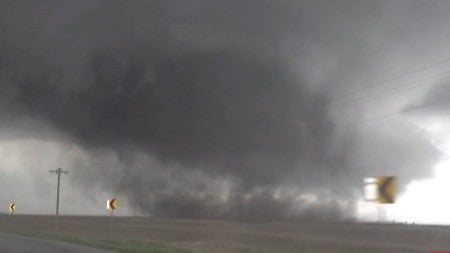
"Timmy Twister"...I love it!
Good morning, the atmosphere over E TX, LA and AR is ramping up this morning, it's going to be a very busy day. Folks get ready.
Well we all know the models see ghost systems all the time. When I get suspicious is when the GFS shows the same thing, at the same time (instead of 384 hours every single run) for dozens of runs in a row. And not only the GFS, but the other models seeing the potential as well. To ignore such a thing would not be wise. It started out with only the GFS, but if you recognize the overall pattern then you can either say "huh, it may be right" or "nah, it's out to lunch". In this case I thought it might be on to something during the first week of May, and sure enough the other models are seeing something too. Given the pattern, it actually would not be that surprising to have an EPAC storm 10-15 days before their season starts.
More on Timmy the Twister :0)
Link
Still shows the monster ridge that will be setting up over the Gulf of Mexico. Again, it really doesn't matter if we get tropical mischief in either ocean, but this pattern by itself is going to boil SSTs in the areas of the NW Caribbean and Gulf of Mexico that have been cold for months.
Viewing: 1 - 51
Page: 1 | 2 | 3 | 4 | 5 | 6 | 7 | 8 | 9 | 10 | 11 | 12 | 13 | 14 | 15 | 16 | 17 | 18 | 19 | 20 | 21 | 22 | 23 | 24 | 25 | 26 | 27 | 28 — Blog Index