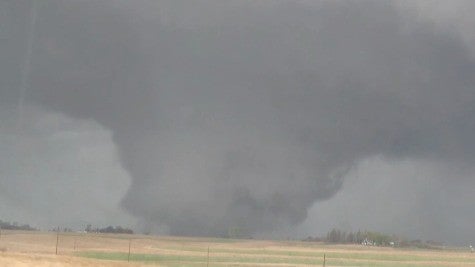
Large and intensifying Hurricane Alex bears down on northeastern Mexico, South Texas
Hurricane Alex continues to intensify as it slowly bears down on the coast of northeastern Mexico. Brownsville long-range radar shows the spiral bands of Alex, which has dumped heavy rains of up to four inches in northeastern Mexico and near Brownsville, according to satellite estimates of rainfall. The Brownsville airport received 0.78" of rain in the hour ending at 8am CDT, and 0.61" in the hour ending at 9am CDT. Floods from Alex have already killed ten people--six in Nicaragua, and two each in El Salvador and Guatemala.

Figure 1. Snapshot of the Brownsville long-range radar showing Hurricane Alex approaching the coast.
The 7:12am CDT eye penetration of the Hurricane Hunters found a central pressure of 959 mb, a modest 2 mb drop from the reading four hours previous to that. They noted a very tiny eye, ten miles in diameter, with a gap in the northwest side. Tiny eyes like this tend to be unstable, and in the 9:05am CDT eye penetration, the Hurricane Hunters found that the inner eyewall had collapsed, and the pressure had risen 2 mb, to 961 mb. A new, much larger eye will form today as the day progresses. During these "eyewall replacement cycles", a hurricane will typically weaken a few millibars , and the strongest winds will spread out over a larger area as the hurricane conserves angular momentum. Thus, the hurricane still has about the same amount of destructive power, it is just spread out over a larger area. This tends to increase the hurricane's storm surge, but lessens the wind damage, since the extreme winds of the inner eyewall are no longer present. Satellite loops show a large, well-organized storm with increasing amounts of low-level spiral bands forming, and improving upper-level outflow. Data from last night's flight of the NOAA jet showed an unusually moist atmosphere surrounds Alex, so dry air is no longer a problem for it. It's a good thing Alex has less than a day before making landfall, or else is would be a large and very powerful major hurricane.

Figure 2. Visible light image of Tropical Storm Alex taken at 19:35 UTC (2:35 pm CDT) on June 29, 2010, by NASA's Aqua satellite. At the time, Alex was a tropical storm with 70 mph winds. Image credit: NASA.
Storm Surge
Traditionally, a storm's ranking on the Saffir-Simpson Scale--the familiar Category 1, 2, 3, 4, 5 rankings we always talk about--have also been used to quantify storm surge threat. However, large, weaker storms that cover a huge area of the Gulf of Mexico, like Alex, can generate a larger storm surge than a smaller but more intense hurricane with a higher Saffir-Simpson rating. Thus, the National Hurricane Center has formally discontinued use of the Saffir-Simpson scale to characterize storm surge, and is studying the possibility of issuing separate Storm Surge Warnings a few years from now. These would be in addition to their traditional Hurricane Warnings. To give us a better idea of a storm's surge potential, Dr. Mark Powell of NOAA's Hurricane Research Division has developed the Integrated Kinetic Energy scale to rank storms. The scale ranges from 0 to 6, and a parallel wind damage scale that runs from 0 to 6 is also generated. Alex had an Integrated Kinetic Energy of 2.6 on the 0 to 6 scale at 1:30pm CDT yesterday, and its destructive potential rating for winds was just 1.2. Thus, Alex's surge ranked alomst one-and-a-half categories higher in destructive potential than its wind. These numbers have probably increased by a full category since yesterday afternoon. NHC is giving a 40% - 60% chance of a storm surge of at least 3 feet affecting the Brownsville area, and 10% - 30% chance the surge will exceed 5 feet. In theory, a Category 2 hurricane moving WNW at 5 mph can bring a storm surge of up to 8 - 9 feet to the South Texas and northern Mexican coast.
Other Impacts
Alex is bringing bands of heavy rain to the coasts of Texas and Mexico, as seen on the Brownsville, Texas radar. Hurricane local statements with projections for how Alex will affect the coast are now being issued by the National Weather Service in Brownsville and Corpus Christi. Flooding damage from the expected 6 - 12 inches of rain from Alex will be the main concern. Wind damage is a lesser concern, since the core of Alex is making landfall in a swampy, sparsely populated region of Mexico. The combined wind, surge, and flooding damage from Alex may be similar to 2008's Hurricane Dolly, which hit near Brownsville. Dolly was a Category 2 hurricane offshore that weakened to a Category 1 hurricane with 85 mph winds when it made landfall, and did about $1 billion in damage. Dolly also generated two weak EF-0 tornadoes, and Alex is capable of generating a few tornadoes as well, according to the latest discussion from NOAA's Storm Prediction Center. The atmosphere is moderately unstable, there is plenty of moisture, and wind shear at low levels has been increasing this morning. The greatest threat for tornadoes will occur late this afternoon, on the right side of where the storm makes landfall.
Alex in historical context
Alex is the first June hurricane since Hurricane Allison of 1995. Allison briefly became a minimal 75 mph hurricane before weakening and hitting the Florida Panhandle as a tropical storm. Alex is the strongest June hurricane since Hurricane Bonnie of 1986, which had 85 mph winds. Bonnie was the first hurricane I flew into as a member of the Hurricane Hunters. Bonnie made landfall along the upper Texas coast, and caused less than $20 million in damage. If Alex strengthens to 90 mph winds, it will be the strongest June hurricane since Hurricane Alma of 1966, which had 125 mph winds as it skirted the Florida Keys. There have been only ten hurricanes in May or June since 1945; only four of these were major Category 3 or higher storms.
Track forecast for Alex
All of the models take Alex to the west or west-northwest into northern Mexico by early Thursday morning. However, the steering currents are fairly weak, and Alex could stall and move erratically at times today. I don't anticipate that this weakness in the steering currents will allow Alex to move northward and make landfall in Texas. After landfall, the ridge of high pressure forcing Alex westward should remain in place and strengthen, keeping Alex's remnants over northern Mexico for several days.
Intensity forecast for Alex
Alex is over a region of ocean with moderately high total ocean heat content . Wind shear has fallen to a low 5 knots, and is projected by the SHIPS model to remain in the low range, below 10 knots, through landfall. The combination of low wind shear, moderately high ocean heat content, and plenty of moisture should allow Alex to continue to intensify today. Alex's pressure is already characteristic of a Category 3 hurricane, but the storm is so large that it is taking time for the winds to catch up to the pressure falls. It is unlikely that Alex's winds will be at Category 3 strength at landfall, since the storm is undergoing an eyewall replacement cycle, and does not have time to build a tight inner eyewall with strong winds before landfall. A Category 2 storm at landfall looks more likely.
Elsewhere in the tropics
The latest run of the NOGAPS model predicts the formation of a tropical disturbance in the Western Caribbean on Monday. None of the other models is showing anything brewing over the coming seven days.
Wind and ocean current forecast for the BP oil disaster
Alex is generating very rough conditions over the Deepwater Horizon blowout location, with 6 - 8 foot waves and 3 - 4 foot swells. Strong southeast to south winds of 15 - 25 knots will blow over the oil slick region today through Thursday, according to the latest marine forecast from NOAA. The resulting currents will push oil to many protected bays and estuaries that haven't seen oil yet. In addition, the 1 - 2 foot storm surge Alex is generating along the Louisiana coast will act to push oil deep into some low-lying marshlands. While this oil will be diluted some by the wave action, the impact of the oil and accompanying toxic dispersants on the marshlands is of concern. The latest trajectory forecasts from NOAA and the State of Louisiana show oil will also move westward along the central Louisiana coast towards the Texas border. Winds will decrease to 10 - 15 knots Friday through Monday but remain out of the southeast, keeping the pressure on the regions of coast in Louisiana, Alabama, and Mississippi that are seeing oil hit their shores this week.
Resources for the BP oil disaster
Map of oil spill location from the NOAA Satellite Services Division
My post, What a hurricane would do the Deepwater Horizon oil spill
My post on the Southwest Florida "Forbidden Zone" where surface oil will rarely go
My post on what oil might do to a hurricane
NOAA's interactive mapping tool to overlay wind and ocean current forecasts, oil locations, etc.
Gulf Oil Blog from the UGA Department of Marine Sciences
Oil Spill Academic Task Force
University of South Florida Ocean Circulation Group oil spill forecasts
ROFFS Deepwater Horizon page
Synthetic Aperture Radar (SAR) imagery from the University of Miami
Next post
Either Rob Carver or myself will do an update late this afternoon or this evening.
Jeff Masters
Weather inbound to Hurricane Alex.
Flight deck view from a WC-130J Hurricane Hunter aircraft
Reader Comments
Page: 1 | 2 | 3 | 4 | 5 | 6 | 7 | 8 | 9 | 10 | 11 | 12 | 13 | 14 | 15 | 16 | 17 | 18 | 19 | 20 | 21 | 22 | 23 | 24 | 25 | 26 | 27 | 28 | 29 | 30 | 31 | 32 | 33 | 34 | 35 | 36 | 37 | 38 | 39 | 40 | 41 | 42 | 43 | 44 | 45 | 46 | 47 | 48 | 49 | 50 | 51 | 52 | 53 | 54 | 55 | 56 | 57 | 58 | 59 | 60 | 61 — Blog Index
NOGAPS caught Alex when the ECMWF did. So we'll see.
If he's not, he should be.
Ahh, I see. It is an *inland* warning, not the same as the coastal warning. I'd be willing to bet the inland warnings are issued by your local weather forecast office and not the NHC.
The NOGAPS develops this system in around 96-120 hours, but the ECMWF shows it around 216-240hr...so I'm not thinking they are showing the same system.
no, just mexico
maybe, we should throw the models out.
It seems as though that's the common denomenator with the ECMWF. As odd as it is when the first runs come out... a week later it ends up doing what the ECMWF says it would do
Yep.
Other models ore forecasting a small cluster of thunderstorms that could potentially become an area of low pressure near the panhandle of Florida.
http://2.bp.blogspot.com/_ScGjBIDpW5c/TCncaUTdpAI/AAAAAAAABRs/6ODsm3fnAZo/s1600/gfs_ten_072l.gif
http://2.bp.blogspot.com/_ScGjBIDpW5c/TCncdFOGFVI/AAAAAAAABR0/OGceocFFtW8/s1600/gfs_85v_066l.gif
i´m out
558
WFUS54 KBRO 301802
TORBRO
TXC061-301845-
/O.NEW.KBRO.TO.W.0011.100630T1802Z-100630T1845Z/
BULLETIN - EAS ACTIVATION REQUESTED
TORNADO WARNING
NATIONAL WEATHER SERVICE BROWNSVILLE TX
102 PM CDT WED JUN 30 2010
THE NATIONAL WEATHER SERVICE IN BROWNSVILLE HAS ISSUED A
* TORNADO WARNING FOR...
CENTRAL CAMERON COUNTY IN DEEP SOUTH TEXAS.
* UNTIL 145 PM CDT
* AT 102 PM CDT...NATIONAL WEATHER SERVICE DOPPLER RADAR INDICATED A
TORNADO 18 MILES EAST OF PORT ISABEL...MOVING WEST AT 55 MPH.
* THE TORNADO WILL BE NEAR...
SOUTH PADRE ISLAND BY 115 PM CDT.
LAGUNA HEIGHTS BY 120 PM CDT.
HOLLY BEACH BY 125 PM CDT.
LA LEONA BY 135 PM CDT.
LOZANO BY 140 PM CDT.
SAN BENITO BY 145 PM CDT.
PRECAUTIONARY/PREPAREDNESS ACTIONS...
THIS IS A DANGEROUS STORM! MOVE INTO THE INTERIOR ROOM ON THE LOWEST
FLOOR OF A STURDY BUILDING...AWAY FROM WINDOWS. COVER YOUR HEAD AND
BODY WITH PILLOWS OR BLANKETS.
PLEASE REPORT TORNADOES OR FUNNEL CLOUDS...WINDS OF 58 MPH OR
HIGHER...AND ANY WIND DAMAGE TO YOUR NATIONAL WEATHER SERVICE IN
BROWNSVILLE BY CALLING 956-504-1432.
yea some will never understand
good point
Wow, rapid strengthening just in the past 90 minutes.
I expect a cat. 2 by 5 pm EDT.
And good thing, too. That eyewall is really sealing things up. Another day over water and this could be much nastier than it is (I know...duh, right?).
just to see if i can post this radar. its awsome. patrap you are right, how bout that radar
Hey, brother! How's things?
Thanks.
paltrap
after going thru so many storms since 1962 in la. i have only 1 thought for all those who think that theirr personal possions are more important than their lives is when the man sayss geet the hell out of dodge leave.i have seen it all in my 71+years and you might loosse personal things you cant loose your life.
thess storms weathe tropical/hurricanes are not something to take for granite.i have been thru btsy,cammile,ivan,andrew,katrina rita,gustav and so many otherss but imm still here and if i would have stayed i might not be posting this today.use common sense and leave all can be replaced except your life
PLEAse pay attention and do what tthe athurotties say to do at least you can come back
good luck to all
hamla
n11rg
rick
bay st louis ms
I dont know what youre looking at but "Going north" would not be the direction I would call it.... at best its going WNW right now.
just because convection lacks there, doesn't mean its from dry air, the hurricane just isn't producing any lift or convergence there.
Somehow I doubt a PW reading between 2.5 and 3.00 inches throughout the storm has anything to do with dry air... Thats about as much moisture the air can possibly hold...
I don't think the coast is particularly populated along there. As for flooding, both sides of the Rio Grande Valley could take it pretty hard.
I like the new one better.
I think that will be just about right
Fine stuff there from a Good source.
Memory..
Thanks for that.
We have a Home off of 90 right at Louise's Gift Shop near Blossman Gas.
So I can relate..
Betsy was my first eyewall dance,but I was a mere 5.5 then.
Looks like Alex will end up just slightly north of the edge of the cone of uncertainty.
They need to do a direct NW adjustment in their forecast, and pay less attention to the models and more on the rate of strengthening based on satellite imagery and radar! Anyone want to email the NHC?
Ju8st poked my head in for a minute to catch up from this morning. Why is the NHC track showing a SW movement before the WNW move to landfall? From what I've read in the last two pages of the blog, it appears that either that SW movement is already past or that the NHC was mistaken (which would alter the expected point of landfall). Fill me in, brudda.
It's going into a good area for landfall. Damage to property should be minimal.
Then you can follow along the learning cure..
Cuz a Blind Duck in Bangkok can easily see the dry air in the Systems envelope on the south side.
Viewing: 1051 - 1101
Page: 1 | 2 | 3 | 4 | 5 | 6 | 7 | 8 | 9 | 10 | 11 | 12 | 13 | 14 | 15 | 16 | 17 | 18 | 19 | 20 | 21 | 22 | 23 | 24 | 25 | 26 | 27 | 28 | 29 | 30 | 31 | 32 | 33 | 34 | 35 | 36 | 37 | 38 | 39 | 40 | 41 | 42 | 43 | 44 | 45 | 46 | 47 | 48 | 49 | 50 | 51 | 52 | 53 | 54 | 55 | 56 | 57 | 58 | 59 | 60 | 61 — Blog Index