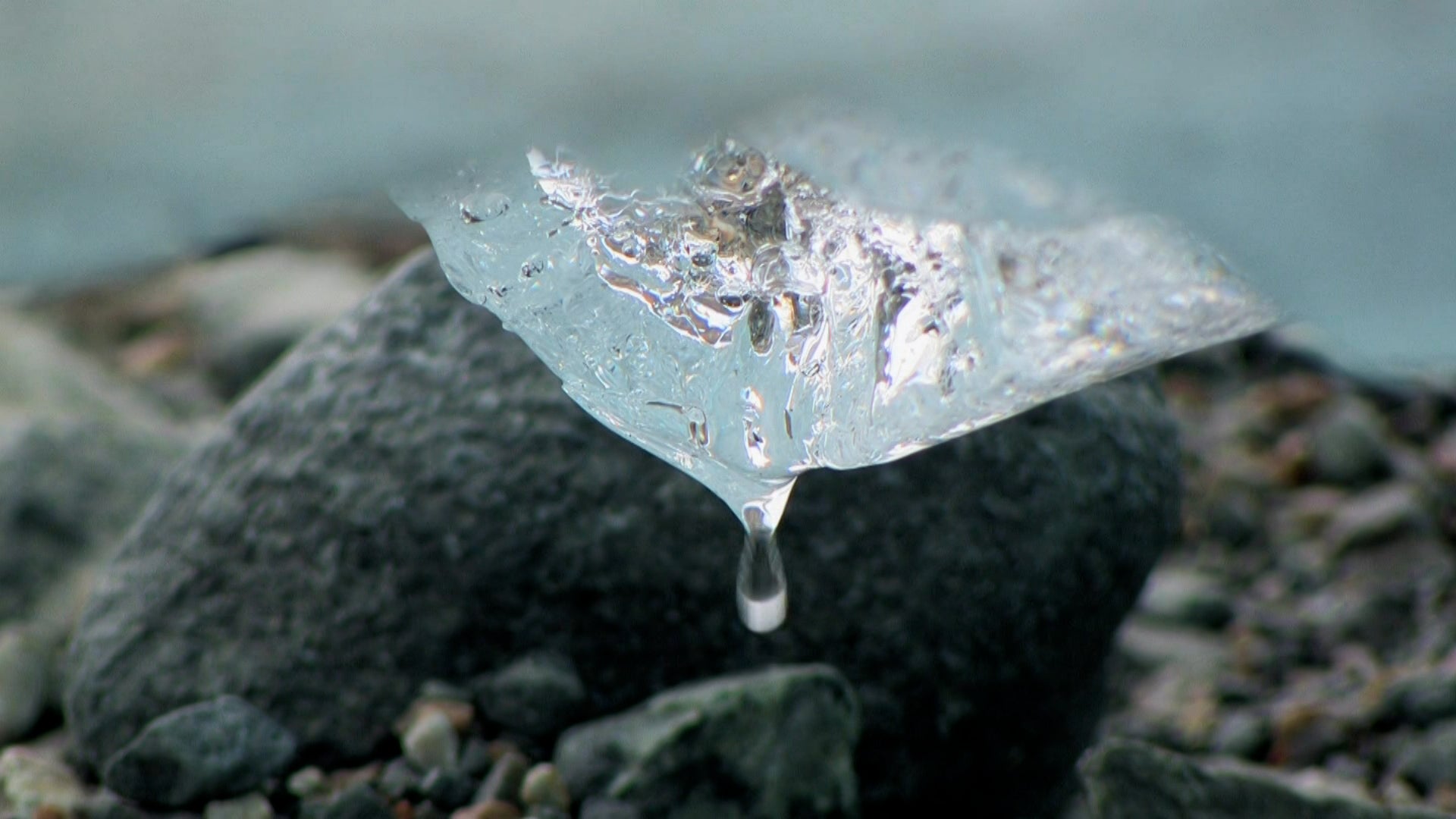
Greenland update for 2010: record melting and a massive calving event
No humans were present on the morning of August 4, 2010, in a remote fjord in Northwest Greenland, when the air vibrated with a thunderous crack as one of the largest icebergs in world history calved from the Petermann Glacier, the island's second largest ocean-terminating glacier. Where the glacier meets the sea, a 43 mile-long tongue of floating ice existed at the beginning of 2010. On August 4 2010, a quarter of this 43 mile-long tongue of floating ice fractured off, spawning a 100 square mile ice island four times the size of Manhattan, with a thickness half that of the Empire State building. According to Andreas Muenchow, associate professor of physical ocean science and engineering at the University of Delaware's College of Earth, Ocean, and Environment, the freshwater stored in this ice island could have kept the Delaware or Hudson rivers flowing for more than two years, or kept all U.S. public tap water flowing for 120 days. There was speculation that the ice island could find its way into the open Atlantic Ocean in two years, and potentially pose a threat to oil platforms and ships. However, as the ice island made its turn to get from the narrow Petermann Fjord to enter Nares Strait between Greenland and Canada, the mighty iceberg split into thousands of small icebergs that will not pose an unusual threat to shipping when they emerge into the Atlantic.

Figure 1. The 100 square-mile ice island that broke off the Petermann Glacier heads out of the Petermann Fjord in this image taken by NASA's Aqua satellite on August 21, 2010. Image credit: NASA. I've constructed a 7-frame satellite animation available here that shows the calving and break-up of the Petermann Glacier ice island. The animation begins on August 5, 2010, and ends on September 21, with images spaced about 8 days apart. The images were taken by NASA's Aqua and Terra satellites.
Petermann Glacier spawned smaller ice islands in 2001 (34 square miles) and in 2008 (10 square miles). In 2005, the Ayles Ice Shelf, about 60 miles to the west of Petermann Glacier, disintegrated and became a 34 square-mile ice island. The August 2010 Petermann Glacier calving event created the largest iceberg observed in the Arctic since 1962, when the Ward Hunt Ice Shelf on the north coast of Canada's Ellesmere Island calved off a massive 230 square mile chunk. The Ward Hunt Ice Shelf also calved off a huge 21 square mile ice island a few days after the August 2010 Petermann Glacier calving event. According to an article in livescience.com, "Driftwood and narwhal remains found along the Ellesmere coast have radiocarbon dates from roughly 3,000 to 6,800 years ago, implying that the ice has been intact since those remains were deposited." All of the these calving events are evidence that the ice sheets in the Arctic are responding as one would expect to significantly warmer temperatures.
Warmer ocean temperatures cause significant melting of Greenland's glaciers
At a talk last December at the world's largest conference on climate change, the American Geophysical Union (AGU) meeting in San Francisco, glacier expert Eric Rignot of UC-Irvine implicated ocean warming as a key reason for the calving of the Petermann Glacier's ice island. The ocean waters near the glacier have warmed by 1 - 2°C over the past three years, he said, and all of the periphery of Greenland has seen ocean heat increases in recent years, with the result that 20 - 80% of all the mass lost by Greenland's glaciers in recent years could be attributed to melting of the glaciers by warmer waters attacking them from beneath. Ocean temperatures along the southwest coast of Greenland (60N to 70N, 60W to 50W) computed from the UK Hadley Center data set during 2010 were 2.9°C (5.2°F) above average--a truly remarkable anomaly, and far warmer than the previous record of 1.5°C above average set in 2003. Sea surface temperature records for Greenland began in the 1920s. A study earlier this year published in the journal Science (Spielhagen et al., 2011) found that ocean temperatures on the east side of Greenland are now at their warmest levels in at least 2,000 years. The researchers studied a sediment core containing fossil remains of planktic foraminifers, which vary as a function of water temperature. The study noted that not only have the waters flowing northward on the east side of Greenland warmed significantly, the volume of water flowing north has also increased, resulting in a large transport of heat into the Arctic. "Such an increased heat input has far-reaching consequences," they wrote.

Figure 2. Departure of sea surface temperature from average for 2010 from the NOAA Daily Optimum Interpolation SST Anomaly data set for October 2010. Areas colored red are warmer than the 1971-2000 average, areas colored blue are cooler than that average. A large region of record warm water temperatures extended along the west coast of Greenland, leading to record warm air temperatures and record melting along the western portion of Greenland in 2010. Ocean temperatures along the southwest coast of Greenland (60N to 70N, 60W to 50W) computed from the UK Hadley Center data set during 2010 were 2.9°C (5.2°F) above average--a truly remarkable anomaly, surpassing the previous record of 1.5°C set in 2003. Sea surface temperature records for Greenland began in the 1920s. Image credit: NOAA Visualization Lab.
Record warmth and melting in Greenland during 2010
Greenland's climate in 2010 was marked by record-setting high air temperatures, the greatest ice loss by melting since accurate records began in 1958, and the greatest mass loss of ocean-terminating glaciers on record. That was the conclusion of the 2010 Arctic Report Card, a collaborative effort between NOAA and European Arctic experts that comes out each year. Was 2010 the warmest year in Greenland's history? That is difficult to judge. We know it was also very warm in the late 1920s and 1930s in Greenland, but we only have two stations, Godtahab Nuuk and Angmagssalik, with weather records that go back that far (Figure 3.) Godtahab Nuuk set a record high in 2010, but temperatures at Angmagssalik in 2010 were similar to what was observed during several years in the 1920s and 1930s. Marco Tedesco of the City College of New York's Cryosphere Processes Laboratory remarked that last year's record warmth and melting in Greenland began when an unusually early spring warm spell reduced and "aged" the snow on the surface of the ice sheet, so that the snow became less reflective, allowing it to absorb more heat from the sun. This accelerated snow melt even further, exposing the bare ice, which is less reflective than snow and absorbs more heat. This feedback loop extended Greenland's record melting season well into the fall.

Figure 3. Historic temperatures in Greenland for the six stations with at least 50 years of data, as archived by NASA. Three of the six stations set record highs in 2010. However, only two of the six stations (Godtahab Nuuk and Angmagssalik) have data going back beyond the 1930s, which was a period of warmth in Greenland similar to the warmth of the current decade. Godtahab Nuuk set a record high in 2010, but 2003 still ranks as Angmagssalik's hottest year on record.

Figure 4. The 2010 summer melt season was lasted more than 40 days longer (purple colors) than the mean melt season from 1979 - 2007. Image credit: Arctic Report Card.
Why Greenland matters: sea level rise
The major concern with a warming climate in Greenland is melting of the Greenland ice sheet, which currently contributes about 25% of the observed 3 mm/year (1.2 inches per decade) global rise in sea level. Higher sea levels mean increased storm surge inundation, coastal erosion, loss of low-lying land areas, and salt water contamination of underground drinking water supplies. Greenland ice mass loss is accelerating over the long term, according to independent estimates using three different techniques (Figure 5), with more mass being lost each year than the previous year. According to Rignot et al., 2011, ice mass loss is also accelerating in Antarctica, and "the magnitude of the acceleration suggests that ice sheets will be the dominant contributors to sea level rise in forthcoming decades, and will likely exceed the IPCC projections for the contribution of ice sheets to sea level rise in the 21st century." As I discussed in a 2009 blog post, How much will global sea level rise this century?, the IPCC in 2007 estimated that global sea level would rise 0.6 - 1.9 feet by 2100, but several studies since then predict a higher range of 1.6 - 6.6 feet.
During the warm period 125,000 years ago, before the most recent ice age, roughly half of the Greenland ice sheet melted. This melting plus the melting of other smaller Arctic ice fields is thought to have caused 7.2 - 11.2 feet (2.2 - 3.4 meters) of the 13 - 20 foot (4 - 6 meter) sea level rise observed during that period. Temperatures in Greenland are predicted to rise 3°C by 2100, to levels similar to 125,000 years ago. If this level of warming occurs, we can expect sea levels to rise 13 - 20 feet several centuries from now. There's enough water locked away in the ice sheet to raise sea level to rise 23 feet (7 meters), should the entire Greenland ice sheet melt.

Figure 5. Loss of mass from Greenland's ice sheet in gigatons per year from 1992 through 2009, as computed from satellite gravity measurements from the GRACE satellites (red line) and from a mass balance method. The mass balance method computes the amount of snow on the surface, the amount of ice mass lost to wind and melt, and the amount of ice lost computed from glacier velocity and ice thickness. Adding together these terms gives the total amount of ice lost or gained over the ice sheet. The acceleration is given in gigatons per year squared. Another paper by Zwally et al. (2011) used a third method, laser satellite altimetry, to determine Greenland mass loss. Between 2003 to 2007, the ice sheet lost 171 gigatons of mass per year. Between 1992 to 2002, Greenland was only losing only 7 gigatons per year. Image credit: Rignot et al., 2011, Geophysical Research Letters.
References
Rignot, E., et al., 2011: Acceleration of the contribution of the Greenland and Antarctic Ice Sheets to sea level rise, Geophysical Research Letters, in press, doi:10.1029/2011GL046583.
Spielhagen, et al., 2011, Enhanced Modern Heat Transfer to the Arctic by Warm Atlantic Water, Science 28 January 2011: Vol. 331 no. 6016 pp. 450-453 DOI: 10.1126/science.1197397
Zwally, J., et al., 2011, Greenland ice sheet mass balance: distribution of increased mass loss with climate warming; 2003 - 07 versus 19922 - 2002, Journal of Glaciology, Vol. 57, No. 201, 2011.
Wunderground's climate change section has a Greenland web page with detailed information and references.
Jeff Masters
Reader Comments
Page: 1 | 2 | 3 | 4 | 5 | 6 | 7 | 8 | 9 | 10 | 11 | 12 | 13 | 14 | 15 | 16 | 17 | 18 | 19 | 20 | 21 | 22 — Blog Index
Or degrees in Physics and Math?
Evening all.
While the term 'scorching' is frequently misused as hyperbolic descriptive by weathermen, the news media, and the public...
...actual scorching begins at temperatures from 110degreesCelsius/230degreesFarenheit (carmelization) to 154degreesC/309degreesF (MaillardReaction) depending on the material.
Frankly I don't know of any scientific authority who has predicted* an AnthropogenicGlobalWarming-induced temperature rise up to 110degreesC, let alone up to 154degreesC.
Perhaps you can cite one.
* Other than in a billion or so years as the Sun continues to heat up because of higher fusion rates due to core compression, which is irrelevant inregard to AGW.
BTW -- If the water vapor contained in the atmosphere were added to the oceans, it would increase the average height of sea level by ~2.5inches/63millimetres to ~5.5inches/139millimetres...
...depending on whether "about 1% of the atmosphere is composed of water vapor" is comparing the number of molecules (for the former) or comparing the mass of the molecules (for the latter)...
...and assuming the other numbers (mass of the atmosphere, mass of the ocean, average depth of the ocean) I've scavenged off the WWWeb are correct.
A launch malfunction sent the Glory satellite crashing into the ocean, almost exactly mimicking the 2009 loss of NASA's Orbiting Carbon Observatory
By John Matson | Friday, March 4, 2011 | 6
In the last few years NASA has built and launched two world-class climate satellites, both of which promised invaluable new data on the natural and human influences on Earth's changing climate. Neither of them, however, will ever deliver the data that climate scientists so eagerly expected from them. Both spacecraft, in fact, are at the bottom of the ocean, having succumbed to nearly identical rocket mishaps that prevented them from reaching orbit.
Link
Glory was to monitor the intensity of solar energy reaching Earth's upper atmosphere and to measure airborne atmospheric particles that affect how much of that energy reaches the surface. Those measurements would have reduced uncertainties in models that project future climate trends and helped to sort out how much climate influence man-made aerosols such as soot and smoke have compared with natural sources such as sea spray and airborne soil particles. "It would have made important measurements for the understanding of Earth as a system,"
There is no question that natural variation plays a part in periodic climate change. However, those climate changes happened due to something destabilizing (quite rapidly, relatively speaking) the existing climate. Planetary climate does not change just because it "feels like it". Nor do temperatures rise without the input and/or capture of additional energy.
Unless you can demonstrate another way in which temperatures can rise planet wide that is not attributable to the greenhouse effect, it's highly probable that the warming we are seeing is a result of anthropogenic causes.
Yes. And? No one has claimed that there can't be variations. Ocean circulations and weather patterns do shift from time to time, resulting in such occurrences.
Climate isn't about extremes, it's about averages. Weather can swing about wildly, and even periods as long as ten years are too noisy to draw much conclusion from.
The warming trend we are seeing now has been going on for many decades. This implies additional energy is being added to the system and is not being radiated off into space. At the very least, this should make people curious about why that's the case and what impacts such a change can have.
NASA has this to say about it:
A cold period that lasted from about A.D. 1550 to about A.D. 1850 in Europe, North America, and Asia. This period was marked by rapid expansion of mountain glaciers, especially in the Alps, Norway, Ireland, and Alaska. There were three maxima, beginning about 1650, about 1770, and 1850, each separated by slight warming intervals.
And again, the planet doesn't warm for no reason. The variation in solar energy is minimal, therefore something on the planet is acting to either trap or produce heat. Anything producing enough heat on the planet to cause the amount of warming we've seen would be quite noticeable, so that's out. Which means SOMETHING is trapping heat.
You do understand that there is a pretty big difference between how a weather model operates and how a climate model operates, right? Because this statement seems to indicate that you don't.
You can get real climate and ocean model source code online and see just how complex they are. The easiest ones to get started with are probably ModelE and MOM4. However, you're going to need some serious background to understand the math and physics involved. You'll also need some serious computing power if you want to run anything other the basic low res runs.
Now, if you can demonstrate that these models are worthless and make no worthwhile predictions, and build a solid enough case that you can get your research peer reviewed, I guarantee you'll win a Nobel Prize. However, these models have been used to make predictions and they have been pretty good at it if science journal articles are anything to go by, so you've got a pretty high mountain to climb in that regard.
Or in other words, any idiot on the web can dismiss anything anyone says. But when it comes to science, you've got to back up your claims. Opinions mean very little in the scientific community.
Indeed.
Gnight WU!
here is a vid for ya jf
That's a Special video to watch from time to time....
Hazelton BC
As far as PW values go, that is the general rule
There are days in the Florida wet season that have PW's that high. On those days, I have seen rainfall so heavy, you think your roof is going to cave in, it is truly incredible.
However, the average PW is between 1.9 and 2.10 inches during the wet season here.
Torrential rain has always been a very interesting part of meteorology, well every part is interesting to me, lol. But anyway, just the process in which it occurs is amazing, and not yet understood completely.
that front moving in to Central Florida will have plenty of PW to work with as well. However the problem here in Florida during the dry season usually isn't from lacking in moisture, contrary to what you might expect. The problem is, in the dry season, the dynamics, upper support, and forcing mechanisms needed for significant rain, usually miss the state. High PW does no good if there is nothing to squeeze it out.
Actually the only place possible is the subtropics this time of year.
We are paying 1.24 a litre.. I won't bore you with the math... but thats well over $4 a gallon.
3.79 litres per American Gallon.
"The topic of anthropogenic global warming has become so polarized it is now hard to talk about it without what amounts to name-calling entering into the discussion. In blogs, e-mails, and published opinion pieces, terms like “deniers” and “contrarians” are leveled in one direction while “warmist” and “alarmist” are leveled in the other. Both the scientific community and broader society have much to gain from respectful dialog among those of opposing views on climate change, but a reasonable discussion on the science is unlikely if we cannot find non-offensive terminology for those who have taken positions different than our own.
As Peggy Lemone mentioned in a Front Page post last week, some months ago, the CMOS Bulletin reprinted a paper originally published in the Proceeding of the National Academy of Sciences by Anderegg et al. that simply used the terms “convinced” and “unconvinced” to describe those who had been convinced by the evidence that anthropogenic climate change was occurring and those who had not been convinced. This terminology helps in a number of ways. First and foremost, it does not carry with it the baggage of value judgment, since for any particular scientific argument there is no intrinsically positive or negative connotation associated with being either convinced or unconvinced. In addition, this terminology highlights that we are talking about a scientific, evidence-based, issue that should be resolved through logical reasoning and not something that should be decided by our inherent belief system. (And for that reason, I work very hard to avoid saying someone does or does not “believe” in global warming, or similar phrases.)
The sense I have gotten is that those who do not feel that human influence is causing the global temperatures to rise would prefer to be called “skeptics.” However, I have tried to avoid using this term as a label for those individuals. Skepticism is a cornerstone upon which science is built. All of us who have been trained as scientists should be skeptics with respect to all scientific issues — demanding solid evidence for a hypothesis or claim before accepting it, and rejecting any position if the evidence makes it clear that it cannot be correct (even if it had, in the past, been well-accepted by the broader community).
I have seen some pretty egregious cases of individuals who call themselves climate change skeptics accepting claims that support their position with little or no documented evidence while summarily dismissing the results of carefully replicated studies that do not. On the other side, I have seen cases of climate scientists who have swept aside reasonable counter hypotheses as irrelevant, or even silly, without giving them proper consideration. Neither situation represents the way a truly skeptical scientist should behave. All of us in the community should expect better.
We will not be able to have substantive discussions on the many facets of climate change if we spend so much time and energy in name-calling. And we really need to have substantive discussion if we are going to serve the public in a reasonable way as a community. Thus, it is imperative that we find some terminology that allows a person’s position on climate change to be expressed without implied, assumed, or imposed value judgments.
There may be other neutral terms that can be applied to those engaged in the climate change discussion, but “convinced” and “unconvinced” are the best I have seen so far. I have adopted this terminology in the hope of reducing some of the polarization in the discussion."
What a simply outstanding statement by Dr. Seitter.
Agreed. Great statement by Dr.Seitter. I personally don't believe I have ever used the words "alarmist" or "warmist" here to describe anyone, but I have definitely been called a "denier", "denialist", "cyclist" and the like. Such words are guaranteed to start more arguments than worthwhile discussion. I certainly tire of seeing everyone skeptical of some of the statements made concerning AGW referred to in such ways regardless of the specifics of their beliefs.
Personally I have always stuck to the designations of "AGW skeptic" and "AGW proponent"; I would think nobody would be offended by these terms. I think "convinced" and "unconvinced" are great choices though. Somehow I doubt they would catch on with either side however.
Added: A lot can be said for trying to avoid using any single term to collectively refer to either group, as even among AGW skeptics (and AGW proponents) there seems to a lot of variations in the specifics of what is believed.
Good Night all...assuming anyone is still here.
More fodder for the fighting on this blog.
IT took Nature/God a few million years to convert (sequester) atmospheric CO2 via plants etc into Coal and Petroleum.
I see in a very unreliable news outlet that millions of years ago the CO2 in the air was quite a lot higher then it is now.
Geologist said they were analyzing very old rocks for there CO2 content versus new rocks. They also made comment that it was very warm (no ice on the plant to speak of) during that time frame when all the plants (plus a few dinosaurs) were growing, dying and accumulating to form the areas of the planet that are now coal and petroleum.
For the sake of argument (this blog would die with out it) that the sun has been outputting a stable, average energy level to the planet from the beginning (Genesis/Big Bang anyone?) and continues to do so to this day.
Now the obvious part…. Nature/God took millions of years to convert the CO2 into petroleum and coal……. It took Gods creation about 100 years to convert it back to CO2.
Let’s assume the Climate is a PID (proportional/ integral/differential) system (this might be a reach as only Nature/God seem to be controlling the terms of the PID loop, but hang in there).
Let’s also assume that the energy for this PID control system comes from the Sun (a constant) and that CO2 is the input stage of the system and world wide temperature is the output.
In process control a fast, large magnitude input change is called a step change. Millions of years of sequestering versus 100 years of releasing CO2; the part that Man does have a significant role in, qualifies as a step change.
Simple systems generally react quickly (proportional with out any I or D). The Climate is any thing but simple so it seems to be responding a bit slowly. However, any system no matter how complex when subject to a significant step change will respond with a change.
What we do not seem to know, is how much the change will be and how fast the change will be even though it seems kind of slow now.
Summary (every diatribe should end with a summary even if it is not really relevant to the main point):
• If any change is not a result of Mans activities, that means it is an act of God. God is good, so change (record rain fall-flooding, record hurricanes, record snowfall etc) is good, so most of the wealth in the world can remain sequestered by about 2% of the population.
• If the change is Mans doing, then change (record rain fall-flooding, record hurricanes, record snowfall etc) is bad, and we need to redistribute the wealth…..
Disclaimer, my point could have been made with out the nasty sarcasm, but were would the fun be in that, and it would be counter to the blog.
Dr.Seitter your statement was a definite dilution of angst (nicely done), but do not despair when human nature prevails.
It is late, and I am in a bad mood as I live by the RED RIVER of the NORTH.
Nooo that sucks
You are going about this ENTIRELY wrong. ANYONE who believes in the humans are insignificant argument, pay attention...
Look at it this way: Temperatures are clearly rising, SO SOMETHING MUST cause this rise. There is always a cause. If none of the other factors which affect our planets temperature are changing except one, then that one factor would be 100% responsible. NO MATTER how little a role it plays in temperature, if it is the only variable affecting our planets temp that is changing, it is 100% responsible.
What would cause a change? Either a change in solar input, a change in the amount of trapping, or a new, massive heat source here on earth.
It's been shown many times solar input is not increasing and there are no new significant sources of heat (except maybe urbanization which IS man made anyway).
This leaves only the trapping argument. (And urban heart effect, but thats also man made warming)
I agree with Dr. Seitter's call for less polarization on the climate change issue--but a simple change in nomenclature won't accomplish that task, I don't think.
Seitter's correct about those who use the word "skeptic"; all scientists--and science-minded people--should be skeptical. That's how science moves forward. But in his words, "I have seen some pretty egregious cases of individuals who call themselves climate change skeptics accepting claims that support their position with little or no documented evidence while summarily dismissing the results of carefully replicated studies that do not." So there's that.
He also goes on to say, "I have seen cases of climate scientists who have swept aside reasonable counter hypotheses as irrelevant, or even silly, without giving them proper consideration." Perhaps because I affiliate myself with that second group I may be biased, but in my experience of studying and writing about climate science, what the "unconvinced" consider "reasonable counter hypotheses" and what I do are two very different things. That is, saying that NASA, NOAA, and the UK Met office are run by incompetent and possibly evil nitwits whose degrees and experience mean absolutely nothing isn't a "reasonable counter hypothesis". Claiming that all the evidence of a warming planet is false, phony, fake, misinterpreted, and manipulated isn't a "reasonable counter hypothesis", either. Neither is saying that some deity will magically stop us from harming either the planet he or she made, or us, the creatures crawling upon it.
No, a "reasonable counter hypothesis" would explain that the planet isn't warming, and why it isn't; it would explain how the rapidly rising CO2 levels are not affecting temperatures; it would explain how, despite the numerous markers indicating otherwise, that excess CO2 isn't from man's activities. I've not seen any such valid "reasonable counter hypothesis". Only endless obsessions with "algore", and endless talk of the ranks of greedy climate scientists enriching themselves off their lush government grants, and endless rehashings of many-times-debunked pseudoscience and wishful thinking, and endless obfuscation put out by people who stand to gain hundreds of billions of dollars more by effectively delaying any and all mitigation efforts.
So far as Seitter's own suggestion of using the labels "convinced" and "unconvinced", I'm not at all sure those are much better or different than what we have now. Calling a person "convinced" implies that they've bought into the theory lock, stock, and barrel, and absoluteyly nothing could ever possibly sway them. That's definitely not me, nor most of the AGWT adherents I know. "Unconvinced", on the other hand, isn't much different than "skeptic", as it still allows folks to simply use the same arguments as always, though wrapped in a newer piece of paper. I'm not sure where the benefit would lie, then, though if Seitter and others want to use them, of course they would work just as well as anything now used.
Seitter's correct that "a reasonable discussion on the science is unlikely if we cannot find non-offensive terminology for those who have taken positions different than our own." But as with any sharply divided issue, it's only natural--if not healthy--that polarization occurs. And with such polarization, offense is, sadly, bound to occur. That's just how we humans are.
----------
Musings of a Saturday morning. As always, feel free to ignore.
Interesting feature you pointed out. Imagine how insane it would be to get Sub-Tropical Storm Arlene in March?
Wind shear is pretty high though. But that would be amazing!
There was a Category 2 hurricane in the Caribbean once in March 1908.
If that happened again we'd all be sitting here with our mouths wide open in shock. I think even Levi and Dr. Masters would be completely baffled.
Also, this month I'd keep an eye for something to pop up in the South Atlantic. March tends to be the prime month for storms as both Catarina and Anita formed in March.
I'd like to see this cat2 on satellite,but it's 1908...
March 6 12 UTC 23.8N 60.2W -- deg -- mph -- kph 60 mph 95 kph -- mb Tropical Storm
March 6 18 UTC 22.7N 60.7W 205 deg 12 mph 20 kph 65 mph 100 kph -- mb Tropical Storm
March 7 0 UTC 21.6N 61.1W 200 deg 12 mph 20 kph 75 mph 120 kph -- mb Hurricane - Category 1
March 7 6 UTC 20.6N 61.5W 200 deg 11 mph 18 kph 80 mph 130 kph -- mb Hurricane - Category 1
March 7 12 UTC 19.7N 61.9W 205 deg 10 mph 16 kph 90 mph 150 kph -- mb Hurricane - Category 1
March 7 18 UTC 18.8N 62.2W 195 deg 10 mph 16 kph 100 mph 160 kph -- mb Hurricane - Category 2
March 8 0 UTC 18.0N 62.5W 200 deg 9 mph 14 kph 100 mph 160 kph -- mb Hurricane - Category 2
March 8 6 UTC 17.3N 62.8W 200 deg 8 mph 12 kph 80 mph 130 kph -- mb Hurricane - Category 1
March 8 12 UTC 16.6N 63.1W 200 deg 8 mph 12 kph 75 mph 120 kph -- mb Hurricane - Category 1
March 8 18 UTC 16.0N 63.4W 205 deg 6 mph 11 kph 75 mph 120 kph -- mb Hurricane - Category 1
March 9 0 UTC 15.4N 63.7W 205 deg 6 mph 11 kph 75 mph 120 kph -- mb Hurricane - Category 1
March 9 6 UTC 14.9N 64.0W 210 deg 5 mph 9 kph 60 mph 95 kph -- mb Tropical Storm
March 9 12 UTC 14.4N 64.2W 200 deg 5 mph 9 kph 45 mph 75 kph -- mb Tropical Storm
March 9 18 UTC 13.8N 64.6W 215 deg 8 mph 12 kph 40 mph 65 kph -- mb Tropical Storm
Thank you for post 366 - it sometimes does need reinforcing that we, and only we, can save our planet from..... ourselves.
Able in 1951 actually obtained major hurricane status in the month of May!
It can't be. It wasn't. And nobody said it was. Dr. Masters wrote, "The August 2010 Petermann Glacier calving event created the largest iceberg observed in the Arctic since 1962."
"Since 1962". Not "in earth history".
Viewing: 351 - 401
Page: 1 | 2 | 3 | 4 | 5 | 6 | 7 | 8 | 9 | 10 | 11 | 12 | 13 | 14 | 15 | 16 | 17 | 18 | 19 | 20 | 21 | 22 — Blog Index