An early start to hurricane season?
The Atlantic hurricane season officially begins on Wednesday, June 1, but the Caribbean is already showing signs of the change of seasons. Moisture and heavy thunderstorm activity have increased in the region between Central America and Jamaica in recent days, and rainfall amounts of 1 - 2 inches have been common over the past three days over Cuba, Hispaniola, and much of Central America. The subtropical jet stream has been bringing high wind shear of 30 - 50 knots over the Caribbean the past week, but this shear has fallen to 20 - 40 knots this morning, and is predicted to fall below 20 knots by Thursday. All of the computer models predict that an area of low pressure will form in the region between Jamaica and Honduras by Thursday. This low will have the potential to develop into a tropical depression late this week. There is some dry air over the Western Caribbean near Mexico's Yucatan Peninsula that may retard the process, but a surge of moisture accompanying a tropical wave currently passing through the Lesser Antilles may counteract this, when the wave arrives in the Western Caribbean on Thursday. Water temperatures in the Central Caribbean are about 1°C above average, 29°C, which is plenty warm enough to support development of a tropical storm. Some recent runs of the NOGPAS model have predicted development of a tropical depression by late this week, potentially affecting Jamaica and Eastern Cuba. The other models have not been as gung-ho, but have been showing the potential for a strong tropical disturbance with very heavy rains forming late this week. In any case, residents of Jamaica, Cuba, the Cayman Islands, Haiti, Honduras, and Nicaragua should anticipate the possibility that heavy rains of 2 - 4 inches may affect them Thursday through Saturday this week.

Figure 1. Total precipitable water (a measure of how much rain would fall if we condensed all the water vapor present) for May 31, 2011 at 7am EDT. Plentiful water vapor in the SW Caribbean would create about 2 inches of rain (50 mm, orange colors) if it were all condensed out. Image credit: University of Wisconsin CIMSS.
Receipt did not travel 525 miles from Joplin tornado
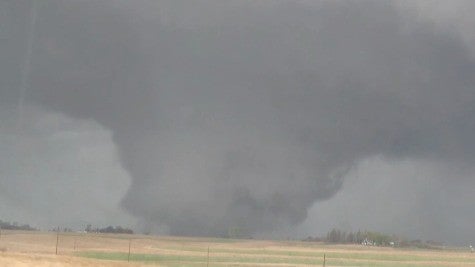
The May 22 EF-5 tornado that struck Joplin, Missouri did not set a new record for longest transport of debris by a tornado. According to MSNBC, a couple living in Royal Center, Indiana, in North Central Indiana, 525 miles from Joplin, found a receipt from the Joplin Tire store three days after the tornado hit Joplin. However, a press release from Purdue University clarified that the receipt did not arrive via the tornado, but had been left behind by a relative that had visited Joplin before the tornado. The longest distance recorded for debris from a storm was a cancelled check that traveled 210 miles after the 1915 tornado in Great Bend, Kansas.
The death toll from the May 22, 2011 tornado in Joplin, Missouri is 139, although there is still considerable uncertainty about this number. The Joplin tornado is the 8th deadliest in U.S. history, and the most deadly since the 1947 Woodward, Oklahoma twister that killed 181 people. The tornado season of 2011 now has approximately 520 deaths, which would make it the deadliest tornado season since 1936, according to statistics compiled by NOAA. In the 1936 tornado season 552 people died, mostly because of violent tornadoes that hit Tupelo Mississippi (216 killed), and Gainesville, Georgia (203 killed.)

Figure 2. Satellite image taken at 23:45 UTC (7:45pm EDT) May 22, 2011, showing the line of tornadic thunderstorms that spawned the Joplin tornado. Image credit: NOAA Visualization Laboratory.
Jeff Masters
Reader Comments
Page: 1 | 2 | 3 | 4 | 5 | 6 | 7 | 8 | 9 | 10 | 11 | 12 | 13 | 14 | 15 | 16 | 17 | 18 | 19 | 20 | 21 | 22 | 23 | 24 | 25 | 26 | 27 | 28 | 29 | 30 | 31 | 32 | 33 | 34 | 35 | 36 | 37 | 38 | 39 | 40 | 41 | 42 | 43 | 44 — Blog Index
Vorticity is on the rise near the surface... Not to mention ive taken a look at the shear tendency maps, and the Sub tropical Jet is on its move to the North now, Upper Low is now West of Florida, in the eastern gulf...
Good to see that everyone is having fun with this blobby-thingy.
Sharpen your skills, guys.
We going to need them this season, I do believe...
It has stopped raining here.....
I still feel Thursday is a good bet for when this starts to deepen, if it's going to. It looks a little better than I thought it would already, but we will see. It could also not strengthen at all.
Kinda like they did with Ex-Agatha last year in the Caribbean.
you are seeing things, while the area is slowly getting better organized; it is not close to TD status yet
That would be a mid-level vortex betrayed by the cirrus clouds of a dying thunderstorm complex. They are very common but mean almost nothing. If you want surface circulation, look closer to 12.5N, 82W. That's where it should be trying to develop if it is there.
Mostly just Arlene (from the Caribbean AOI) but not Bret. That NC Blob is interesting, but it's not going to form into anything. It's still connected to the cold front, and the NHC won't say anything if it's still connected. This thing'll be zipped off by the next trough that comes through. Doesn't stand a chance. I like watching those little things though.
Hi Ben, I seem to remember you were predicting this blob about 2 months ago whilst we were discussing the other thing forming in the south west Caribbean.
Or was that 'another blob' that hasn't got here yet, or got diverted to another zone?
Let me try to explain. When deciphering visible satellite imagery, it's imperative to look at the type of cloud that you are looking at. Notice the milky, almost semitransparent look to the clouds where your area of rotation is. Yes there is rotation, but the clouds that are rotating are mid- high-level cirrus and altostratus. That, combined with the fact that there was a strong convective burst there this morning, point to the conclusion that it is a mid-level vortex left over from that convective complex. Such features weaken with time and rarely have any baring at all on the system's surface organization.
So Maybe,Just Maybe, we could see to cyclones form, but right now, not likely, and not to mention if the Carolina Blob were to form, it would be a competitive race between the two areas to see who gets the Title Tropical Depression One...
Carolina Blob: 25% Chance of Formation in the next 48 Hours, before hitting land...
SW Caribbean Low: 60% Chance of Formation in the next 48 hours...
Blob? IDK, I remember predicting something forming in Late May well off The Carolinas but not this blob. Anyways I still think the SW Caribbean disturbance is now much more likely to form and be a concern for multiple land masses but still like cyclonekid said, it's a rather interesting feature.
Hello pottery
Yes it has for now,more showers showing on radar.
1.7 inches here today.
I agree...It has become a lot more organized than I expected it to at this time.
Development by tomorrow: Near 0%
Development by Thursday: 10%
Development by Friday: 30%
Development by Saturday: 50%
Development by Sunday: 50%
Development by Monday: 70%
We also discussed keeping a ''note book'' to remember predictions.
Anyway you were very close to the 'End of May!'
I think the lower one in the Caribbean has a very good chance of getting a name but sometimes I think too much.
whoa...intense. :P
Well, in theory, yes, but the reality is that the convection has found a sweet pocket of upper divergence immediately south of the jet core, and it's hard for low pressure to compete to the southeast so close to the Columbian Heat Low in the afternoons as well.
My personal interpretation of the visible imagery indicates to me that any cyclonic turning of the winds at the surface is attempting to occur farther west near 82W. There is also the new westerly wind at San Andres to consider, though we will have to see if that continues.
Evidence #1:
Anticyclone over the low, Allowing the shear to be low enough...(Carolina Blob)
Evidence #2:
Decent Vorticity Within the low:
Evidence #3:
Convection still firing, even though it has dry air around the West, South, and Southeastern Sides:(don't have pic but have link for)
Water Vapor
Rainbow IR
Visible
Pretty Good, but it needs to keep it up in order to get any kind of attention from the NHC.
yuppers
Hi!!
Was in Brasso Seco last night, and put an enamel mug out in the rain at about 7:oopm.
This morning at 6:00 it was overflowing bigtime.
It's 3.8" deep, the mug!!
Rained all night up there, sometimes Torrential.
Real nice.
I'd be a lot more concerned about development if it had more time over the Gulf Stream.
The ONLY storm to "officially" make landfall in Texas after having crossed Florida. :)
BEGIN
NHC_ATCF
invest_al932011.invest
FSTDA
R
U
040
010
0000
201106010042
NONE
NOTIFY=ATRP
END
INVEST, AL, L, , , , , 93, 2011, DB, O, 2011060100, 9999999999, , , , , , METWATCH, , AL932011
AL, 93, 2011053100, , BEST, 0, 387N, 699W, 20, 1018, DB, 0, , 0, 0, 0, 0,
AL, 93, 2011053106, , BEST, 0, 373N, 702W, 20, 1018, DB, 0, , 0, 0, 0, 0,
AL, 93, 2011053112, , BEST, 0, 355N, 707W, 25, 1017, DB, 0, , 0, 0, 0, 0,
AL, 93, 2011053118, , BEST, 0, 342N, 721W, 25, 1017, DB, 0, , 0, 0, 0, 0,
AL, 93, 2011060100, , BEST, 0, 330N, 732W, 25, 1017, DB, 0, , 0, 0, 0, 0,
93L is here?
Awesome!
Tomorrow: 10% / Tomorrow Night: 10%
Thursday: 40% / Thursday Night: 60%
Friday: 70% / Friday Night: 80%
Saturday: 70% / Saturday Night: 70%
Sunday: 60% / Sunday Night: 70%
Monday: 60% / Monday Night: 60%
Tuesday: 50% / Tuesday Night: 40%
And here..... we.... go.
Viewing: 1101 - 1151
Page: 1 | 2 | 3 | 4 | 5 | 6 | 7 | 8 | 9 | 10 | 11 | 12 | 13 | 14 | 15 | 16 | 17 | 18 | 19 | 20 | 21 | 22 | 23 | 24 | 25 | 26 | 27 | 28 | 29 | 30 | 31 | 32 | 33 | 34 | 35 | 36 | 37 | 38 | 39 | 40 | 41 | 42 | 43 | 44 — Blog Index