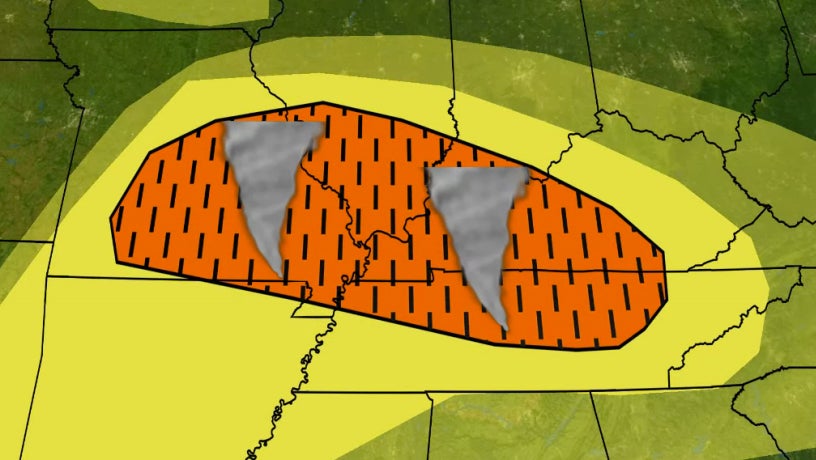
Caribbean disturbance slow to develop; 5 EF-5 tornadoes this year confirmed
The tropical disturbance (Invest 93L) that crossed over Florida on Wednesday, bringing welcome rains of 1 - 3 inches, is now a naked swirl of low clouds over the central Gulf of Mexico. The disturbance is embedded in a large area of dry air associated with an upper level low pressure system, and this dry air is discouraging development. 93L is also moving into a region of moderate wind shear of 10 - 20 knots, and NHC is giving 93L a 0% chance of developing into a tropical depression before the storm makes landfall in Mexico south of Brownsville on Saturday. There are a few heavy thunderstorms trying to fire up near the center of 93L's fairly well-formed circulation, but I don't think this storm is going to bring more than 1 - 2 inches of rain to the coast on Saturday.

Figure 1. Morning satellite image of the Central Caribbean disturbance.
Central Caribbean disturbance 94L
Disorganized heavy thunderstorm activity continues in the region between Central America and Jamaica. Wind shear has fallen to the moderate range, 10 - 20 knots, and is predicted to continue to fall over the next two days. This should allow the disturbance, dubbed Invest 94L by NHC on Friday afternoon, to increase in organization, though it will take many days for it to approach tropical depression status, since it is so large and poorly organized. The last two runs of the NOGAPS model have developed the disturbance into a tropical depression or storm by early next week, with the system moving northwards into Jamaica, the Cayman Islands, and eastern Cuba. The other major models do not show the disturbance developing during the coming week. NHC is giving the disturbance a 10% of developing into a tropical depression by Sunday. A surge of moisture accompanying a tropical wave may aid development when the wave arrives in the Western Caribbean on Sunday. Water temperatures in the Central Caribbean are about 1°C above average, 29°C, which is plenty warm enough to support development of a tropical storm. Residents of Jamaica, eastern Cuba, the Cayman Islands, Haiti, and the Dominican Republic should anticipate the possibility that heavy rains of 2 - 4 inches may affect them today through Sunday.
Five EF-5 tornadoes confirmed in 2011
The National Weather Service in Oklahoma City announced Wednesday that the violent tornado that hit Binger, El Reno, Peidmont, and Guthrie, Oklahoma on May 24, killing nine people, was an EF-5 with winds greater than 210 mph. The rating was given based on measurements made by a University of Oklahoma portable "Doppler on wheels" radar. The long track, large wedge tornado caused extensive damage, with well built houses cleanly swept from their foundation and trees debarked. This tornado brings the total number of EF-5 tornadoes this year to five, tying 2011 with 1953 for 2nd place for greatest number of these top-end tornadoes in one year. Only 1974 (six) had more. The EF-5 tornadoes of 2011:
1) The April 27, 2011 Neshoba/Kemper/Winston/Noxubee Counties, Mississippi tornado (3 killed, 29 mile path length.)
2) The April 27, 2011 Smithville, Mississippi tornado (22 killed, 15 mile path length.)
3) The April 27, 2011 Hackleburg, Alabama tornado (71 killed, 25 mile path length.)
4) The May 22, 2011 Joplin Missouri tornado (138 killed, 14 mile path length.)
5) The May 24, 2011 Binger-El Reno-Peidmont-Guthrie, Oklahoma tornado. (9 killed, 75 mile path length.)

Figure 2. Aerial view of damage from the May 22, 2011 Joplin, Missouri tornado. Image credit: Wikipedia.
A few other remarkable statistics on the tornado season of 2011, compiled from NOAA's official press release and Wikipedia's excellent tornado pages:
- The April 25 - 28 tornado outbreak, with 330 tornadoes, was the largest tornado outbreak of three days or less duration on record. The previous record was 148 tornadoes, set during the April 3 - 4, 1974 Super Outbreak.
- For April 27, 186 tornadoes have been confirmed. This is the largest 1-day tornado total on record, beating the 148 recorded in 24 hours on April 3 - 4, 1974.
- The April 14 - 16 tornado outbreak, with 162 confirmed tornadoes, ranks as the fourth largest tornado outbreak of three days or less duration on record.
- The May 21 - 26 tornado outbreak, with 158 confirmed tornadoes, ranks as the 5th largest 6-day or shorter tornado outbreak on record. A May 2003 6-day outbreak had 289 tornadoes, and a May 2004 6-day outbreak had 229 tornadoes. The year 2011 now has three of the top five tornado outbreaks on record.
- April confirmed tornado total was 683, making it the busiest tornado month on record. The previous record was 542 tornadoes, set in May 2003. The previous April record was 267 tornadoes, which occurred in April 1974. The 30-year average for April tornadoes is 135.
- If the three deaths in Massachusetts from Wednesday's tornadoes are confirmed, this year's tornado death toll will be 522, beating 1953 as the deadliest tornado year since modern tornado records began. That year, 519 people died, and three heavily populated cities received direct hits by violent tornadoes. Waco, Texas (114 killed), Flint, Michigan (115 killed), and Worcester, Massachusetts (90 killed) all were hit by violent F-4 or F-5 tornadoes. A similar bad tornado year occurred in 1936, when violent tornadoes hit Tupelo Mississippi (216 killed), and Gainesville, Georgia (203 killed.) During that time period, the tornado death rate per million people was 60 - 70 times as great as in the year 2000 (Figure 4), implying that this year's tornadoes would have killed many thousands of people had we not had our modern tornado modern warning system.
- The May 22, 2011 Joplin, Missouri tornado killed 138 people and injured 1150, making it the deadliest U.S. tornado since 1947, and 8th deadliest in history. The $1 - $3 billion estimate of insured damage makes it the most expensive tornado in history.
- Damage from the April 25 - 28 super tornado outbreak was estimated at $3.5 - $6 billion, making it the most expensive tornado outbreak of all-time.
- The tornado that hit Springfield, Massachusetts on June 1 was at least an EF-3 with 136 - 165 mph winds. It was only the 9th EF-3 or stronger tornado to hit Massachusetts since 1950, and the third deadliest, with three deaths.
- The year 2011 now ranks in 3rd place behind 1974 and 1965 for highest number of strong to violent EF-3, EF-4, and EF-5 tornadoes (Figure 3.)

Figure 3. Number of strong to violent EF-3, EF-4 and EF-5 tornadoes from 1950 to 2011. The year 2011 now ranks in 3rd place behind 1974 and 1965. There is not a decades-long increasing trend in the numbers of these most dangerous of tornadoes. Image credit: NOAA/National Climatic Data Center (updated using stats for 2008 - 2011 from Wikipedia.)

Figure 4. Death rate per million people per year in U.S., 1875-2000. Thin line with dots is raw rate, curved thick line is death rate, filtered by 3-point median and 5-point running mean filter, and straight solid lines are least squares fit to filtered death rate for 1875-1925 and 1925-2000. Dashed lines are estimates of 10th and 90th percentile death rates from 1925-2000. The death rate fell from 8 per million to .12 per million between 1940 and 2000. Image credit: A Brief History of Deaths from Tornadoes in the United States, Harold Brooks and Charles Doswell III.
Joplin tornado the 7th U.S. billion-dollar weather disaster of 2011
The Joplin tornado is the 7th U.S. weather disaster of 2011 costing more than a billion dollars. With a major flooding disaster coming on the Missouri River, and hurricane season still to come, 2011 has an excellent chance of beating 2008's record of nine billion-dollar weather disasters. The billion dollar weather disasters of 2011 so far:
1) 2011 Groundhog Day's blizzard ($1- $4 billion)
2) April 3 -5 Southeast U.S. severe weather outbreak ($2 billion)
3) April 8 - 11 severe weather outbreak ($2.25 billion)
4) April 25 - 28 super tornado outbreak ($3.5 - $6 billion)
5) Mississippi River flood of 2011 ($9 billion)
6) Texas drought ($1.2 billion)
7) Joplin tornado ($1 - $3 billion)

Figure 5. River flood outlook for the U.S. Image credit: NOAA.
The next U.S. billion-dollar weather disaster: a Missouri River flood?
A great 100-year flood has arrived along the Missouri River and its tributaries from Montana to Nebraska. Record spring rains, combined with snow melt from record or near-record winter and spring snows, brought the Missouri River at Williston, North Dakota to 27.9' yesterday, just an inch short of the highest crest on record (28.0' on 4/01/1912.) Tributaries to the Missouri, such as the Souris River in North Dakota and the North Platte River in Nebraska, are already flooding at all-time record heights. With warm summer temperatures and additional rainfall expected over much of the area during the coming week, snow melt and rain runoff will swell area rivers even further, creating a damaging 100-year flood. Wunderground weather historian Christopher C. Burt has the details in his latest post, and I will be writing more on this latest epic flood next week.
I'll have a new post on Monday, or earlier if the Caribbean disturbance shows significant development.
Jeff Masters
Here it is turning into a monster.
Reader Comments
Page: 1 | 2 | 3 | 4 | 5 | 6 | 7 | 8 | 9 | 10 | 11 | 12 | 13 | 14 | 15 | 16 | 17 | 18 | 19 | 20 | 21 | 22 | 23 | 24 | 25 | 26 | 27 | 28 | 29 | 30 | 31 | 32 | 33 | 34 | 35 | 36 | 37 | 38 | 39 | 40 | 41 | 42 | 43 | 44 | 45 | 46 | 47 | 48 | 49 | 50 | 51 | 52 | 53 | 54 | 55 | 56 | 57 | 58 | 59 | 60 | 61 | 62 | 63 | 64 | 65 | 66 | 67 | 68 | 69 | 70 | 71 | 72 | 73 | 74 | 75 — Blog Index
...GULF COAST STATES...
A MODERATELY TO STRONGLY UNSTABLE AIR MASS WILL LIKELY BE IN PLACE
AGAIN ACROSS THE REGION ON SATURDAY. AS TEMPERATURES WARM WELL INTO
THE 90S...A FEW THUNDERSTORM ARE EXPECTED TO DEVELOP FROM THE FL
PANHANDLE WWD INTO FAR ERN TX. THE COMBINATION OF STEEP LOW-LEVEL
LAPSE RATES...STRONG INSTABILITY AND WEAK SHEAR WILL BE FAVORABLE
FOR ISOLATED MICROBURSTS AND SOME SEVERE HAIL...MAINLY BETWEEN
20-02Z.
..IMY/COHEN.. 06/04/2011
Link
Would be nice to get that rain. It always seems to stop at the TX border. Except for the severe weather NE TX has gotten. Fingers crossed though. :)
Wonder why they didnt run the 6z models on the last night?
I understand, we should be getting those afternoon showers with are humitity combined with the heat hope that gets started soon.
MESOSCALE DISCUSSION 1084
NWS STORM PREDICTION CENTER NORMAN OK
0419 AM CDT SAT JUN 04 2011
AREAS AFFECTED...N CNTRL INTO NERN IA
CONCERNING...SEVERE POTENTIAL...WATCH POSSIBLE
VALID 040919Z - 041115Z
A SEVERE THREAT WILL EXIST ALONG A NARROW CORRIDOR MAINLY OVER NRN
AND NERN IA EARLY THIS MORNING. IF STORMS GROW UPSCALE...THEN THE
THREAT COULD EXPAND INTO SERN MN AND SWRN WI. IN SUCH A CASE...A
SMALL WATCH COULD BE REQUIRED.
A LONE STORM CONTINUES TO MOVE ENEWD JUST N OF THE SURFACE COLD
FRONT AND NEAR THE 850 MB FRONT AT AROUND 45 KT. WITH DEEP LAYER
SWLY FLOW ORIENTED ROUGHLY PARALLEL TO THE BOUNDARY...AND READY
ACCESS TO WARM SECTOR INSTABILITY...THIS STORM IS LIKELY TO PERSIST
IN A FORWARD PROPAGATING MANNER...WITH LOCALLY STRONG TO SEVERE
WINDS.
..JEWELL.. 06/04/2011
HYDROLOGIC OUTLOOK
NATIONAL WEATHER SERVICE SAN JUAN PR
329 AM AST SAT JUN 4 2011
...THE POTENTIAL FOR PERIODS OF HEAVY RAINFALL MONDAY AND TUESDAY
INCREASES THE RISK FOR SIGNIFICANT FLOODING...
A PERSISTENT LOW IN THE WEST CENTRAL CARIBBEAN IS KEEPING VERY
DEEP MOISTURE OVER THE AREA. TROUGHING WILL EXTEND NORTHEAST OF
THIS AND OVER HISPANIOLA...KEEPING AREAS OF HIGH HUMIDITY OVER
PUERTO RICO...AND THE U.S. VIRGIN ISLANDS. A DEEP POLAR TROUGH
DIGGING INTO THE WESTERN ATLANTIC WILL SUSTAIN GOOD VERTICAL LIFT
OVER THE LOCAL AREA THAT WILL HELP TO GENERATE AREAS OF HEAVY
RAINFALL NOW THROUGH WEDNESDAY. CURRENT INDICATIONS ARE THAT THE
HEAVIEST RAINS WILL OCCUR SATURDAY...MONDAY AND TUESDAY...WITH THE
MOST FLOODING LIKELY EARLY NEXT WEEK.
HYDROLOGICAL CONDITIONS ACROSS PUERTO RICO ARE BECOMING MORE
SUSCEPTIBLE TO FLASH FLOODING WITH SATURATED SOILS AND ABOVE
NORMAL STREAM AND RIVER FLOW DUE TO THE PERSISTENT RAINS OVER THE
PAST FEW WEEKS. ANY ADDITIONAL RAINS OVER THE COMING DAYS WILL
ONLY AGGRAVATE THIS SITUATION. WHILE ALL AREAS ARE AT RISK OF
EXPERIENCING SOME FLOODING...AREAS NORTH OF THE CORDILLERA CENTRAL
ARE AT GREATEST RISK OF EXPERIENCING THE MOST SIGNIFICANT FLOODING
DUE TO THE PRESENT STATE OF THE SOIL CONDITIONS. ADDITIONALLY
PLUMES OF SHOWERS FROM THE SOUTHWEST MAY SET UP OVER THE U.S.
VIRGIN ISLANDS ON MONDAY AND TUESDAY THAT COULD PRODUCE FLOODING
IN AREA GUTS.
Link
Strange they don't develop it. It's looking pretty healthy now.
Aware of that, that's why I didn't call it a CDO. The low is to the west, it looks like 94L moved overnight but it didn't.
we will have to find out when we get the first couple of vis images
The low is sitting just West of the blowup of convection this morning
I don't know if the track to LA is possible. I'm guessing they see 94l getting trapped under the high until there's a break to draw it north? As for the one south of PR looks like something comes up from SA develops gets drawn NE thru Caribbean then out to see. Both GFS and NOGAPS show that.
Storm Surge
Frequent Questions
Research
Hurricane Hunters
Saffir-Simpson Scale
Forecasting Models
Glossary/Acronyms
Storm Names
Breakpoints
Hurricane History
Seasons Archive
Forecast Accuracy
Climatology
Most Extreme
About the NHC
Mission and Vision
Personnel | Visitors
NHC Virtual Tour
Library
Joint Hurr Testbed
NCEP | Newsletter
Contact Us – Help
FirstGov.gov is the U.S. Government's official Web portal to all Federal, state and local government Web resources and services.
Follow the National Hurricane Center on Facebook
Follow the National Hurricane Center on Twitter
Caribbean Sea Offshore Waters Forecast
000
FZNT23 KNHC 040857 CCA
OFFNT3
OFFSHORE WATERS FORECAST FOR THE SW AND TROPICAL N ATLANTIC AND
CARIBBEAN SEA...CORRECTED
NWS NATIONAL HURRICANE CENTER MIAMI FL
530 AM EDT SAT JUN 04 2011
OFFSHORE WATERS FORECAST FOR THE TROPICAL N ATLC FROM 07N TO 22N
BETWEEN 55W AND 65W...THE SW N ATLANTIC S OF 31N W OF 65W
INCLUDING BAHAMAS...AND THE CARIBBEAN SEA.
SEAS GIVEN AS SIGNIFICANT WAVE HEIGHT...WHICH IS THE AVERAGE
HEIGHT OF THE HIGHEST 1/3 OF THE WAVES. INDIVIDUAL WAVES MAY BE
MORE THAN TWICE THE SIGNIFICANT WAVE HEIGHT.
AMZ089-041530-
SYNOPSIS FOR CARIBBEAN SEA AND TROPICAL N ATLC FROM 07N TO 22N
BETWEEN 55W AND 65W...CORRECTED
530 AM EDT SAT JUN 04 2011
ADDED MENTION OF POSSIBLE TROPICAL CYCLONE
.SYNOPSIS...A 1008 MB LOW NEAR 16N78W WITH A TROUGH SW TO
NORTHERN PANAMA WILL REMAIN NEARLY STATIONARY THROUGH EARLY NEXT
WEEK WITH A POTENTIAL TO BECOME A TROPICAL CYCLONE. A TROPICAL
WAVE S OF 16N ALONG 57W/58W IS MOVING W 10 TO 15 KT. THE WAVE
WILL ENTER THE FAR E CARIBBEAN TONIGHT AND INTO EARLY SUN BEFORE
LIFTING NE AS A TROUGH MON THROUGH WED.
$$
NORTHERN PANAMA WILL REMAIN NEARLY STATIONARY THROUGH EARLY NEXT
WEEK WITH A POTENTIAL TO BECOME A TROPICAL CYCLONE. A TROPICAL
WAVE S OF 16N ALONG 57W/58W IS MOVING W 10 TO 15 KT. THE WAVE
WILL ENTER THE FAR E CARIBBEAN TONIGHT AND INTO EARLY SUN BEFORE
LIFTING NE AS A TROUGH MON THROUGH WED.
$$
I guess thats what I was seeing in the models.
now remeber that ASCAT pass was in the very very early hours of this morning
I doubt it.
Do you by any chance know how old a ASCAT image is from when they time stamp it?
I do its on the bottom of the image in purple
6Z on GFDL and HWRF?
94L is a real Teaser!
It's been sitting there, slowly slowly waiting on-- what?
In the meantime I would expect that the SST's under all of that cloud to have dropped off a couple degrees in the last week, which is a good thing.
A big flare-up in the last hour away from the center, but we should see lots of those as the area is so unstable and condusive to flare-ups all over the place.
In the meantime, a Tropical Wave is close to me at 11n 61w and it's raining hard for the last hour.
The Meteorological Service has extended the Flash Flood Watch for low-lying and flood-prone areas of all parishes until 5:00 a.m. tomorrow.
A FLASH FLOOD WATCH means that flash flooding is possible and residents are advised to take precautionary measures, keep informed by listening to further releases from the Meteorological Service and be ready for quick action if flooding is observed or if a Warning is issued.
The area of Low Pressure over the Caribbean Sea, south of Jamaica has remained almost stationary overnight. Satellite imagery and RADAR reports indicate that most of the showers remained offshore during the course of the night.However,the forecast is for periods of showers and thunderstorms, which could be heavy at times, may affect most parishes today and continuing into early next week.
Fishers and other marine interests are advised to exercise caution, as strong winds and rough sea conditions are expected in the vicinity of showers and thunderstorms.
The Area of Low Pressure currently has a medium chance of developing into a tropical cyclone during the next 48 hours, and the Meteorological Service will continue to monitor the progress of this system.
nch
About 2hrs.
ok when you said posting of the pass. do you mean them posting it or we posting it?
Them
nope this morn
I believe you are correct. It was about 8 hours ago
From what i see on IR WV Dvorak loops the COC has moved to now about 75miles directly south of Lyssons Jamaica (W76.21 N16.47) to be exact.
I was looking on this site. It said the last run was 00z last night. Maybe I read it wrong. Is a possibility. :) They said they run them at 0645z too. So I assumed they missed a run. Link
Viewing: 1451 - 1501
Page: 1 | 2 | 3 | 4 | 5 | 6 | 7 | 8 | 9 | 10 | 11 | 12 | 13 | 14 | 15 | 16 | 17 | 18 | 19 | 20 | 21 | 22 | 23 | 24 | 25 | 26 | 27 | 28 | 29 | 30 | 31 | 32 | 33 | 34 | 35 | 36 | 37 | 38 | 39 | 40 | 41 | 42 | 43 | 44 | 45 | 46 | 47 | 48 | 49 | 50 | 51 | 52 | 53 | 54 | 55 | 56 | 57 | 58 | 59 | 60 | 61 | 62 | 63 | 64 | 65 | 66 | 67 | 68 | 69 | 70 | 71 | 72 | 73 | 74 | 75 — Blog Index