Wunderground launches new Local Climate Change section
In honor of Earth Day on Sunday, wunderground has launched a new Climate Change Center, which gives people resources to understand how the climate is changing both globally and in their local neighborhoods. I am particularly pleased with our Local Climate Change feature, which allows one to see how temperature and precipitation have changed over the past 100+ years at the nearest station with a long period of measurements. Predictions from climate models on what the next 100 years may bring are overlaid for each station. Data for most U.S. stations goes back to 1895; we have data for a few stations in Europe that extend back to the 1700s. Berlin has the longest period of record in this database, with data back to 1702.

Figure 1. Screenshot of the Local Climate Change page for Washington, DC. Measured temperatures since 1820 are shown in grey. By clicking on the "Show post-1900 trend:" box, we see that the trend since 1900 has been for an increase in temperature of 1.5°C (2.7°F) per century. Moving the thin vertical red line over the image using the mouse shows that the warmest year on record in Washington D.C. was 1991. Predictions for a future with low emissions of heat-trapping gases like carbon dioxide are shown in yellow; the high emissions prediction is shown in red. Separate tabs are available to examine precipitation and snow.
Skeptical?
Also included in the new Climate Change Center is a section addressing the common skeptical arguments made against climate change. We offer three levels of explanation. The "Basic" level is the default, but one can also see more technical in-depth discussions by clicking on the "See All Explanation Levels" link. The material was developed by physicist John Cook for his excellent skepticalscience.com web site, which is widely referenced in the climate science communication community.
Video 1. I'm featured in this video on extreme weather and climate change done by veteran videographer Peter Sinclair for the Yale forum on Climate Change and the Media this month. I'm also featured in Part 1 of this series. Our new Climate Change Center has a section for climate change videos, which includes a twice-monthly feature from GreenTV detailing the world's notable wild weather events of the past two weeks.
Earth: the Operator's Manual airs Sunday night
Penn State climate scientist Dr. Richard Alley hosts parts II and III of Earth: the Operator's Manual on PBS beginning at 7pm Sunday, April 22--Earth Day. Part I of this excellent series aired in April 2011. The series gives an overview of climate change, but primarily focuses on what we can do to help slow down climate change though smart energy choices. Dr. Alley, a registered Republican, geologist, and former oil company employee, is the Evan Pugh Professor of Geosciences at the Pennsylvania State University, and one of the most respected and widely published world experts on climate change. Dr. Alley has testified before Congress on climate change issues, served as lead author of "Chapter 4: Observations: Changes in Snow, Ice and Frozen Ground" for the Fourth Assessment Report of the Intergovernmental Panel on Climate Change (IPCC), and is author of more than 170 peer-reviewed scientific articles on Earth's climate. He is also the author of a book I highly recommend--The Two Mile Time Machine, a superb account of Earth's climate history as deduced from the 2-mile long Greenland ice cores. Dr. Alley is an excellent and engaging speaker, and I highly recommend listening to his 45-minute keynote speech, "The Biggest Control Knob: CO2 in Earth's Climate History", given at the 2010 American Geophysical Union meeting, via this very watchable recording showing his slides as he speaks in one corner of the video. If you want to understand why scientists are so certain of the link between CO2 and Earth's climate, this is a must-see lecture.
Have a great weekend, everyone, and I'll be back Monday with a new post. I'd like to thank Wunderground meteorologist, Angela Fritz for spearheading the creating the new Climate Change Center; it's a product I'll be referring to frequently in the future, and one we'll be updating in the coming months with data on local sea level rise, fire risk, and drought.
Jeff Masters
Reader Comments
Page: 1 | 2 | 3 | 4 | 5 | 6 | 7 | 8 | 9 | 10 | 11 | 12 | 13 | 14 | 15 | 16 | 17 | 18 | 19 | 20 | 21 | 22 | 23 | 24 | 25 | 26 | 27 | 28 | 29 | 30 | 31 | 32 | 33 | 34 — Blog Index
Nope NNW. Its just the end line of storms building?? NNW I guess. You have to go to local radar to see it.
The urban heat island effect never ceases to amaze me, as the lowest temperature for Orlando for the next week is forecast to be 53F. Yet interior South Florida is going into the mid 40s? That just strikes me as odd. 150 years ago, I bet if interior South FL had lows in the mid 40s in late April, interior Central FL would be in the upper 30s - lower 40s (localized microclimate effects aside).
I think we may be seeing the beginnings of a new squall line that has been anticipated with the storm.
I have not, nor will I do anything to get banned for. I just stated fact for someone's idiotic statement at the time, that's all.
Have a good day.
Whats up TAwx13? 2012 is currently running third behind 2008b and 2011
Something that residents across the area came up with because thunderstorms seem to die off when approaching the area, or go around the city. Where I live now also has one, in my opinion. Look here:
LOL!! We here in Tampa seem to miss EVERY weather event. It always goes above, below or around us! Therefor, we have a shield. Old tale that I heard is that the Indians performed a ritual here so that we would never get hit with severe/damaging storms. SO far so good and I have lived here 31 years!
Hi Nigel.
Both years had well above average to record (2011) Sea Surface Temperatures, so it makes sense that the current ones would be below that. I think we may follow 2010 rather closely in terms of SSTs/TCHP.
I loaded the Wundermap and the station to the right of that one was +47 so, just a bit off, lol
not very much rain out there right now.
YUP! =] just take Hurricane Charley for example. Headed straight for Tampa. At the last few hours went to Orlando.
Two different tornado touchdowns and a funnel cloud report.
Well, their area has not been blown away from a hurricane in what over 50 years... hence
"The Tampa shield"....
their time is coming, everyone's time comes eventually...
Who are you? I recognize your comments and I know you have been around longer than your
anniversary date shows on this handle..
They are coo coo!!
Can't just go by the NAM.. This looks to be the beginnings of a good outbreak of storms, then should organize into a small squall line tonight. That's what I'm seeing at this time.
Does anybody know if there is a single historical instance of a hurricane's center coming within 10 miles of the Tampa Bay area (aside from the 1921 hurricane)?
Which is ironic, as Tampa is called the 'lightning capital of the US' sometimes.
I know! LOL!!!
It's weird to have such wintry wx here this late in April... marked temp shift happened around 3 p.m. as this front moved in... we got some decent rain showers in some parts of the island, though the SW stayed pretty dry.
Several have come close but this is the last one to give the city a direct hit
Oh it is. Actually it's a triangle between Tampa, Orlando, and Fort Myers. The only other place in the world that has a higher occurrence of lighting is sub Saharan Africa. Just because we get a lot of lightning though doesn't necessarily mean that you're going to have bad weather, it is kind of ironic I guess.
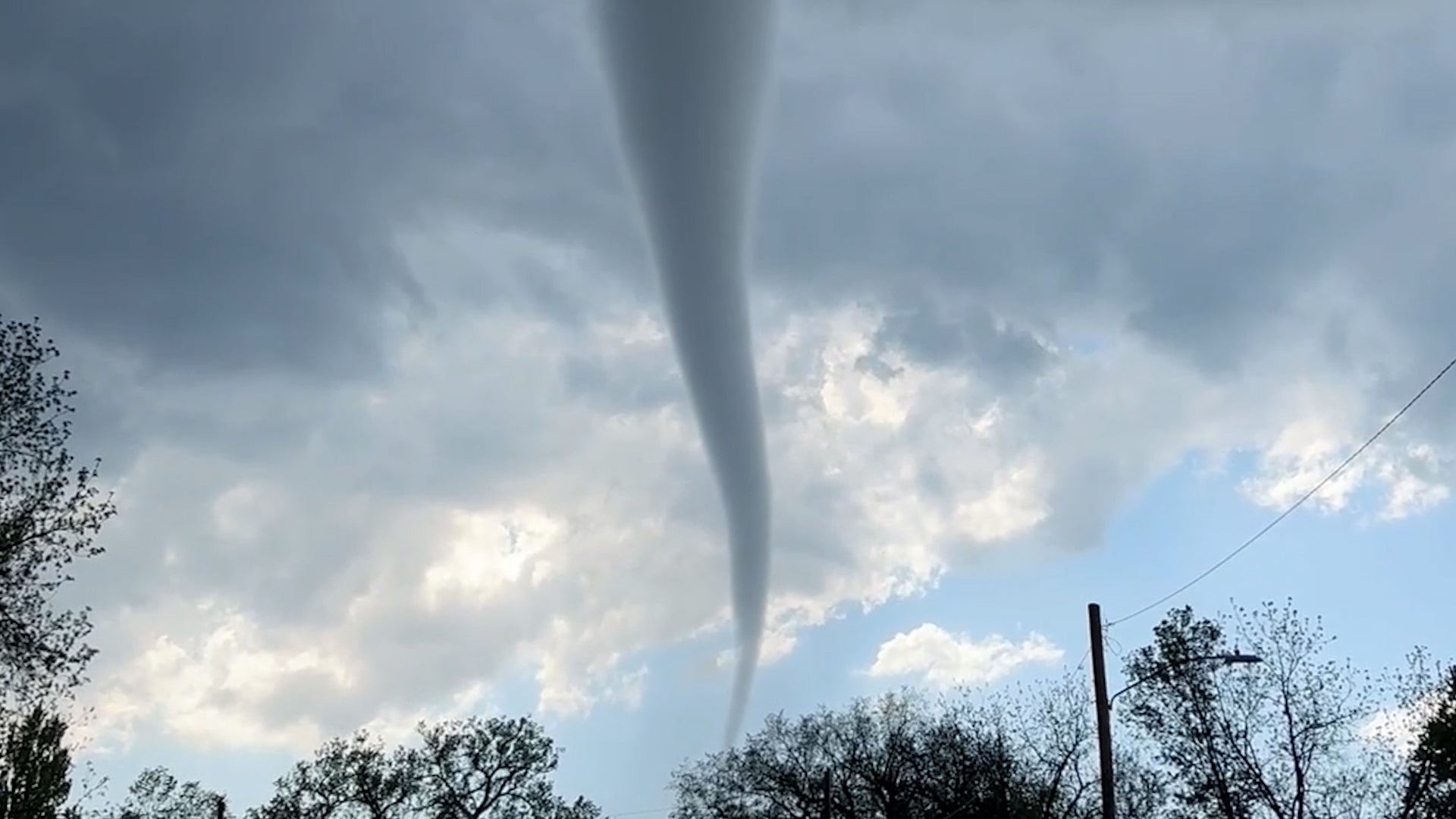
Confirmed tornado on the southern storm
BULLETIN - EAS ACTIVATION REQUESTED
TORNADO WARNING
NATIONAL WEATHER SERVICE SIOUX FALLS SD
421 PM CDT SAT APR 21 2012
THE NATIONAL WEATHER SERVICE IN SIOUX FALLS HAS ISSUED A
* TORNADO WARNING FOR...
CLAY COUNTY IN NORTHWEST IOWA...
* UNTIL 445 PM CDT
* AT 421 PM CDT...NATIONAL WEATHER SERVICE METEOROLOGISTS WERE
TRACKING A CONFIRMED TORNADO NEAR SPENCER. DOPPLER RADAR SHOWED
THIS TORNADO MOVING SOUTHEAST AT 35 MPH.
* THE TORNADO WILL AFFECT MAINLY RURAL AREAS OF CLAY COUNTY...
INCLUDING THE FOLLOWING LOCATIONS DICKENS AND GILLETT GROVE.
PRECAUTIONARY/PREPAREDNESS ACTIONS...
TAKE COVER NOW. MOVE TO AN INTERIOR ROOM ON THE LOWEST FLOOR OF A
STURDY BUILDING. AVOID WINDOWS. IF IN A MOBILE HOME...A VEHICLE OR
OUTDOORS...MOVE TO THE CLOSEST SUBSTANTIAL SHELTER AND PROTECT
YOURSELF FROM FLYING DEBRIS.
&&
LAT...LON 4292 9494 4317 9532 4326 9526 4326 9520
4317 9491 4295 9491
TIME...MOT...LOC 2121Z 306DEG 28KT 4316 9521
$$
HANKO
Surprise us.
latest weather briefing
Yeah there was too much cloud cover and rain in South Florida. However, north into Central Florida/North Florida, there was many times the sun peaked out, heck I had partly cloudy skies for a long time today. So the severe weather risk remains in tact for Central Florida as we are seeing pop up showers and storms develop along the cold front in the GOM. This should create clusters of storms, organize into a small squall line. This is what I'm seeing for now.
1848 = Cat 4 landfall in the Tampa Bay area.
1950 = Hurricane Easy passed within about 10-25 miles offshore of St. Pete.
There have been others, especially "minimal" hurricanes. But those two come to mind offhand.
Proof it is:
Link
Slight risk starts at 5% tornado, 15% hail/wind and ends at a 10% tornado, 30% hail/wind on a Day 1 outlook. Anything higher is a Moderate risk, and anything lower is a See Text.
Viewing: 851 - 901
Page: 1 | 2 | 3 | 4 | 5 | 6 | 7 | 8 | 9 | 10 | 11 | 12 | 13 | 14 | 15 | 16 | 17 | 18 | 19 | 20 | 21 | 22 | 23 | 24 | 25 | 26 | 27 | 28 | 29 | 30 | 31 | 32 | 33 | 34 — Blog Index