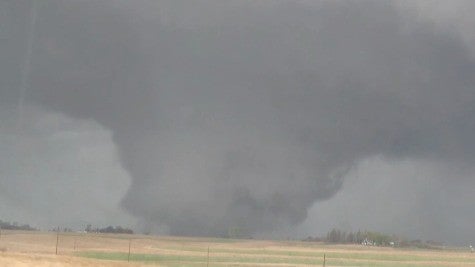
An early and vicious tornado season
It's been a vicious and early tornado season in the U.S. this year. Already, two major tornado outbreaks have killed 20 people each--the Central Florida tornado event of February 2, and last week's swarm of at least 35 tornadoes in the Southeast. In addition, an outbreak of 10 tornadoes hit the deep south February 12, killing one person in New Orleans. Only one year in recorded history has had more tornado deaths so early in the year--1949, when a tornado in Warren, Arkansas killed 55 people on January 3. The 45 fatalities in 2007 is close to the 3-year average of 46 fatalities observed for the entire year, and the 151 tornadoes observed so far in 2007 is about double what is usually observed.
Damage surveys are still being done of the devastation from last week's tornado outbreak, but it appears that five strong EF-3 tornadoes with winds of 136-165 mph touched down. Three of these twisters were killers, including the tornado that hit Enterprise, Alabama, killing eight students at the high school. The two EF-3 tornadoes observed during the Central Florida tornado event bring this year's total of EF-3 twisters to seven, a very high number of these strong tornadoes for so early in the year. What's causing such an early and severe tornado season? Well, the Central Florida outbreak can be blamed on El Niño. The other two outbreaks occurred when El Niño was suffering a rapid demise, so we'll have to blame them on unusually early spring-like weather in the U.S. With the peak months of tornado season still to come, let's hope for an unusally early end to tornado season as well!
Jeff Masters
Reader Comments
Page: 1 | 2 | 3 | 4 — Blog Index
By Karen Turni Bazile,Times Picayune
The Army Corps of Engineers has no plans to elevate the Mississippi River-Gulf Outlet levee on the Orleans Parish side of the Bayou Bienvenue locks, and St. Bernard officials say that's bad news for parish residents and those in the Lower 9th Ward.
St. Bernard officials have generally praised the corps' quick-footed effort to rebuild the devastated levees along the Gulf Outlet to a height of 20 feet in St. Bernard after Hurricane Katrina. But several said they were caught off guard and disappointed by news they learned at Tuesday's Parish Council meeting that there are no plans to elevate the levee between the bayou and the concrete wall on the Industrial Canal, leaving a height gap of as much as 9 feet.
That stretch of earthen levee in Orleans Parish was authorized to stand at 14 feet but has subsided to a height of 11 and 12 feet in many places, said Chris Gilmore, the corps' senior project manager for levees and floodwalls in St. Bernard Parish. The levee on the St. Bernard side was authorized for a height of 17.5 feet and was overbuilt to 20 feet to allow for subsidence.
Gilmore, who regularly updates the council on corps projects, said the corps doesn't want to spend money raising that stretch of the levee because it won't be needed once floodgates authorized by Congress are built in the next few years. The levees will lie inside the gates.
After the flood-control system failed catastrophically during Hurricane Katrina, the Bush administration gave the corps a twofold mandate for restoring protection to the metro area: rebuild by June 1, 2006, the destroyed or damaged sections of the system to the heights authorized by Congress when it passed the Lake Pontchartrain and Vicinity Hurricane Protection Plan in 1965; and have the rest of the system up to its authorized height by Sept. 1, 2007.
However, the situation with this section of levee is unique, Gilmore said, because the plan doesn't call for it to be elevated to its authorized height of 14 feet because of the proposed gates.
The gates' locations are still being determined, but Gilmore said leaving the levees at a lower height on the Orleans side of Bayou Bienvenue increases the vulnerability to flooding for St. Bernard and the Lower 9th Ward until the gates are built. He said the issue is being studied, and some elevation work could be authorized on an interim basis since the gates won't be completed until 2010.
St. Bernard Parish Council Chairman Joey DiFatta said he and other parish officials plan to voice their concerns at a special meeting today of the East Louisiana Flood Protection Authority Levee Board, the newly consolidated east bank levee board, in the St. Bernard Parish Council chambers. "What burns me up is that they rebuilt our levees (in St. Bernard) in six or seven months, but they have no construction plans for that (Orleans) portion of the levee in the works. I will be here screaming and hollering" at the meeting, DiFatta said.
. . . . . . .
Karen Turni Bazile can be reached at kturni@timespicayune.com or (504) 826-3321
Here is another look at current SST'S in the atlantic basin.
(Sea Surface Temps Gulf/Caribbean)
(Sea Surface Temps Atlantic Basin)
and thus the reason nothing gets done..you aint got some influence to peddle..the project just isn't as important
Angeles...
This rain season... or water year... is currently the driest to date
in downtown Los Angeles since records began in 1877. Since the
beginning of the water year... which began July 1 2006... downtown Los
Angeles has received just 2.42 inches of rain. That is a whopping
9.13 inches below the normal precipitation to date... which is 11.55
inches. To date... downtown Los Angeles has received only 21 percent
of normal rainfall. If downtown Los Angeles receives less than 2.00
inches of rain from now through June 30th... this will be the driest
rain season ever.
March... with an average rainfall of 3.14 inches... can be a very
wet month in Los Angeles... as in 1884 when 12.36 inches of rain
fell. However... there do not appear to be any major storms in
sight for Southern California. After March... average rainfall
drops off sharply in April to 0.83 inches... then to 0.31 inches
in may... and just 0.06 inches in June. Normal seasonal rainfall at
downtown Los Angeles is 15.14 inches.
Seasons with the least rainfall from July 1st through March 6th
are listed below.
Rank water precip % of normal final seasonal
season 7/1-3/6 thru 3/6 rainfall
(7/1-6/30)
1... ... ... (2006-07)... ... 2.42"... ... ..21%... ... ... ... ..????"
2... ... ... (1898-99)... ... 2.98"... ... ..26%... ... ... ... ..5.59"
3... ... ... (1923-24)... ... 3.06"... ... ..26%... ... ... ... ..6.67"
4... ... ... (1947-48)... ... 3.21"... ... ..28%... ... ... ... ..7.22"
5... ... ... (1903-04)... ... 3.25"... ... ..28%... ... ... ... ..8.72"
6... ... ... (1962-63)... ... 3.52"... ... ..30%... ... ... ... ..8.38"
7... ... ... (1960-61)... ... 3.99"... ... ..35%... ... ... ... ..4.85"
8... ... ... (2001-02)... ... 4.02"... ... ..35%... ... ... ... ..4.42" *
9... ... ... (1924-25)... ... 4.05"... ... ..35%... ... ... ... ..7.94"
10... ... ..(1998-99)... ... 4.28"... ... ..37%... ... ... ... ..9.08"
* driest season ever in Los Angeles
During the driest season ever... the 2001-2002 season...
precipitation from July 1st 2001 to March 6th 2002 was 4.02
Viewing: 151 - 180
Page: 1 | 2 | 3 | 4 — Blog Index