Heat Waves (4) A Climate Case Study:
In the last article I wrote that the extreme events of 2011 were providing us with the opportunity to think about climate and how to cope with a warming world. The U.S. is experiencing an extreme heat event this week (Masters @ WU). This heat wave is the consequence of a strong, stationary high pressure system over the central U.S., and it will move to the east over the next few days. Back on July 14th The Capital Weather Gang did a nice write up on the forecast of the heat wave. At the end of this blog are links to my previous blogs on heat waves and human health.
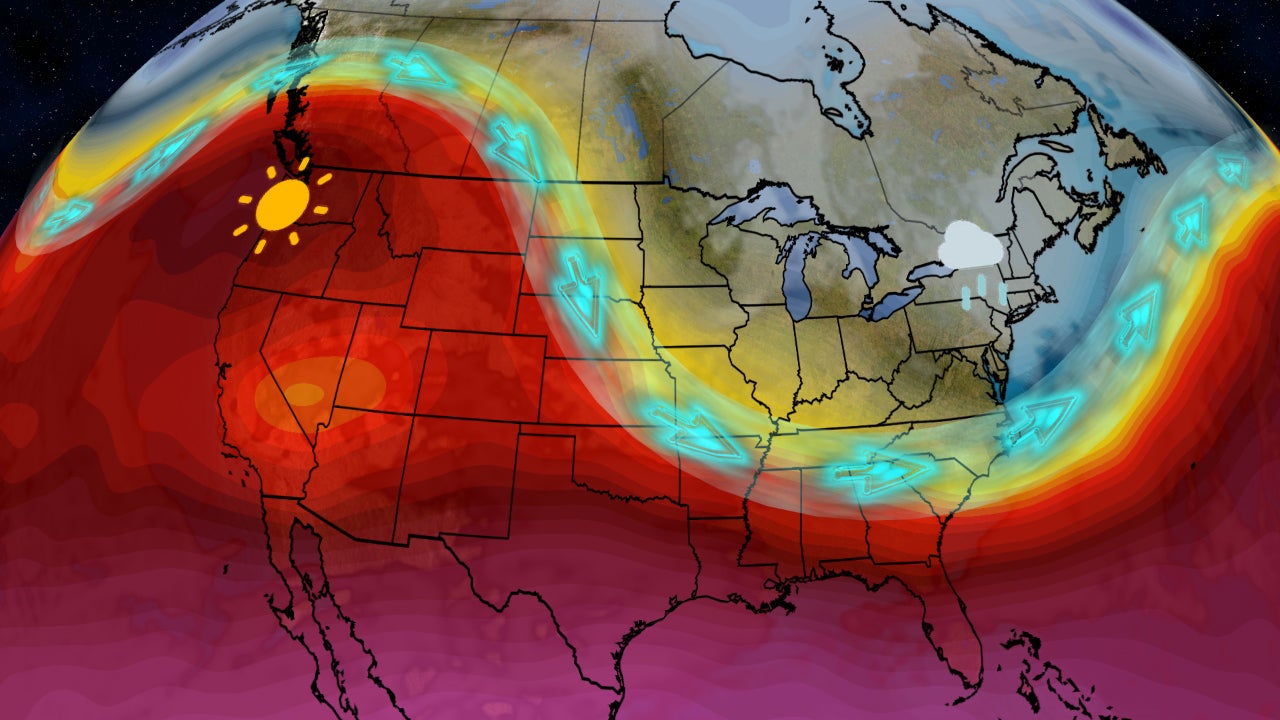
When thinking about weather, climate, and extreme events an important idea is “persistence.” For example, a heat wave occurs when there are persistent high temperatures. Persistent weather patterns occur when high and low pressure systems get large and stuck; that is, they don’t move. In the Figure below, you need to imagine North America and the United States. There is a high pressure center over the proverbial Heartland. With blue arrows I have drawn the flow of air around the high pressure system, and in this case moist air. There is moisture coming from the Gulf of Mexico and, in fact on the date when this was drawn, from the Pacific. This is common in the summer to see both the Gulf of Mexico and Pacific as sources of continental moisture.

Figure 1: Schematic of a high pressure system over the central United States in July. While generic, this is drawn to represent some of the specifics of 2011. The green-shaded area is where there have been floods in 2011. The brown-shaded area represents sustained drought in the southern part of the nation.
At the center of this high pressure system there is a suppression of rain, because the air is moving downward. This sets up a situation where the surface heats from the Sun’s energy. There is not much mixing and cooling, because of the suppression of the upward motion that produces rain. Hence, if this high pressure system gets stuck, then there is persistent heat. This is a classic summer heat wave.
Let’s think about it some more. There is lot of moisture being drawn around the edge of the high pressure system, and this moisture contributes to the discomfort of people. People – just a short aside about people: if we think about heat and health, then we are concerned about people’s ability to cool themselves. It is more difficult to cool people when it is humid because sweat does not evaporate. Suppose that in addition to this moisture, there is a region where the ground is soaked with water from flooding. Then on top of already moist air coming from the Gulf, there is local evaporation into the air being warmed by the Sun. If on the interior of the high, where the rain is suppressed, there is hot, wet air, then it becomes dangerous heat.
It’s not easy to derive a number that describes dangerous heat. But in much of the eastern U.S. a number that somehow combines temperature and humidity is useful. Meteorologists often use the heat index. It’s the summer time version of “it’s 98 degrees, but it feels like 105.” For moist climates, the heat index is one version of the “it feels like” temperature. Jeff Masters tells me that in Newton, Iowa yesterday, July 17, 2011, the heat index was 126 degrees F. (see here, and 131 F in Knoxville, Iowa on July 18)
Another measure of heat and humidity is the dew point; that is, the temperature at which dew forms, and effectively limits the nighttime low. The dew points in Iowa, South Dakota, Minnesota, and Wisconsin are currently very high and setting records. Here is a map of dew point for July 19, 2011.

Figure 2: Exceptionally high dew points centered on Iowa.
Now if I was a public health official, and I was trying to understand how a warming planet might impact my life, then here is how I would think about it. First, the Gulf of Mexico and the Pacific are going to be warmer, and hence, there will be more humid air. This will mean, with regard to human health for the central U.S., heat waves will become more dangerous, without necessarily becoming hotter. It is also reasonable to expect heat waves will become more frequent and last longer, because those persistent, stuck high pressure systems are, in part, forced by the higher sea surface temperatures. If I am a public health official here is my algorithm – heat waves are already important to my life, and they are likely to get more dangerous, more frequent, and of longer duration. But by how much? Do I need to know by how much before I decide on a plan for action?
If I think about the air being more humid, then I might expect to see trends in the heat index. I might expect to see trends in dew points, and trends in the nighttime minimum temperatures getting higher. (That’s where a greenhouse effect really matters.) I worry about persistent heat, warm nights, and the inability of people and buildings to cool themselves. I worry about their being dangerous heat in places where people and emergency rooms are not used to dangerous heat – not acclimated to heat – not looking for heat-related illness.
Let’s go back to the figure. Rain is suppressed in the middle of the high pressure system, but around the edge of the high pressure system it will rain; there will be storms. (see Figure 3 at the end) The air around the edge of high is warm and very wet. Wet air is energetic air, and it is reasonable to expect local severe storms. (See Severe Storm on Lake Michigan) And if the high pressure is persistent, stuck, then days of extreme weather are possible. If this pattern sets up, then there is increased likelihood of flooding. If I am that public health official, then I am alerted to the possibility of more extreme weather and the dangers thereof. But, again, can the increase of extreme weather be quantified? Do I need to quantify it before I decide on a plan of action?
Still with the figure - what about that region of extended drought and the heat from the high pressure system? Dehydration becomes a more important issue. As a public health official, I start to see the relation of the heat event to other aspects of the weather, the climate. I see the relation to drought. I see the flood, and it’s relation to the winter snow pack and spring rains.
So what I have presented here is to look at the local mechanisms of the weather – what are the basic underlying physics responsible for hot and cold, wet and dry – for moist air? If I stick to these basic physics, and let the climate model frame the more complex regional and global picture, what can I say about the future? Do I have to have a formal prediction to take action? Here in 2011, I see drought and flood and hot weather and warm oceans that interact together to make a period of sustained, dangerous heat. It does not have to “set a record” to convey the reality of the warming earth. It tells me the type of event that is likely to come more often, of longer duration, and of, perhaps, of greater intensity. If I am a public health planner, then I can know this with some certainty. The question becomes, how do I use that information in my planning?
r

Figure 3: Radar loop showing precipitation around the edge of the large high pressure system in the middle of the continent. July 19, 2011.
Previous Blogs on Heat Waves
Hot in Denver: Heat Waves (1)
Heat Waves (2): Heat and Humans
Heat Waves (3): Role of Global Warming
Reader Comments
Page: 1 | 2 | 3 | 4 | 5 | 6 | 7 | 8 | 9 | 10 | 11 | 12 | 13 | 14 | 15 | 16 | 17 | 18 | 19 | 20 | 21 | 22 | 23 | 24 | 25 | 26 — Blog Index
3rd place since 1979.
Both passages close to being open now.
Looks like 4th to me.
Pretty close but it looks like 3rd to me. Perhaps tomorrow will show it better.
Melting to a level it hasn't been in at least 10,000 years.
The world is a-warming...
Link
ACK!!!!
What a Politician.
Gingrich Says 2006 Climate Change Ad He Starred In Was 'Misconstrued'
Back in 2006, Newt Gingrich was a Man Of Ideas. And one of the ideas he had was that he would appear in a PSA with Nancy Pelosi, paid for by the Alliance for Climate Protection, which was founded by Al Gore. In that PSA, Gingrich said things like: "We do agree, our country must take action to address climate change," and "if enough of us demand action from our leaders, we can spark the innovation we need."
Thanks. It has earned the seal.
CB did you think of this part of your equation F1>F2, with respect to the Gulf Stream ?
Those people in Europe might not like it :)
Hey, I did not make the video or post it's precursor....
What happened to global warming?
Jul 21, 2011
This week's heat wave notwithstanding, scientists have been puzzled as to why global warming has occurred at a slower pace since 1998, following decades of increasing temperatures.
A new study out today in the journal Science reports the cause could be an increase in the amount of aerosols – tiny, airborne solid and liquid particles from both natural and man-made sources – high up in the stratosphere.
In the study, scientists from the National Oceanic and Atmospheric Administration (NOAA) and other agencies found that an increase in stratospheric aerosols decreased the global warming that would have otherwise occurred by 25 percent since 1998.
"There was less warming than you would have had without the aerosols," says study co-author John Daniel of NOAA's Earth System Research Laboratory in Boulder, Colo.
Sea salt, dust and volcanic ash are three common types of natural aerosols; these airborne particles can also come from man-made sources from the burning of fossil fuels.
"Most of the global warming of the past half-century has been driven by continuing increases in anthropogenic greenhouse gases," the study reports, "but natural aerosols from particular 'colossal' volcanic eruptions have significantly cooled the global climate at times, including for example the 'year without a summer' experienced after the eruption of the Tambora volcano in 1815 and notable cooling after the Pinatubo eruption in 1991."
Daniel added that he wouldn't have thought that the aerosols would still be a factor now, this long after the 1991 volcanic eruption of Pinatubo.
The stratospheric aerosol increase could also be due in part to human emissions of sulfur precursors (such as sulfur dioxide from burning coal), the authors point out in the study.
This study follows another study earlier this month in the Proceedings of the National Academy of Sciences, which found that China doubled its coal consumption from the years 2003 to 2007, leading to a huge increase in sulfur emissions that may have had a cooling effect on the planet. The researchers in that study suggested that this cooling effect may have counteracted ongoing warming due to increased carbon dioxide concentrations, permitting natural forces to predominate the planet's temperature.
Will there be a point in the future at which the impact of aerosols on global temperatures will be less of a factor than it is now?
"What happens in the future depends on the cause of the aerosols," says Daniel. "If it's volcanic, it depends on what volcanoes do. If its sulfur, it depends on what our pollution is."
The paper does not address how man-made versus natural activities contribute to aerosol creation, which they say is a question to be explored in further studies.
As for aerosols' impact on climate models used to estimate future global warming, according to the study, "climate model projections neglecting these changes would continue to overestimate the … global warming in coming decades if these aerosols remain present at current values or increase."
Sounds like a classic case of CYA>
To those who have no clue,
could they be you?
Some errors in this -
1) The warming has not slowed down since 1996. Here are the annual global temperature anomalies for the past two decades:
With respect to the 1951-80 average:
91 0.35C warmer
92 0.13
93 0.13
94 0.23
95 0.37
96 0.29
97 0.39
98 0.56
99 0.32
00 0.33 Average for the decade 0.31C warmer than the 1951-80 average.
01 0.47
02 0.56
03 0.55
04 0.48
05 0.63
06 0.55
07 0.58
08 0.44
09 0.58
10 0.63 Average for the decade 0.55C warmer than the 1951-80 average
So, the first decade of the 21st century was warmer than the last decade of the 20th century by 0.24 deg C, which is what would be expected.
2) Sulfur precursors from sulfur dioxide? What does that mean? Sulfur dioxide is the main cooling aerosol. Volcanoes pump it into the stratosphere, where it reflects back sunlight. The sulfur dioxide from Pinatubo in 1991 cooled the planet by 0.5 deg C for a year and 0.2 deg C the following year. Thereafter, it had no significant cooling effect so, presumably, the SO2 had settled out by then.
3) Increasing output of sulfur dioxide as a result of increased Chinese coal burning ought, in theory, to have some cooling effect, although this sulfur dioxide does not find its way into the stratosphere. It dissolves in water and is rained out in a few days as acid rain. However, the temperature record simply does not support the claims being made in the article that warming has slowed down. If it is true that Chinese sulfur dioxide has slowed the warming, that means that without it, average global temperature in the first decade of the 21st century would have been greater than 0.55 deg C anomaly. If that's the case, then we're in worse trouble than we realize.
As I've explained to before, this isn't some game of "gotcha"; this is WU, not 4Chan with its "pwning". No, it's vastly more important than that. But if one is going to insist on playing such a juvenile game anyway, he should at least do a little research before responding with shouts of "incompetent" and "false" and "no sources". That is, if he wishes to avoid looking foolish.
Now, please go do some reading, and report back here.
All true. This article has been posted perhaps half a dozen times since it came out (reflecting the frustration felt by the denialists side of the issue), and it's been debunked each and every time. In short, the article did contain some grains of true science--but there are so many errors as to render it invalid en toto. Not to mention that whoever wrote that headline needs to be fired. ;-)
The most patently erroneous sentence in the article is this one: "The researchers in that study suggested that this cooling effect may have counteracted ongoing warming due to increased carbon dioxide concentrations, permitting natural forces to predominate the planet's temperature." That is, of course, not even close to what the researchers "suggested"; as you pointed out, they basically stated that even with the sulfur present, warming continued apace, but it would have been even more rapid had the sulfur not been there.
Of course, the denialists are now in the unenviable position of praying for several supervolcano eruptions over the next several years, or trying to figure out a way to intentionally darken the sky with cooling sulfurs. Great plan, that...
Lots of rain and flooding in Europe in the recent past due to warming and more water vapor. My idea reverses that. They would love not having so much rain so therefor they would love the tunnels.
12th place now.
Is that your haemorrhoids?
Korea Times Article...
Korea Herald Article...
Oh, my bad. You had never responded to my intial postings of that article, so I inadvertently assumed you meant the Arctic. Okay, Antarctic ice? Same answer: melting more and more quickly. Overall, Antarctica is losing about 100 cubic kilometers of ice per year, and that loss is accelerating.. Here's a handy-dandy graph from NASA to help you see:
I am happy to see that you agree that Arctic ice has declined; that's something many denialists won't even acknowledge.
Looks like NASA is backpedaling on their fantastic Antarctic ice-loss prediction. As some "denialists" have written, NASA has finally discovered that ice won't melt at -30* C.
Link
Suggest you read the entire article, not just that sloppy denialist paragraph from Kerr; check out his reputation on the web before responding. (NOTE: I'm disputing neither the article--which I haven't read--the magazine, nor the AAAS; just the words of Kerr. In fact, the AAAS is on record as stating: "The scientific evidence is clear: global climate change caused by human activities is occurring now, and it is a growing threat to society.")
exactly how is climate change by human activities a growing threat to society?
can you please summarize for I don't have time to read the article right now and I'll be back later.
Navy Official Discusses Climate Change Investment Strategy
By Bob Freeman
Office of the Oceanographer of the Navy
WASHINGTON, June 21, 2010 A number of recent strategic Defense Department documents have recognized that the changing climate may affect national security and military operations later in the century.
This is particularly true for the globally deployed U.S. Navy, and investments to address climate challenges may need to be made, the service's oceanographer said in a June 18 DoD Live bloggers roundtable.
We're going to have to fold these challenges into a tight fiscal budget, acknowledged Navy Rear Adm. David W. Titley, who also serves as director of the Navy's Task Force Climate Change. He explained that it is important not only to know what investments are right to meet future requirements, but also to know when to make them.
We want to basically pace the threat, Titley said. We don't want to get into a tail chase over climate change, but at the same time, we do not want to spend ahead of need, spending for things that may not be required for years or decades later.
Titley explained that to define the scope of needed investments the Navy will conduct capabilities-based assessments, which he described as foundational studies to determine the requirements for such things as force structure, infrastructure, command and control and communications. We're doing one of these capabilities-based assessments for climate change in general, and another one focused specifically on the Arctic, he said.
Titley said the assessments were timed to coincide with the Navy's program objective memorandum for fiscal 2014. POMs are annual events in which critical decisions on the budget and investment spending are made. Titley said he believes the 2014 budget is where the first climate-change investments may potentially be made.
One of the investments we're really going to have to think about in the next several decades is the impact of sea level rise on the Navy's infrastructure, Titley said.That includes our ports and piers in the continental United States, but we also need to think about bases we use in conjunction with our partners and allies overseas.
As an example, Titley mentioned Diego Garcia, a small, low-lying island in the Indian Ocean that hosts a strategic airfield.
The observations have shown us that through the 20th century, sea level rose by an average of two millimeters per year, Titley said. So that means over the course of the century, we had about 20 centimeters, or roughly eight inches, of sea level rise. The sea level rise we've seen in the first 10 years of the new century is already 50 percent greater than the average sea level rise in the 20th century.
Titley explained that as the oceans get warmer, they expand and take up more space, causing the sea level to rise. In addition, the land-based ice that already is melting -- including mountain glaciers, the Greenland ice field, and even the western Antarctic ice sheet -- will add volume to the ocean. He acknowledged considerable uncertainty over the time line and extent of sea level rise, but he noted that leading climate scientists believe sea levels could rise as much as six feet by the end of the century.
How probable is this? Titley asked. I'm not really sure right now, but I am sure there are significant consequences. We need to make sure, as time goes by, that we understand it, we have a plan, and we know what it will cost us to execute that plan.
That's really one of the foundational elements the task force is going to pursue, he added.
In response to a question on specific infrastructure upgrades, Titley noted that there is no single answer, and said scientists and engineers will need to work together with local communities, taking into account the specifics of every critical location, to determine what types of solutions will be needed.
That is what our capabilities-based assessments will be tasked to figure out, he said.
When asked whether naval bases were prepared for stronger and more intense hurricanes, Titley said that the impact a warming climate may have on tropical storm development is controversial and subject to much research. He explained that ocean warming is only one component of hurricane formation, and that other factors such as upper level wind shear may not support increased frequency and intensity.
What I can tell you,he said, is that our regional commanders make sure their bases are prepared for severe hurricanes every year.
Titley said it's essential to improve predictive capabilities on a variety of time lines to provide reliable forecasts to decision makers. These predictions need to include weather and ocean forecasts in the near term, as well as climatological forecasts extending decades out, he added.
In the past, many federal agencies tended to produce their own predictive models, Titley said. He noted that he is engaging the leadership of other agencies to create partnerships that will ensure that the best minds in the nation are working collectively on solutions. These joint climate models could serve both military and civilian purposes, he said, recognizing that details regarding classification and security would need to be worked out.
I believe that the time is right, and the leadership in many agencies is right, to work this at a national level, he said, to make sure the taxpayer money we put into these predictions give the absolute best return on our collective investment. We owe this to the American people.
Titley said international partnerships also are important to dealing effectively with potential climate-change challenges, particularly in the Arctic. He mentioned that the Canadian navy had invited the United States to participate this year in its annual Operation Nanook polar exercise. U.S. participants will include a destroyer, a maritime patrol aircraft, and specialized ice diving units.
%u201CThis is a tremendous opportunity for several hundred of our sailors and officers to experience operating ships and aircraft well north of the Arctic Circle, Titley said.
There is also a proposal to share lessons learned with the Danish navy, which has significant experience operating in the Arctic waters around its territory Greenland. In addition, Titley said, the Naval Research Laboratory is working with the Russian navy in the Kara Sea this summer, and there are current discussions with the International Hydrographic Organization to determine how to best work with regional partners in cooperative ocean-surveying operations.
This is not meant to be all inclusive, Titley said, but it is an indication of progress in just the last couple of months towards opportunities to work with our international partners.
Titley noted some other examples of progress in considering the strategic impact of climate change.
Recently, the chief of naval operations signed out the Navy's Arctic strategic objectives, he said, and this gives everybody in the Navy a common frame of reference to understand what we are trying to achieve.
He added that the Navy wants to ensure a safe, stable, and secure Arctic.
Titley said the main goal of Task Force Climate Change is to ensure the Navy is not taken by strategic surprise, and he expressed satisfaction that climate change is being considered in strategic war games and limited objective experiments. He described these as thinking exercises that examine various strategic scenarios to determine how to handle them, to evaluate whether the assets are available to handle them, and to identify shortfalls.
Nobody knows what the future will entail, Titley said, but if you run a range of scenarios, and you see that there are common capabilities and capacities that you would need to answer those scenarios, then you can really inform a future budget debate.
Biographies:
Navy Rear Adm. David W. Titley
Related Sites:
"DoD Live" Bloggers Roundtable
Many more droughts and floods,leading to crop failures,famines, rising food prices, food riots and environmental refugees.
More deaths from heat waves, and the spread of tropical diseases into areas where people have little genetic resistance and are therefore more vulnerable to these diseases. Also, more food poisoning cases, cholera etc.
In the long term, rising sea levels inundate cities and coastal areas, increasing the number of environmental refugees.
Link
They keep saying that the climate is changing even when the data show that it hasn't changed for the past decade or more. No matter what, they won't change their position.
Excellent response--and barely scratching the surface.
Now we have the Navy in the climate change game. What's next? Someone out to tell Titley that he's facing drastic budget cuts. Perhaps he ought to stick to something that he might know about: ships. He's not going to have the money to keep his Navy in one piece much less worry about nonexistent climate change. Wonder where they found the one existing eco-wacko in the Navy structure?
Which data are you referring to? Because single piece of credible scientific data says that the climate is indeed changing--and faster than anyone thought possible.
There is no proof all of these things will happen. Drought, crop failures, etc.
As for food prices, they are tied closely to fuel costs for distribution. Haulting the manufacturing of gasoline, or decreasing the overall supply will only cause a food dilema, a real threat to society we see rising today. Also the practice of converting grains to biofuels as an alternative decreases food storage supplies, thus raising the prices of grain to meet the demand for food supply.
More research should be implemented to produce more effective vacinations to tropical borne diseases such as malaria--it is a global initiative already. Also, there are natural, but illegal at the Federal level (hint hint), medicines that thwart the effects of cholera on the human body.
Perhaps this is the age of human history where coastal living should be advised against. There is geological evidence that supports oceans rise and fall over time. We already prevent beach erosion with adding sand, make break waters, route flood waters, & construct sea walls and dykes (as early as the 17th century in the Netherlands). Why not adapt? That's what our ancestors did.
Viewing: 851 - 901
Page: 1 | 2 | 3 | 4 | 5 | 6 | 7 | 8 | 9 | 10 | 11 | 12 | 13 | 14 | 15 | 16 | 17 | 18 | 19 | 20 | 21 | 22 | 23 | 24 | 25 | 26 — Blog Index